A summer sale spin-to-win popup that clears the season's stock
A summer sale is long, quiet and browsed from a phone. The markdowns do the heavy lifting; a prize wheel gives the half-interested shopper one more reason to buy this week rather than after the holiday, and takes an email in exchange. This page is the whole setup: a prize table that stacks on your markdowns without giving the sale away, copy for the four screens, a three-week schedule with weekday windows, and the report to read once the last of the stock has gone.
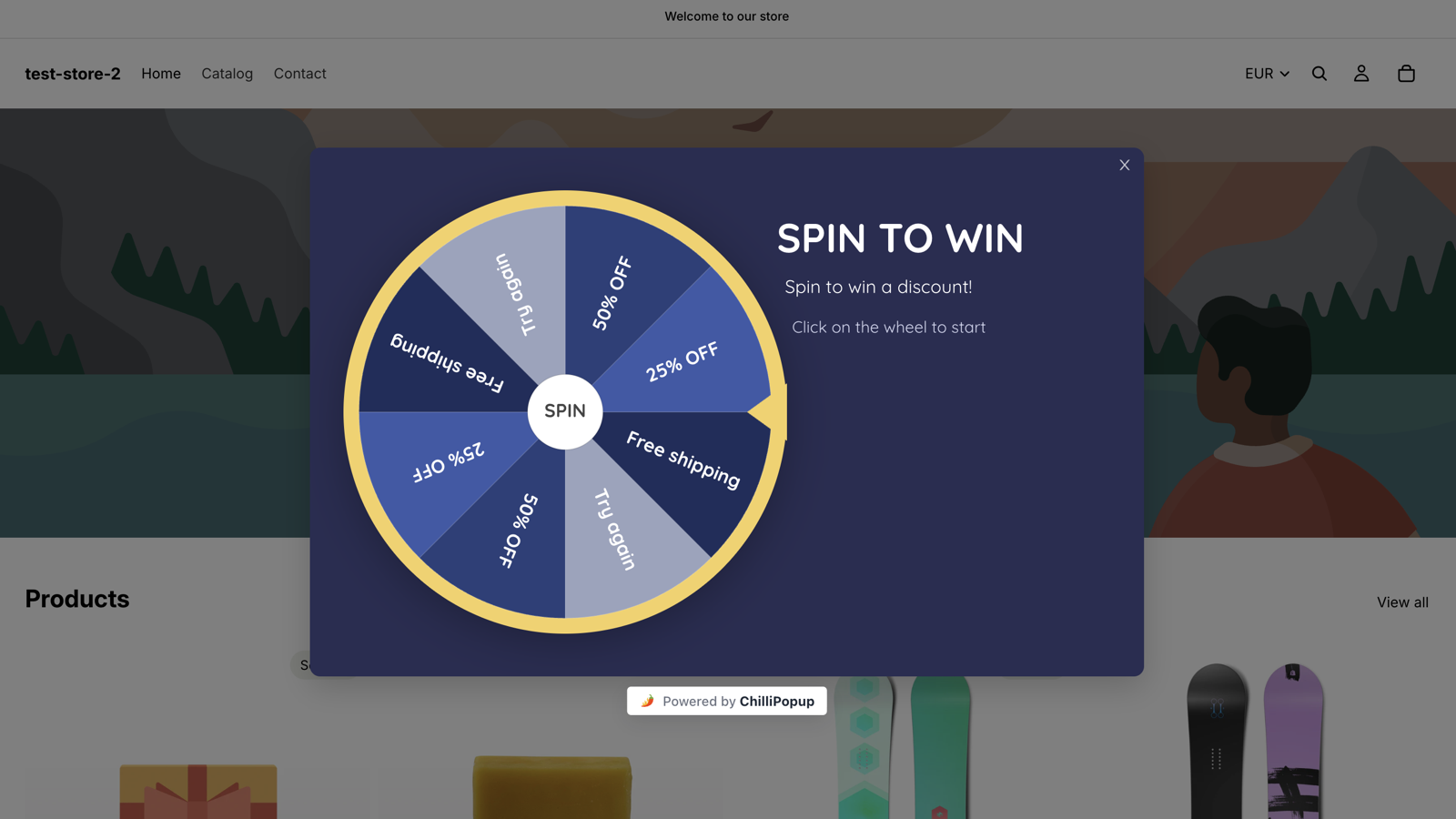
The Spin to Win theme live on a storefront. For a summer sale you keep the mechanics and lighten it: a sun-bleached background, one hot accent, your sale codes on the slices.
Why a wheel in a summer sale
Markdowns move stock. A spin moves it this week.
A sale rail already says 30% off. What a shopper on a sun lounger lacks is a reason to buy now rather than after the holiday. A wheel gives them one, decides for you how generous it is, and asks for an email before it hands over the code.
An extra on the markdown, within limits
Every slice is an extra on top of the sale price, and how often each extra comes up is set by odds you control. The 10% slice lands on most spins; the 30% slice is rare, and its code carries a minimum basket in your store. You know the average discount before the first spin.
Built for a thumb, not a cursor
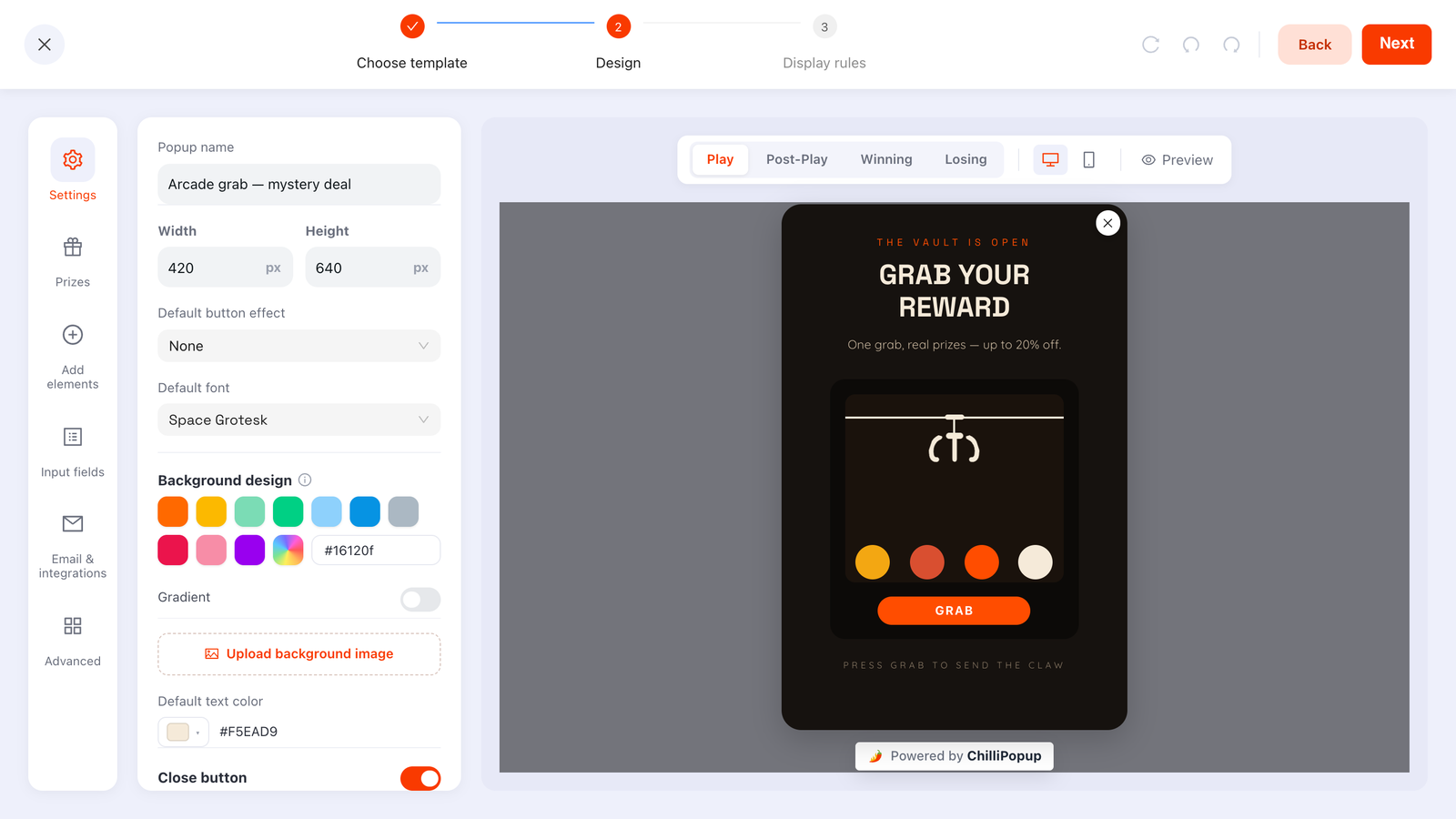
Summer traffic arrives from phones: the beach, the train, the garden. Exit intent needs a cursor, so the wheel opens on scroll depth or a time delay instead, and The Deal Is Right theme is a portrait, mobile-first card that fits a phone screen without pinching.
Three weeks on one schedule
Display rules take a start date, an end date, and weekday and hour windows in your time zone. Set the sale's dates once and the wheel opens itself on the first morning, rests on the days you tell it to, and closes itself on the last night.
The prize table
A summer clearance prize table you can copy
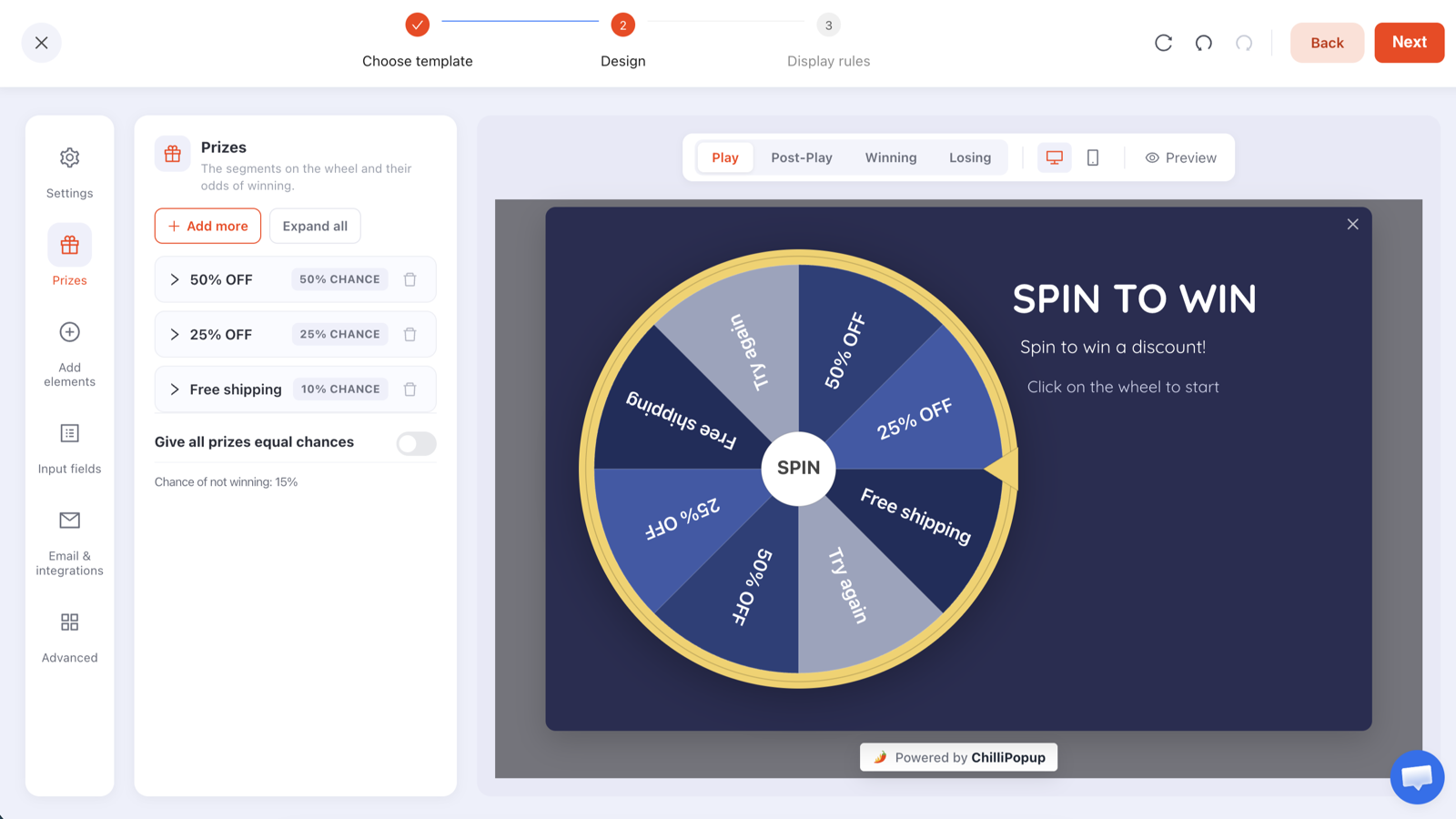
Five prizes and a leftover, every one of them an extra on the sale price. Type the labels, codes and chances into the Prizes panel exactly like this, and the wheel draws itself, Try again slice included.
Slice
Reward code
Win chance
Why it is there
Extra 10% off sale items
SUMMER10
35%
The nudge that turns a browse into a basket. On stock you would mark down further next week anyway, it costs little.
Free shipping
SUMMERSHIP
25%
Summer baskets are small, one swimsuit or a pair of sandals, and shipping is the objection on a small basket.
Extra 20% off sale items
SUMMER20
18%
The slice that moves the deep end of the rail: last season's colours, broken size runs, the things you would rather ship than store.
Free gift with any sale order
SUMMERGIFT
10%
A leftover line from last season, set up in your store as a free-product-with-purchase discount. Clearing stock is the point of the sale.
Extra 30% off sale items
SUMMER30
4%
The headline slice. Four spins in a hundred, and its code carries a minimum basket in your store.
Try again
none
8% (leftover)
Drawn automatically as a grey slice because the prizes add up to 92%. Without it the extras stop feeling like wins.
With these odds, every hundred spins hand out roughly thirty-five extra-10% codes, twenty-five free-shipping codes, eighteen extra-20% codes, ten free gifts and four extra-30% codes, and eight shoppers see the Losing screen. Because every discount is an extra on already-reduced stock, limit each code to the sale collection in your store so it never touches full-price items. Change any percentage and the editor shows the new chance of not winning as you type.
The Prizes panel where the table above goes: a label, a reward code and a win chance per prize, and the chance of not winning computed for you.
Create the codes in your store first: Shopify Discounts, WooCommerce Marketing → Coupons, or Wix Marketing → Coupons. Limit each code to the sale collection, give it the wheel's end date as its expiry, and add a minimum basket to the 30% code.
ChilliPopup never creates or applies codes: it reveals the code you pasted, and only inside a winning result. The configuration that reaches the browser has every code stripped out.
Going deeper in week three? Duplicate the campaign, retype the table with the new extras and codes, and schedule the copy to start the day the first one ends. Campaigns can be duplicated, so the design and rules come with it.
Want no losers? Raise the chances until they total 100%, or flip on equal chances. The Try again slice disappears and every spin wins something, which on a clearance, where every extra is cheap, is a fair choice.
Copy for the four screens
What each screen says
A wheel has four screens: Play, Post-Play, Winning and Losing, each its own canvas in the editor. Write {{prize_label}} and {{prize_code}} anywhere in the Post-Play or Winning copy and the won prize fills them in.
Play
Spin for an extra on the sale
Headline: The sale is on. Spin for an extra.
Sub-line: One spin, one code, valid on everything already reduced. Up to an extra 30% off.
Keep it to two lines. On a phone the wheel fills the card and the disc itself is the button, so a hint like "Tap the wheel to start" is all the instruction it needs.
Post-Play
You landed on {{prize_label}}
Headline: {{prize_label}}, on top of the sale price.
Sub-line: Enter your email and your code appears right here. It works on anything in the sale until 18 July.
One email field and one button. This screen only appears after a win, so nobody hands over an email for nothing.
Winning
Your code is {{prize_code}}
Headline: Use {{prize_code}} at checkout for {{prize_label}}.
Sub-line: It applies to sale items only, on top of the marked price, until Sunday 18 July.
Confetti is on by default here. Add a "Shop the sale" button pointing at the sale collection; the shopper is already halfway there.
Losing
Not this time
Headline: No extra on this spin. The sale is still the sale.
Sub-line: Everything in the sale is already reduced, and the sizes left are the ones going fastest.
Point the button at the sale collection. On a three-week sale a losing shopper may well be back next week, when the frequency rule gives them another spin.
Display rules
Rules for a three-week sale
A wheel carries the same display rules as every ChilliPopup popup: six triggers, targeting, frequency caps and a schedule. A long sale needs a different set from a four-day weekend: less often, more windows, and triggers that work on a phone.
Schedule: start Friday 25 June 2027 at 00:00, end Sunday 18 July 2027 at 23:59, in your time zone. Twenty-four days, opened and closed by the rule rather than by you.
Weekday and hour windows: the markdowns work all week; the wheel is the weekend's extra. Set the weekday window to Friday, Saturday and Sunday so the wheel is an event inside the sale rather than wallpaper over it. Prefer evenings? Set an hour window of 18:00 to 23:59 instead and the wheel becomes a nightly happy hour. Both rules are there; pick the rhythm that fits your traffic.
Triggers: scroll depth at 40% for phones, where exit intent has no cursor to catch, and exit intent for desktop shoppers who are leaving. The first to fire opens the wheel.
Pages: a single page-URL rule, contains /sale, shows it on the sale collection and its product pages and nowhere else, so the cart and checkout never see it. Page rules are any-match: a campaign shows wherever at least one of its page rules is true, so use either contains rules for the pages you want or a single doesn't-contain rule, never both.
Frequency and audience: everyone, once every 7 days, with "hide from visitors who already claimed" switched on. A winner gets one code for the whole sale; a shopper who lost gets another spin the following weekend, when the markdowns are deeper.
Devices: desktop and mobile both on. If your sale traffic is mostly phones, that is where the wheel earns its place, so check the card on a phone before you publish.
Display rules
📅
Schedule25 Jun 00:00 → 18 Jul 23:59
📆
WeekdaysFriday, Saturday & Sunday
📜
Scroll depthAfter 40% of the page
🔗
Page URLContains /sale
🔁
FrequencyOnce every 7 days
🎁
Already claimedHidden after a claimed prize
How it works
Codes, wheel, dates: three steps
A wheel is a popup with a game on its Play step. If you have built a ChilliPopup popup before, you already know the editor.
1
Create the codes in your store
Make one code per prize (SUMMER10, SUMMERSHIP, SUMMER20, SUMMERGIFT, SUMMER30) in Shopify, WooCommerce, Wix or whatever runs your checkout. Limit each to the sale collection, set it to expire on 18 July, and give the 30% code a minimum basket.
→
2
Build the wheel
Pick The Deal Is Right for a mobile-first card, lighten it for summer, type the prize table into the Prizes panel and write the four screens. Every block is drag-and-drop, and your own fonts are welcome.
→
3
Set the rules and publish
Enter the schedule, the weekday window, the triggers, page rules and frequency above, then publish. If the ChilliPopup pixel is already on your site there is nothing else to install: the wheel opens on the first Friday of the sale on its own.
Design
Sun-bleached, one hot accent, the sale in the hub
There is no dedicated summer template, and you do not need one. Both wheel themes are fully editable, and the changes that make a wheel read as summer take a few minutes.
Start from The Deal Is Right: it is a portrait, mobile-first card, and summer traffic is on phones. Start from Spin to Win if your shoppers are at a desk: it is landscape, with the wheel on the left and the headline on the right.
Recolour for heat: a cream or pale sand background, a coral or hot orange for the rim, pointer and hub, and slices alternating between the accent and a sea green or white so the labels stay legible on a bright screen outdoors. Type SALE into the hub label.
Swap the banner for a photograph: The Deal Is Right opens with a game-show banner. Replace it with a photograph of the stock you are clearing as the popup background; background images are standard in the editor, and a photograph of the stock does the selling.
Put the top extra in the headline: "Up to an extra 30% off" is what stops a thumb; the slices tell the truth about the odds.
A/B test one thing across the three weeks: one click creates a Variant B, you choose the split, every visitor sticks with their version and the results sit side by side with a confidence indicator. Try a wheel with a Try again slice against one where every spin wins, or a free-gift slice against a free-shipping one.
The same editor for all four games: Play, Post-Play, Winning and Losing are tabs, Prizes is a panel, and every colour, block and font is yours to change.
After the sale
What to read when the stock has gone
A wheel gets two reports: the popup report every ChilliPopup campaign has, and a game report built from the server's own record of each play. Over three weeks, read them week by week.
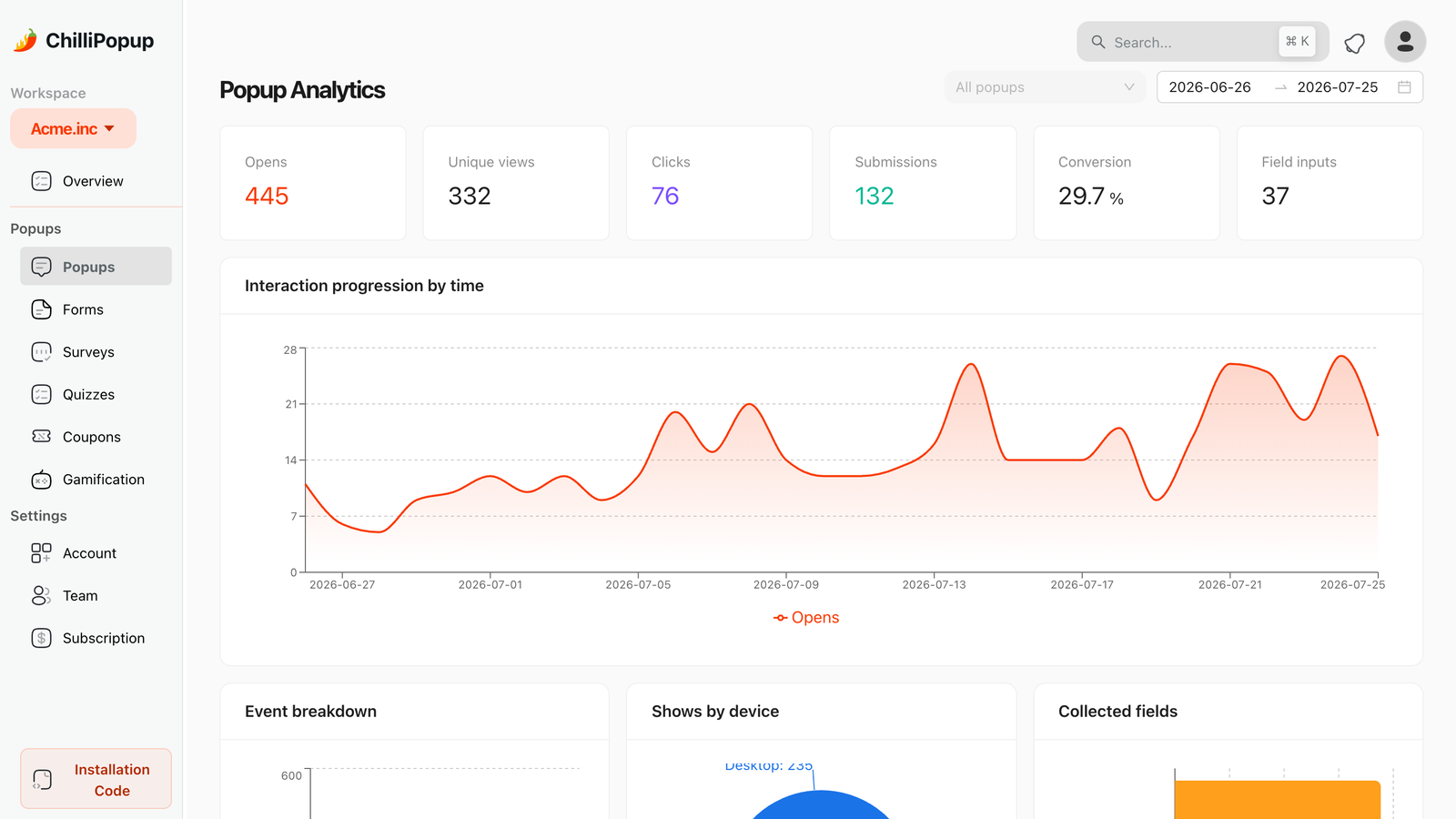
Opens and submissions by day and device: the popup report breaks opens, clicks, closes and submissions down by day and by device, so you can see whether the weekend windows earned their place and how much of the play was on phones.
Claimed wins by prize: the chart shows which extra was actually claimed. If the free-gift slice is claimed far below its 10% share, the gift is not tempting anyone; swap it in the duplicate you run next summer.
The claims table: each winner's email, prize, code, device and time. It lives in your dashboard; ChilliPopup does not send emails and has no Mailchimp, Klaviyo, HubSpot, Zapier or CSV export connector today.
Redemptions and stock: redemptions are counted in your store's discount report. Set them against the claims table and the sale collection's stock count, and you know what the wheel cost and how much of the season it cleared.
The popup report every wheel gets, over the date range you choose. The game report adds spins, wins, losses and claimed wins by prize.
Fifteen promotions with the offer, the audience and the announcement for each, plus the margin maths that tells you which extra you can afford to put on a slice.
Can the wheel run for three weeks without me touching it?
Yes. Display rules take a start date and an end date in your time zone, plus weekday and hour windows, so a wheel scheduled from 25 June to 18 July 2027 opens on the first morning, shows only on the days and at the hours you chose, and closes itself on the last night. You can also unpublish it by hand at any time.
Can the extra discount apply to sale items only?
That is decided in your store, not in ChilliPopup. Create each code in Shopify Discounts, WooCommerce Marketing → Coupons or Wix Marketing → Coupons and limit it to the sale collection or category there, with the wheel's end date as its expiry. The wheel reveals the code you pasted, only inside a winning result; it never creates or applies codes itself.
Most of my summer traffic is on phones. Does exit intent work there?
Exit intent watches for the cursor leaving the page, so it fires on a desktop and not on a phone. Pair it with a scroll-depth or time-delay trigger, or a page-view count; the first trigger to fire opens the wheel. Display rules can also target desktop and mobile separately, and The Deal Is Right theme is a portrait, mobile-first card built for a phone screen.
Can a shopper spin again later in the sale?
Frequency rules decide that: once a day, every visit, every session, or once every few days or visits. Once every 7 days gives a shopper who lost another spin the following week. A separate switch hides the wheel from visitors who have already claimed a prize, which keeps winners to one code for the whole sale; leave it off if you would rather they could win again.
Is there a summer sale wheel template?
Not a dedicated one. The two wheel themes, The Deal Is Right and Spin to Win, are the starting points; you recolour the rim, pointer, hub and slices, put a photograph of the stock behind the wheel and rewrite the copy on each screen in the editor. ChilliPopup's AI drafts popups, forms, surveys and quizzes from a sentence, but the four prize games start from their themes rather than from a prompt.
What does a summer sale wheel cost to run?
The Free plan is $0 per month, forever, needs no credit card and includes all four prize games with the full editor, A/B testing and analytics; it covers 1,000 visitors a month on one domain. Pro is $29 per month and Business $79 per month, each with a 14-day free trial. A small "Powered by ChilliPopup" badge shows under the wheel on every plan, and the extras you give away are the only other cost. See the plans →
Build the wheel once, let it run the whole sale
Type in the prize table, write the four screens, set the dates and the weekend window, and publish. The wheel opens on the first Friday, rests when you told it to, decides every spin on the server, and closes itself on 18 July with a list of every code it gave away.