A sales promotion is three decisions, not one. The offer — what changes hands. The audience — who is allowed to see it. The announcement — how they find out. Most promotions fail on the second and third, not the first: a perfectly good offer shown to everyone, everywhere, forever, is just a price cut with extra steps.
Below are fifteen sales promotion ideas grouped by the job they do — acquiring new customers, raising order value, clearing stock, and bringing people back — each with the offer, who should see it, how to announce it, and the margin trap to watch for.
Key Takeaways
- Pick the promotion by the job. Acquisition, order value, stock clearance and win-back need completely different offers.
- Audience rules are where the margin is saved. A first-order offer shown to loyal customers is money you didn't need to spend.
- Non-price offers beat discounts more often than people expect — thresholds, gifts, early access and games all create urgency without training customers to wait.
- A deadline only works if it's real. The permanently-ending sale is the fastest way to teach customers your prices are fiction.
- Judge every promotion on revenue per session and margin, never on how many codes were claimed.
Before the ideas: the maths that decides which you can afford
A discount doesn't cost you the discount — it costs you the discount off your margin. On a 40% gross margin, a 20% discount removes half your profit on that order, which means you need roughly double the volume just to stand still.
The break-even question: at margin M and discount D, the extra
volume you need is D / (M − D). At 40% margin, a 10% discount needs +33% volume to
break even; a 20% discount needs +100%. Run this before you pick a number, not after.
Two consequences worth internalising. First, small discounts are much cheaper than they look relative to big ones — the curve is steep. Second, an offer that doesn't touch the headline price is often the better deal: free shipping over a threshold costs you the shipping on orders that got bigger, not a slice of every order.
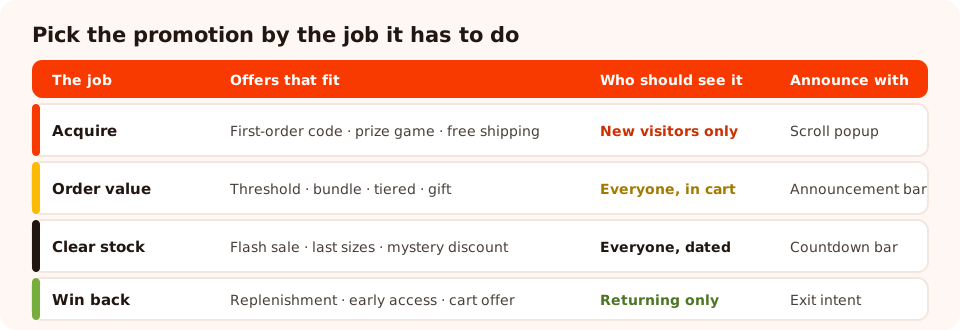
Choose the row first. Almost every wasted promotion is the right offer aimed at the wrong job.
Acquire: five promotions for first-time buyers
1. The first-order incentive
The workhorse. 10–15% off, or a fixed amount, in exchange for an email address. Audience: new visitors only — this is the single most important rule on the page, and the one most stores get wrong. Announce it with a scroll-triggered popup at 50–60%, or on exit intent. Sample copy: "First time here? Take 10% off your first order — enter your email and the code is yours."
2. The prize game
Instead of handing everyone the same code, let them play for it. A spin wheel, scratch card, slot machine or claw machine with per-prize win chances means you decide how often the expensive prize appears — most people win something small, a few win something memorable, and the average cost per claim lands where you set it. It converts better than a flat code because the reward feels earned, and the outcome is decided server-side so it can't be rigged from the browser.
3. Free shipping, threshold-free, for order one
For stores where delivery cost is the top objection, this beats a percentage. It removes the exact thing blocking the purchase, and it doesn't discount the product itself — so the customer's mental price for your product stays intact.
4. The risk-remover
No discount at all: an extended returns window, a longer guarantee, or a free first exchange. Costs you almost nothing on most orders and directly answers the "what if it's wrong" objection that stops first-time buyers. "Not sure about size? First exchange is on us — 60 days."
5. The lead magnet instead of a discount
For considered purchases, a fit guide, a size finder, a sample, or a short quiz that recommends the right product will out-earn a discount — because the barrier is confusion, not price. A product recommendation quiz does double duty: it helps the shopper decide and it collects the email at the end.
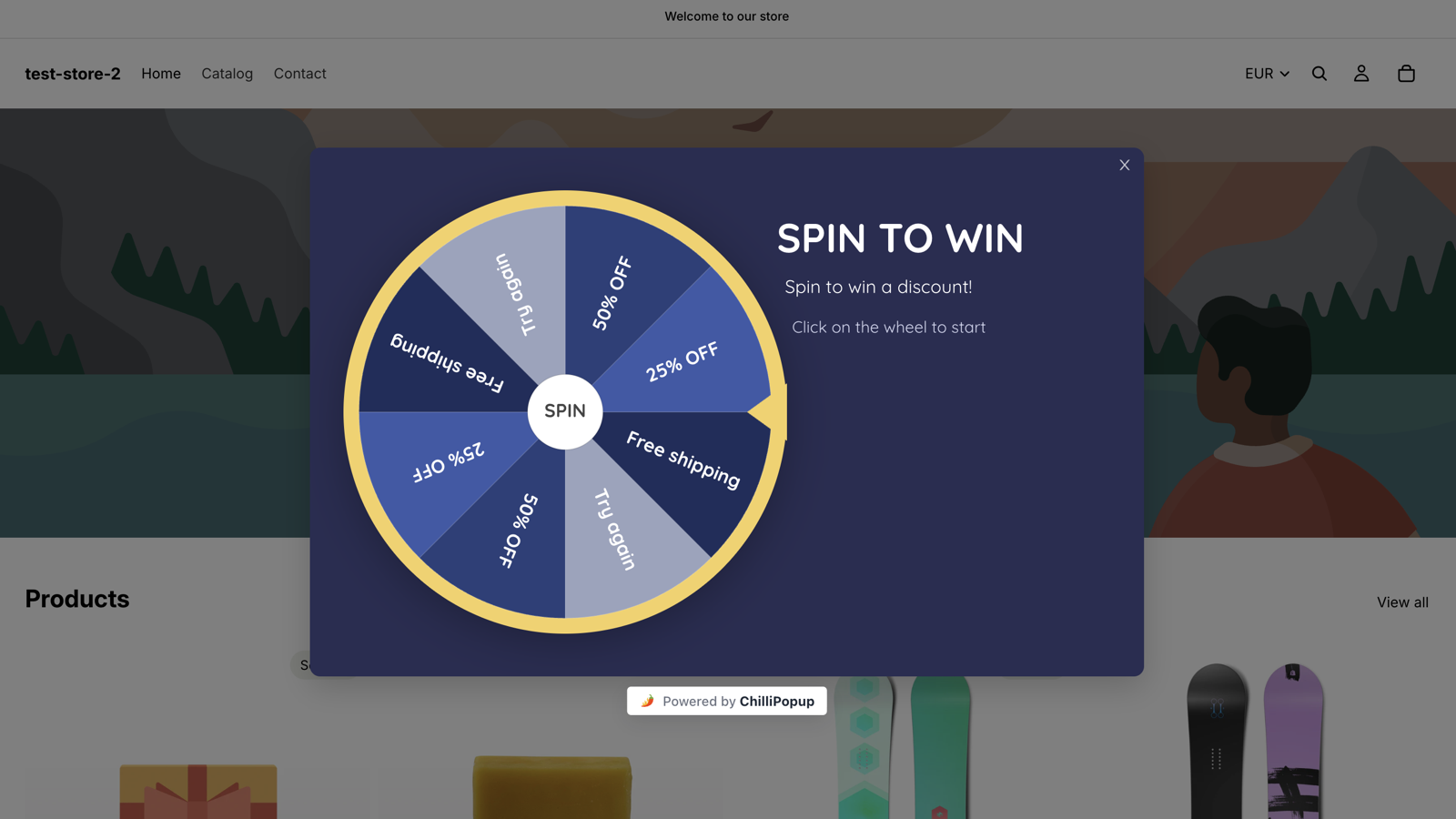
A prize game turns one flat discount into a distribution you control — big prizes rare, small prizes common.
Raise order value: four promotions that grow the basket
6. The free-shipping threshold
The most reliable order-value promotion there is. Set the threshold roughly 20–30% above your current average order value — high enough to require a second item, low enough to feel reachable. Announce it in the cart, not just the header: "You're €12 away from free delivery."
7. Buy more, save more (tiered)
"Buy 2 save 10%, buy 3 save 20%." Works best on consumables and anything bought in multiples. The tier structure does the selling — the shopper does the arithmetic themselves and talks themselves into the next tier.
8. The bundle
Group items that genuinely go together and price the bundle below the sum. Better than a straight discount because you're moving a slower item alongside a popular one, and because the customer can't price-compare a bundle line for line.
9. Gift with purchase over a threshold
A sample, an accessory, or a low-cost-high-perceived-value extra. Costs you unit cost, not margin percentage, and the perceived value is usually far above what you paid. Excellent for clearing a slow SKU at the same time.
| Promotion | What it costs you | Best for | Watch out for |
|---|---|---|---|
| % off everything | A slice of every order, including ones you'd have won anyway | Genuine clearance moments | Training customers to wait for the next one |
| Fixed amount off | A flat sum, so it hurts most on small orders | Higher-priced items | Set a minimum spend or you'll fund tiny orders |
| Free shipping threshold | Delivery cost on orders that got bigger | Raising average order value | Setting it so high nobody reaches it |
| Bundle | Margin on the bundle, not on singles | Moving slow stock with fast stock | Bundling things nobody wants together |
| Gift with purchase | Unit cost of the gift | Perceived generosity on a budget | Gifts nobody values — ask before you buy 5,000 |
| Prize game | The weighted average of your prize pool | Email capture and first orders | Making the top prize too likely |
Clear stock: three promotions with a real deadline
10. The flash sale
24 to 72 hours, one clear discount, one clear end time. Announce it with a countdown so the deadline is visible rather than merely stated — a countdown timer in an announcement bar is enough. The rule that makes flash sales work is the rule most stores break: it has to actually end.
11. Last-chance sizes and colours
Genuine scarcity, no discount required. "Only 3 left in your size." This is the most honest urgency you have, and the only kind that doesn't erode trust — provided the number is real.
12. The mystery discount
The code's value is revealed at the moment of claim — a scratch card or a spin wheel with 10%, 15% and 20% segments. Clears stock without publishing a headline discount that becomes your new expected price, and the reveal itself is the reason people engage.
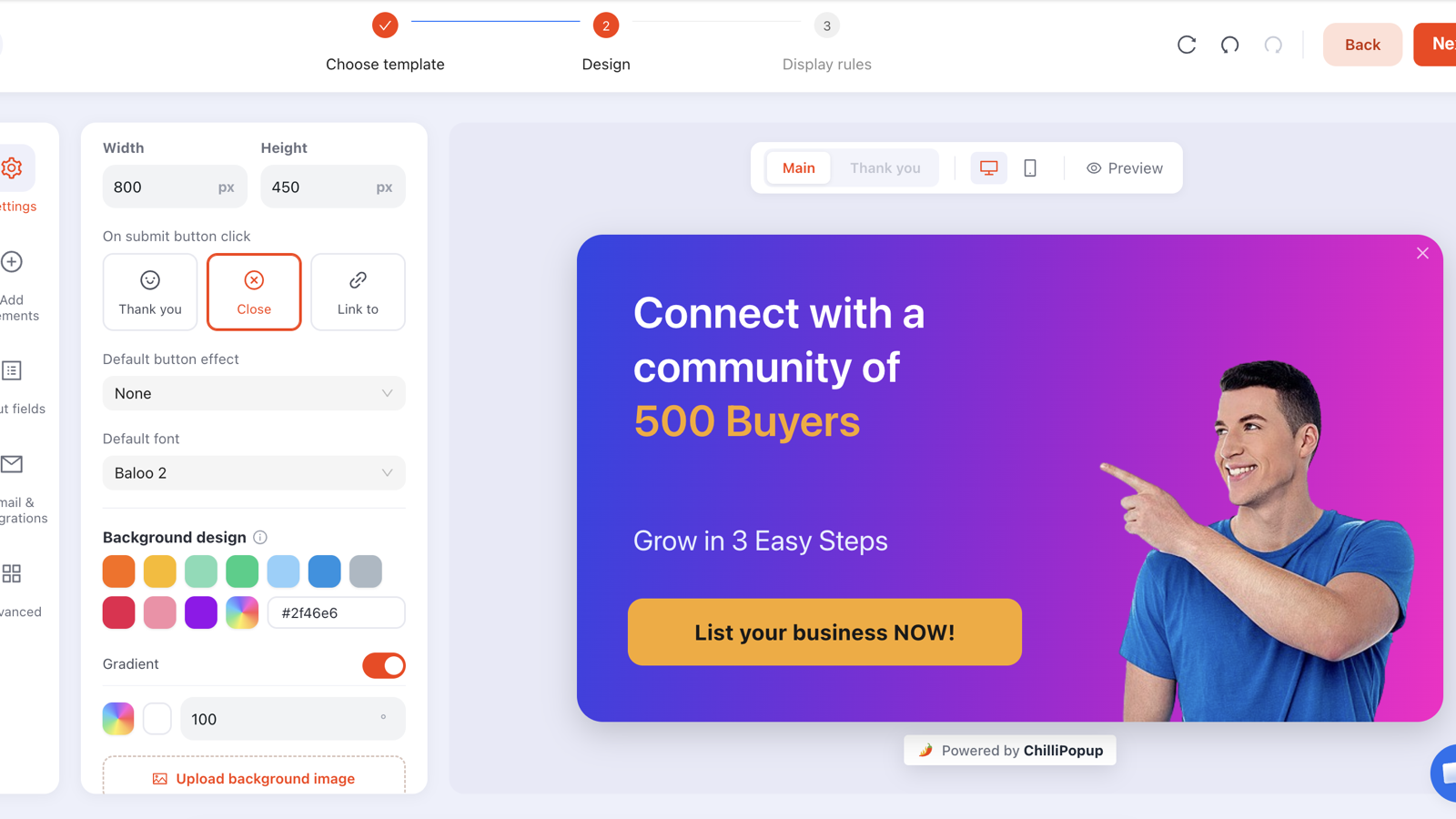
A countdown makes a deadline visible. Just make sure the deadline is the actual deadline.
Win back: three promotions for people who already know you
13. The replenishment nudge
For consumables, timing beats discounting. A returning-visitor campaign that says "Running low? Reorder in two taps" converts because it arrives when the need does. No discount needed at all.
14. Early access for subscribers
The sale opens 24 hours early for people on your list. This does three jobs at once: it rewards subscribers, it makes signing up worth something concrete, and it front-loads the sale so you learn early whether the offer is landing.
15. The "we saved your cart" offer
For a returning visitor who left a full cart, an exit-intent offer that references the cart is the highest-intent moment you will ever get. Keep the incentive small — this shopper is closer than anyone else, so the last thing you should do is pay them heavily to finish.
Segment or overpay. Ideas 1–5 belong to new visitors and 13–15 to returning visitors. Running an acquisition discount with no audience rule means your loyal customers get paid to buy what they were buying anyway — every single day of the campaign.
How to announce a promotion without wrecking the site
The announcement is where good offers die. Match the loudness of the format to the size of the moment:
| Format | Interruption | Use it for |
|---|---|---|
| Announcement bar (top or bottom) | None — it sits in the layout | Free-shipping thresholds, sale-is-running, delivery cut-off dates |
| Corner slide-in | Low | Secondary offers, replenishment nudges, social proof |
| Scroll-triggered popup (50–60%) | Medium — but only reaches readers | First-order incentives, lead magnets, quizzes |
| Exit-intent popup | Medium, but the session was ending anyway | Cart recovery, last-chance offers, prize games |
| Full-screen overlay | High | Genuinely major moments only — a launch, a once-a-year sale |
| Inline form in the page | None | Waitlists, back-in-stock requests, early-access signup |
Whichever format you pick, four display rules do the actual work: audience (new versus returning, with your own definition of "new" in days), page targeting so the campaign is excluded from checkout, frequency so nobody meets it twice a day, and a date window so the promotion starts and stops on its own. That last one is worth setting even for a three-day sale — it's the difference between a deadline and an intention.
Run your next promotion properly
Announcement bars, countdowns, coupon codes and prize games from one editor — with the audience and date rules that keep the offer where you meant it. Free plan, no credit card required. Paid plans from $29/month.
Start free →Delivering the code without leaking it
A single shared code posted on a coupon aggregator becomes a permanent discount you didn't budget for. Two mechanics prevent that:
- Fixed code — one shared code shown to everyone. Simple, fine for a public sale, useless for anything you want to keep contained.
- Unique codes — a pool of one-time codes, issued one per claim, with an optional fallback code shown once the pool runs dry. This is what you want for anything valuable: the code a customer shares has already been used.
Show the code on the popup's thank-you screen straight away — a customer who has to wait for an email to arrive before they can use their discount often doesn't come back. The coupon popup guide covers the delivery patterns in detail.
Seven mistakes that turn a promotion into a loss
- No audience rule. Everyone gets the new-customer discount, including your best customers. The most expensive mistake on this list.
- A deadline that never arrives. "Sale ends Sunday" every Sunday teaches customers to wait, permanently.
- Discounting your bestsellers. Those were selling. Promote the slow stock and let the bestsellers carry full margin.
- The promotion on the checkout page. A discount field in front of someone about to pay sends them off to search for a code, and some of them don't come back.
- Measuring claimed codes instead of profit. Codes claimed is a vanity number. Revenue per session and margin are the real ones.
- Running three promotions at once. Nobody knows which one applies, support gets the questions, and you can't tell which worked.
- Forgetting to turn it off. Set a date window on the campaign so the sale ends even if you're on holiday.
What to measure
- Revenue per session during versus before. The number a discount can't fake.
- Margin, not turnover. A record week at half margin is a mediocre week.
- Average order value, especially for thresholds and bundles — that's the whole point of those two.
- New versus returning customers. An acquisition promotion that only served existing customers didn't do its job, whatever the revenue says.
- Campaign conversion rate. Each campaign reports its own opens, unique views, clicks, submissions and conversion rate, so you can see whether the announcement or the offer was the weak part.
- What happens the week after. If sales collapse below baseline, you pulled demand forward rather than creating it.
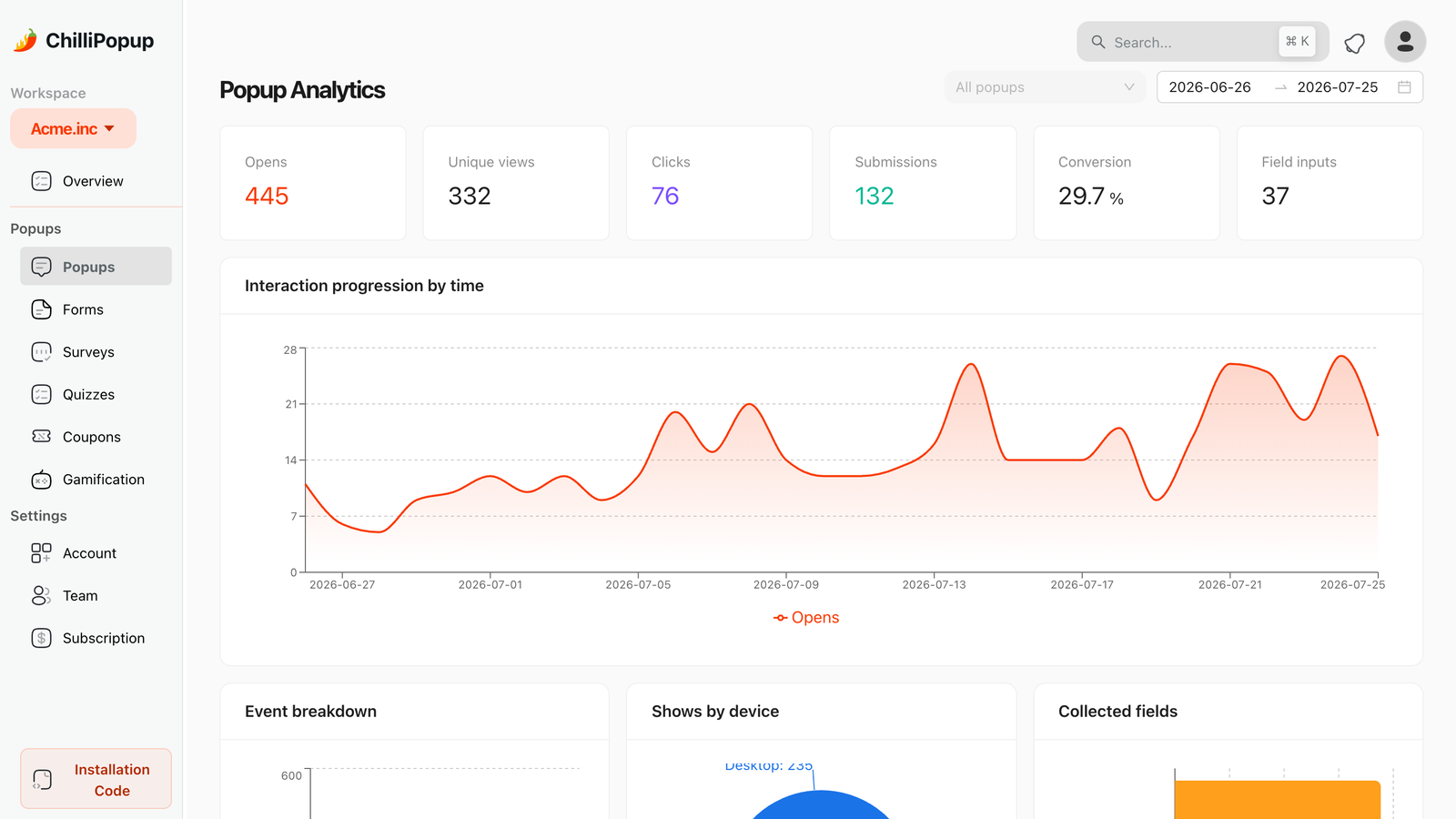
Separating "the announcement wasn't seen" from "the offer wasn't wanted" is the difference between fixing the right thing and the wrong one.
Related reading
Frequently asked questions
What is a sales promotion?
A sales promotion is a temporary offer designed to make people act now rather than later — a discount, a bundle, a free gift, a threshold, a competition, or early access. The defining feature is that it is time-bound: a permanently discounted price is not a promotion, it is your price.
Which sales promotion works best?
It depends entirely on the job. To acquire a first-time customer, a first-order incentive or a prize game works best. To raise order value, use a threshold or a bundle rather than a percentage. To clear stock, use a deadline plus scarcity. Choose the promotion by the job, not by what looks generous.
Is a percentage discount or a fixed amount better?
A rough rule: use a percentage when the item is cheap and a fixed amount when it is expensive, because that is the version that sounds bigger. 20% off a 15 euro item sounds better than 3 euros off; 30 euros off a 200 euro item sounds better than 15%. Run the arithmetic on both and pick the one you can afford that sounds larger.
How do I promote an offer without annoying visitors?
Match the loudness to the moment. An announcement bar sits at the top of every page and interrupts nobody. A scroll-triggered popup only reaches people who are reading. An exit-intent offer only reaches people who are leaving. Reserve full-screen overlays for genuinely major moments, and never show any of them on your checkout page.
How long should a promotion run?
Long enough for your normal buying cycle to complete, short enough to feel like a deadline — for most small stores that is three to seven days. Anything permanently 'ending soon' stops working, because customers learn the deadline is fake and simply wait for the next one.
Do I have to discount at all?
No, and often you should not. Free shipping over a threshold, an extended returns window, a free gift with purchase, early access, a bundle, or a prize game all create urgency without cutting the headline price — which matters because a price customers have seen discounted three times becomes the price they expect to pay.