Nobody wants to fill in another form. Everybody wants to pull the lever once. That gap is the entire argument for a slot machine popup: instead of asking a stranger to hand over an email address for a discount, you ask them to press a button — and the email arrives on the way to the prize they just won.
This guide covers the whole build: how the three reels actually work, how to write a prize table with odds you can live with, where the email ask belongs, the display rules that stop a game becoming a nuisance, and the numbers that tell you whether the machine earned its place.
Key Takeaways
- The pull comes first, the email comes second. Gate the play behind a form and you have built a form with extra steps.
- Design the prize table before the machine. Odds and rewards decide whether the campaign is profitable; colours don't.
- Losing outcomes are a feature. A near-miss keeps a game feeling like a game — as long as it is clearly a game and not a con.
- Decide the outcome on the server. A prize game is the first thing a curious visitor opens developer tools on.
- One play per visitor. A machine you can pull all day is a coupon generator, not a campaign.
What is a slot machine popup?
Slot machine popup, in two sentences
A slot machine popup is a website popup whose main surface is a three-reel slot machine with its own play button. The visitor pulls, the reels land, and a winning combination opens a claim screen that collects their email before revealing the prize code.
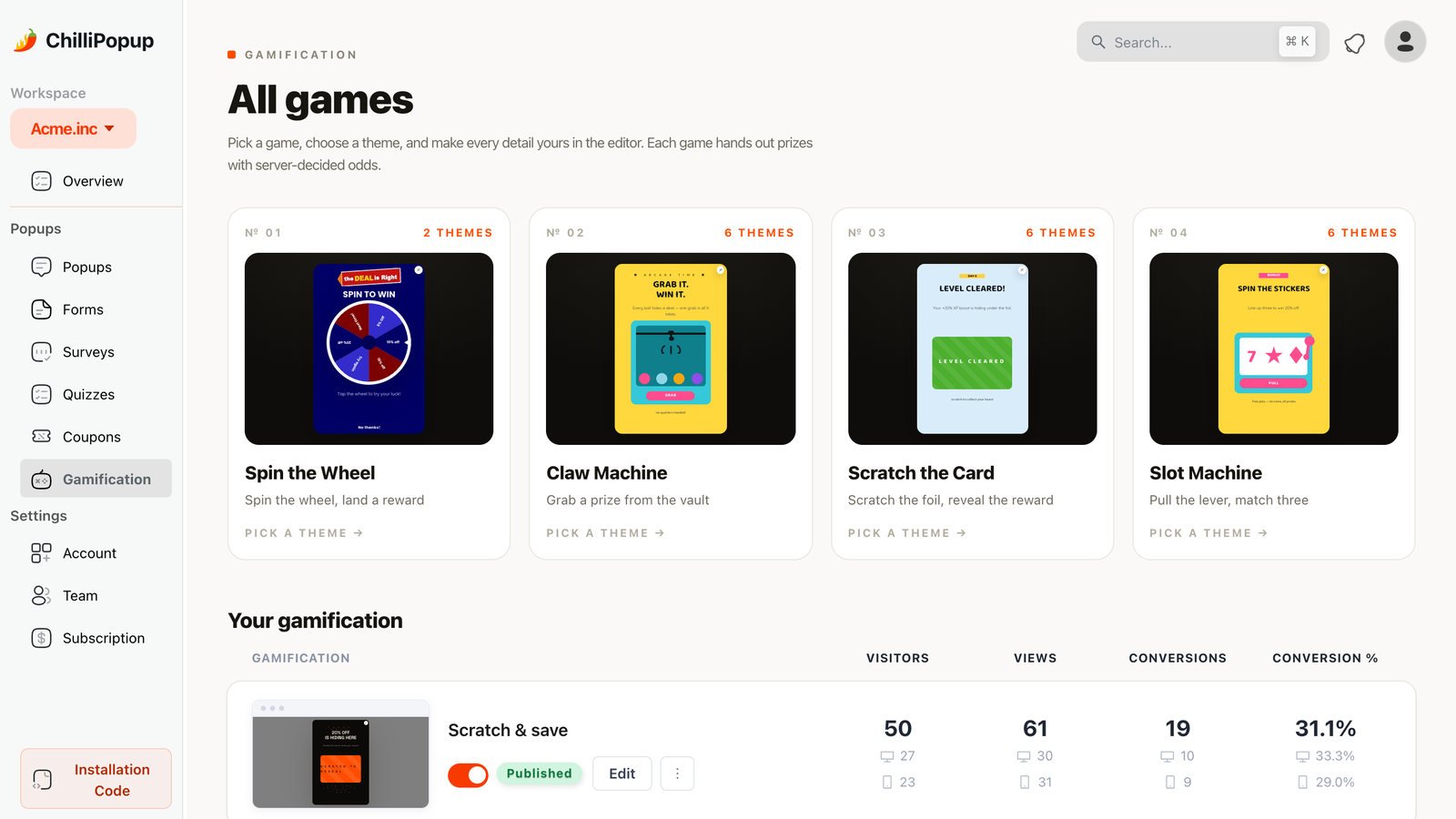
It belongs to the same family as the spin to win wheel and the scratch card. In ChilliPopup all four prize games — wheel, claw machine, scratch card and slot machine — share one prize engine, one set of screens and one report. Only the moment of play changes.
The flow a visitor experiences is always the same four beats:
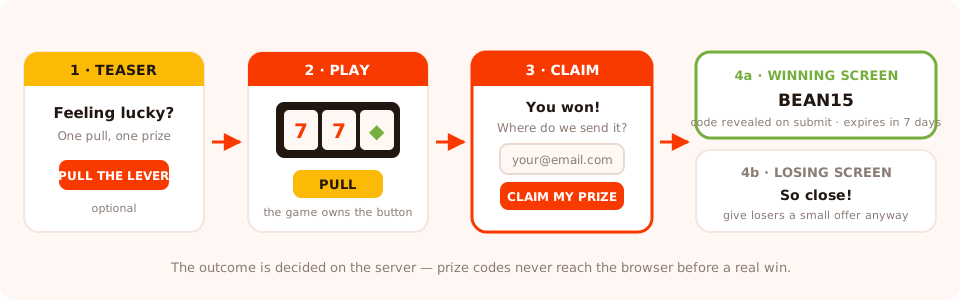
Four screens, one campaign. The email is collected between the pull and the reveal — the only moment where a visitor is genuinely motivated to type it.
- Teaser (optional). A pre-play screen that sells the game before the reels appear: a headline, an image, one button that starts the play.
- Play. The machine itself — a framed three-reel window and its own PULL button. The game surface owns the play trigger, so you do not add a separate submit button here.
- Post-Play. The claim step. This is where the email input lives, and it appears only after a winning pull.
- Winning or Losing. Two separate screens you design yourself. The winning one reveals the code; the losing one keeps its dignity and offers something else to do.
Why a slot machine converts differently to a signup form
A signup popup asks the visitor to make a decision about you: do I want emails from this shop? A slot machine asks them to make a decision about themselves: do I feel lucky? The second question is much easier to say yes to, and by the time the email field appears the visitor has already invested a pull and seen a prize with their name on it.
Three mechanics do the work:
- Variable reward. An unknown outcome is more engaging than a fixed one. "10% off" is a fact; "up to 30% off" that resolves in front of you is an event.
- Near-misses. Two matching symbols and a third that just missed is the single most motivating frame in any reel game. It is also the reason losing outcomes exist as a deliberate design choice rather than an accident.
- Sunk action. Once someone has pulled, the claim form is the last small step to a reward they already feel they own. It reads as paperwork for a prize, not as a price of entry.
The flip side, stated honestly. A game attracts discount hunters as well as customers, and a list built entirely from prize claims can open worse than a list built from genuine interest. Run a game as a burst — a launch, a holiday, a slow month — not as the permanent front door of your store. If you want an always-on capture, a plain popup or an inline form will build a cleaner list.
Design the prize table first
Everything profitable about a slot machine popup is decided in the prizes panel, and everything else is decoration. Each prize carries four things: a label the visitor reads, a reward or coupon code it hands out, a win chance, and a losing flag for outcomes that should look like a result but count as a loss.
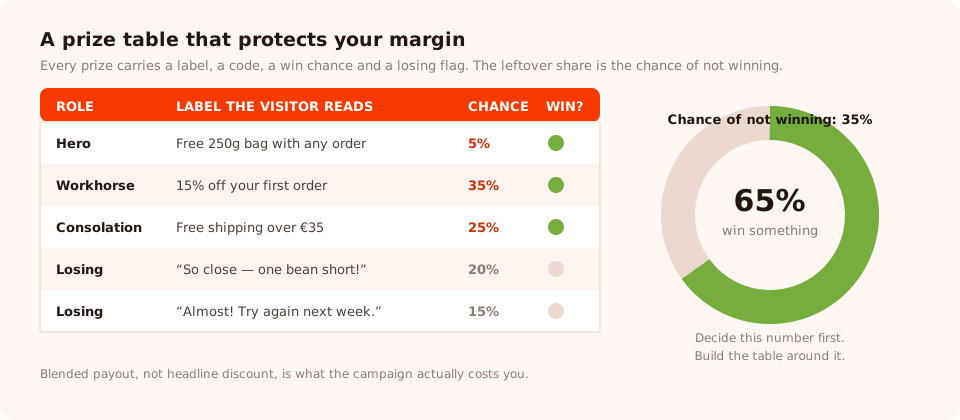
A prize table that survives contact with your margin: one hero, one workhorse, one consolation, and losing outcomes that still feel like a spin.
The shape that works for most stores:
| Role | Example label | Rough share of outcomes | What it is for |
|---|---|---|---|
| Hero | 30% off everything | Small | Makes the game worth playing. It has to be real, or the whole thing is theatre. |
| Workhorse | 10% off your first order | Largest single share | The prize you actually expect to pay out, priced so you are happy when it lands. |
| Consolation | Free shipping over €50 | Moderate | Costs you least, still converts, keeps the win rate generous. |
| Losing outcomes | "So close!" / "Almost" | Whatever is left | Marked as losing prizes so a near-miss reads as a game rather than a bug. |
Odds: two ways to set them
You can give every prize a chance percentage of its own, or flip on equal chances and let the machine treat them all the same. As you tune the individual percentages, the editor shows you the resulting chance of not winning — the share of pulls that land on nothing at all. Decide that number before you write a single label, because it is the one figure that connects the game to your margin.
A rule of thumb. Work backwards from the discount you would happily offer everyone. If a flat 10% off is already fine, then a game whose blended payout is close to 10% costs you nothing extra and buys you a far better conversion moment. If the blend comes out well above that, cut the hero's odds, not the hero.
Reels and symbols
The three reels are chrome, not logic: the symbols are a visual setting (the machine ships with a classic trio and you can supply your own), while the actual outcome comes from the prize table. Swap in symbols that match your catalogue — a coffee bean, a bag, a bottle — and the machine stops looking like a casino and starts looking like your brand having fun.
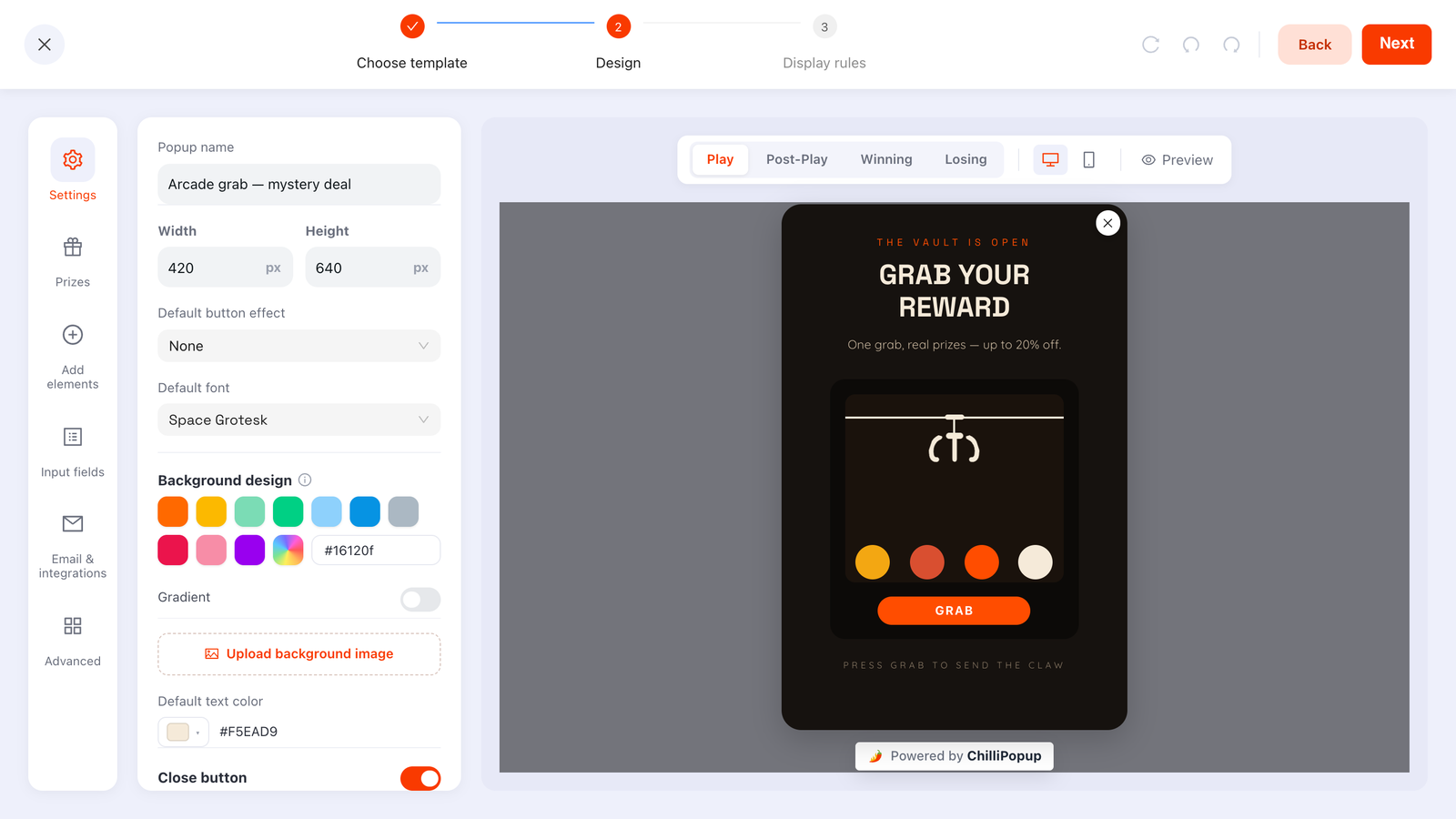
Play, Post-Play, Winning and Losing are separate screens you design yourself, with a Prizes tab holding the labels, codes and odds.
Where the email ask goes — and why it goes there
There is exactly one right answer, and most implementations get it wrong. The email field belongs on the Post-Play claim screen: the visitor pulls first, learns they have won something, and then fills in the claim form. Submitting the form is what reveals the code.
Put it anywhere else and you lose the mechanic:
- Before the pull — you have built a signup form with an animation attached. Everything that made the game work is gone.
- After the reveal — the visitor already has the code. There is now no reason on earth to type an email.
Keep the claim screen to one field. You are one step from a reward; this is not the moment to ask for a phone number, a birthday and a shoe size. If you genuinely need those, ask later — that is what progressive profiling is for.
Say what the email is for. One line under the field — "we'll email your code and the occasional offer; unsubscribe any time" — is the difference between a claim and a dark pattern. If you serve visitors in the EU or the UK, the consent needs to be explicit and specific; our GDPR popup guide covers what that looks like in practice.
Fairness: why the outcome is decided on the server
A prize game is the single most tempting thing on your site to inspect. If the winning combination were chosen in the browser, someone would find it within a week, post it, and your 30% code would be everywhere.
In ChilliPopup the outcome is chosen on our servers, and prize codes are stripped out of the public payload the page downloads. The browser knows the labels and the artwork; it does not know the codes until a real win has been decided. That is not a nice-to-have — it is the difference between a promotion and a leak.
Belt and braces on the coupon side too. Set your discount codes to expire, cap their use in your store's own discount settings, and use a different code per prize tier. The game controls who gets a code; your store controls what a code can do.
Display rules for a slot machine popup
A game is louder than a normal popup, so its rules should be tighter. Every popup in ChilliPopup carries its own display rules; here is the set that suits a machine.
| Rule | What to choose for a game | Why |
|---|---|---|
| Trigger | Exit intent on desktop, or 50% page scroll / 20–30 second delay on mobile | Interrupting an arriving visitor with an arcade cabinet is the fastest way to get dismissed. |
| Page targeting | Collection and product URLs; exclude checkout and account pages | A game over a checkout form is a distraction that costs you the order you already had. |
| Audience | New visitors for acquisition, returning for reactivation — pick one | The same machine cannot do both jobs; the offer has to match the relationship. |
| Frequency | Once every few days at most | One play per visitor is the whole promise. Unlimited pulls is a coupon vending machine. |
| Show again after conversion | Off | Someone who already won and claimed should never see the machine again. |
| Devices | Both, but check the mobile layout | The machine plus a claim field has to fit above the keyboard on a small screen. |
| Date window / schedule | Set an end date for a seasonal campaign | A date range with a GMT offset, or a weekday-and-hour schedule, retires the game for you. |
Two more that matter for stores running several campaigns: page targeting supports contains, does not contain, is exactly, is not, starts with and ends with, so you can carve out a single collection precisely; and every enabled rule is an AND gate, so each one you add makes the machine rarer, not more likely.
A worked example: a coffee roaster's launch machine
Campaign. New single-origin launch, two weeks, first-time visitors only.
Teaser screen
"Feeling lucky? One pull, one prize — on the house."
Button: Pull the lever
Play screen
Three reels with a bean, a cup and a bag as the symbols. Machine button reads PULL. The headline above the reels: "Three of a kind wins the big one."
Prize table
- Free 250g bag with any order — the hero, small odds
- 15% off your first order — the workhorse
- Free shipping over €35 — the consolation
- "So close — one bean short!" — a losing outcome
- "Almost! Try us again next week." — a second losing outcome
Post-Play claim screen
"You won. Where should we send it?" One email field, one button reading Claim my prize, and the small print: "We'll email your code plus the odd note about new roasts. Unsubscribe any time."
Winning screen
"Your code is BEAN15 — use it in the next 7 days." Copy button. A link straight to the new collection so the code has somewhere to go.
Losing screen
"No luck this time. Here's 10% for turning up anyway." Yes — give the losers something small. It costs a fraction and it turns a dead end into a second chance at a subscriber.
The losing screen is the most neglected screen in gamification. Most stores leave it as a shrug. Treat it as a second offer and a losing pull stops being a wasted impression.
Slot machine vs the other three games
They are twins under the hood — same prizes, same claim-and-reveal screens, same reporting. Choose on tone and on the shape of the space you have.
| Game | Feels like | Best for | Watch out for |
|---|---|---|---|
| Slot machine | Arcade, loud, one-more-go | Launches, holidays, playful brands that want to stand out | Casino connotations in conservative markets |
| Spin the wheel | Familiar, mainstream, "discount" | Everyday list growth; the safest first game | Visitors have seen a lot of wheels |
| Scratch card | Tactile, quiet, personal | Mobile-first traffic and calmer brands | Needs a deliberate gesture, so some people stop halfway |
| Claw machine | Suspenseful, novel, arcade | Toys, kids, gifting, anything with physical prizes | The tallest of the four — check it on small screens |
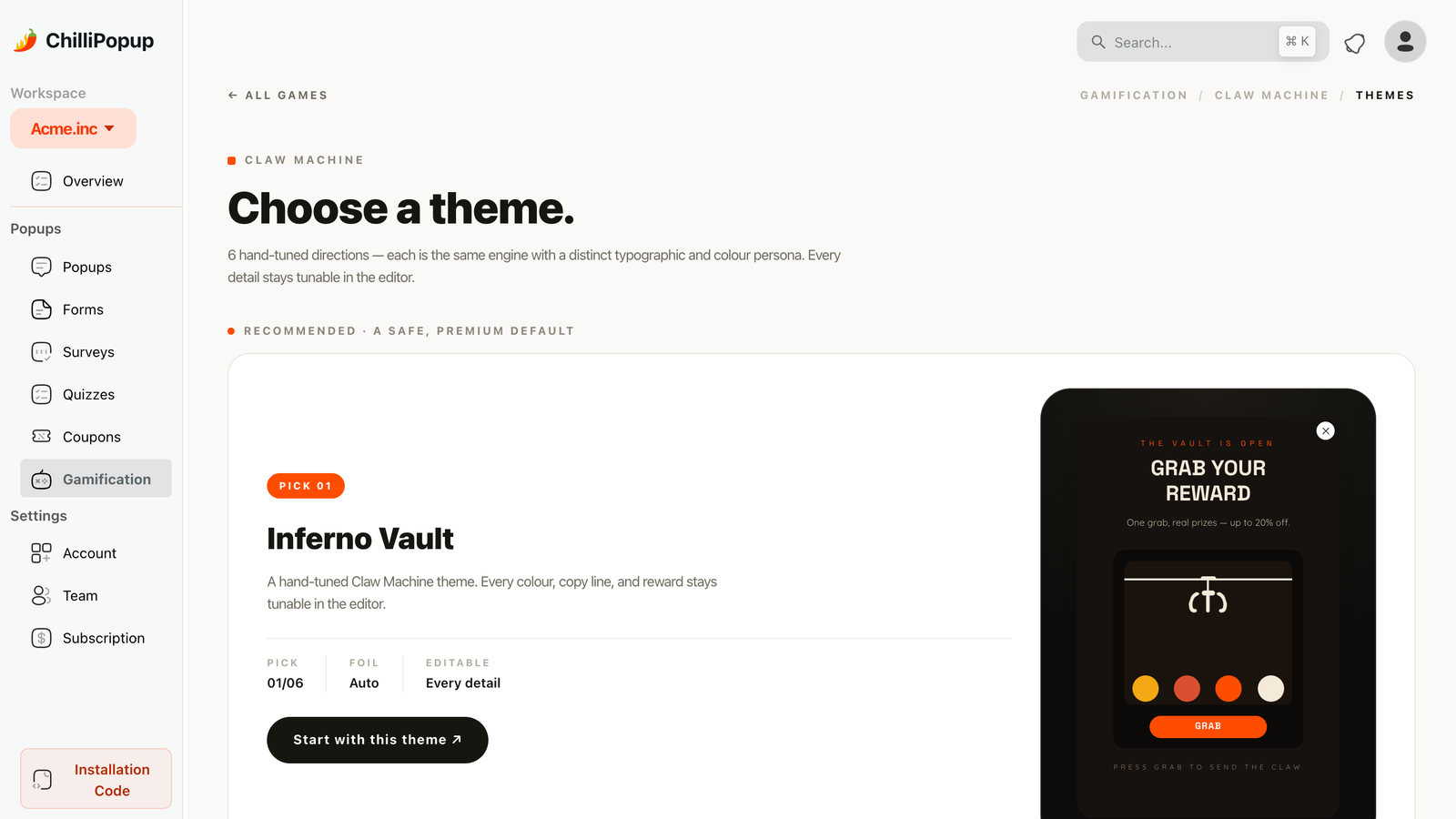
Each game opens onto its own themes. Theme is one setting — swap it whenever the campaign changes.
How to build a slot machine popup, step by step
Half an hour, no code. If the pixel is not on your site yet, start with the one-line install guide — the same script serves every popup, form, survey, quiz and game you ever publish.
1. Pick the game and a theme
Create a popup, choose Slot Machine from the games catalogue, and pick a theme. Themes are a starting point, not a commitment — every colour on the machine (frame, reel window, symbol colour, play button) is editable afterwards.
2. Write the prize table
In the Prizes tab, add your hero, workhorse and consolation prizes with their labels and codes, then add one or two outcomes marked as losing prizes. Write the labels as the visitor will read them, not as your spreadsheet names them.
3. Set the odds
Give each prize a chance, or flip on equal chances. Watch the chance of not winning figure as you go and stop when the blended payout matches the discount you would have given away anyway.
4. Design the four screens
Play (headline plus the machine), Post-Play (one email field and a claim button), Winning (the code, an expiry, a link to the collection) and Losing (a small consolation offer). Turn on the teaser screen if you want a pre-play pitch.
5. Set the display rules
One trigger. Page targeting for the collections that make sense. Switch the display-frequency rule on — the audience and conversion controls only appear once it is — then choose your audience and turn off "show again after conversion".
6. Publish, install, then read the report
Publish (drafts never serve), check it on a phone, and leave it alone for a week. Then open the game report and change exactly one thing.
Put a machine on your site this afternoon
Four games, one prize engine, one pixel — and the same editor you use for popups, forms, surveys and quizzes. Free plan, no credit card required. Paid plans from $29/month.
Start free →What to measure
A game reports differently to a plain popup, because there are two conversions inside it: the play and the claim. The game report gives you plays, wins, losses, claimed wins, a claimed-by-prize breakdown and a winners' email table.
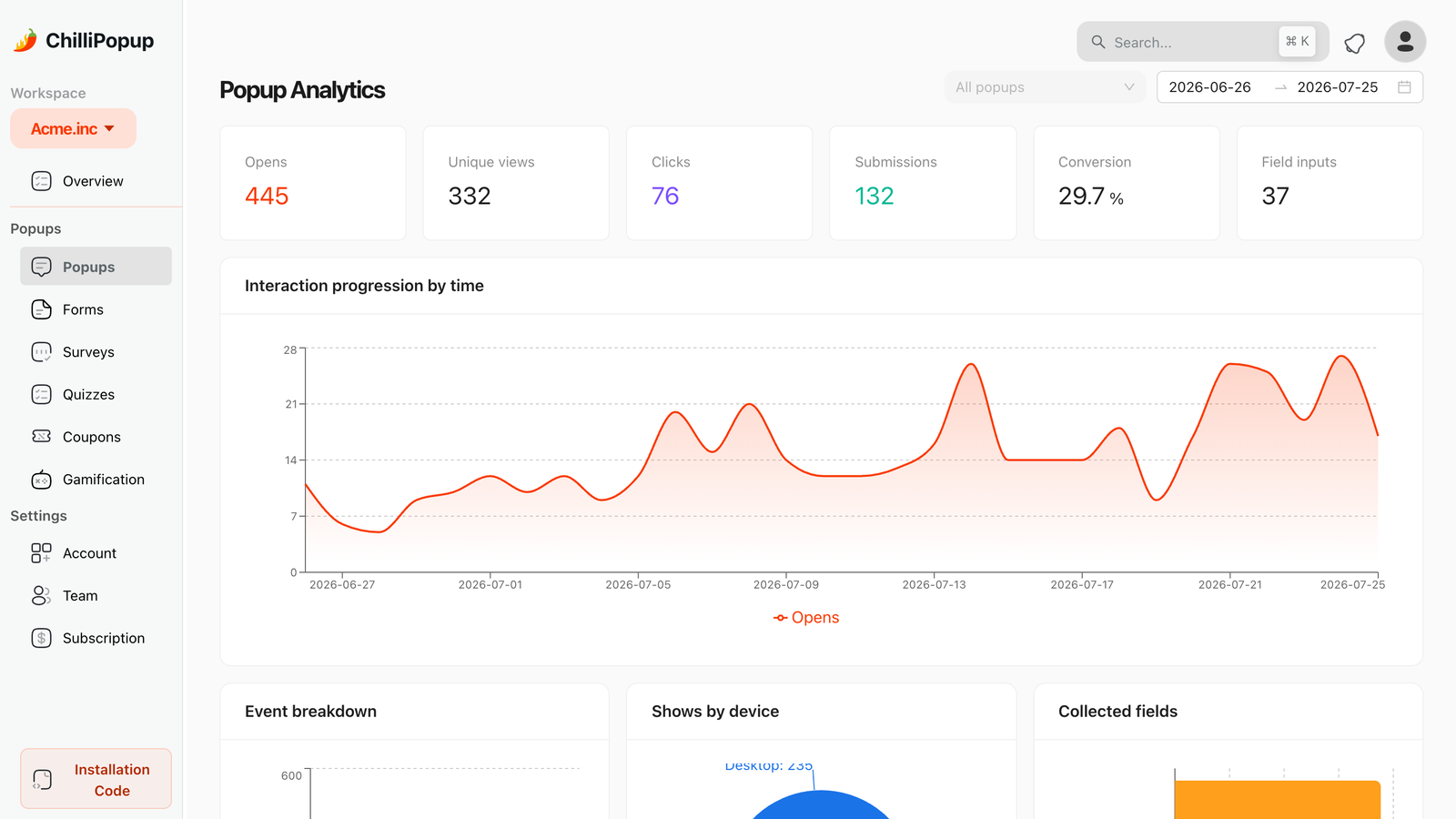
Two conversion rates live inside one game: views to plays, and wins to claims. They fail for completely different reasons.
Read them in this order:
- Views → plays. If this is weak, the problem is the offer or the teaser, not the game. Nobody pulled because nobody understood what they might win.
- Wins → claims. If this is weak, the claim screen is the problem: too many fields, an unclear reward, or a missing line about what the email is for.
- Claimed by prize. Sanity-checks your odds against reality. If the hero is being claimed far more than you intended, your chances need a look.
- Redemption in your store. The number nobody tracks and everybody should. Codes claimed but never used means the prize was not actually desirable.
When you want to compare two versions of the machine — a different hero prize, a different claim headline — run it as a proper split rather than swapping the live one and eyeballing it. Our guide to A/B testing popups covers what is worth testing and what is noise.
Six mistakes that ruin a slot machine popup
- Asking for the email before the pull. The single most common error. It converts the game back into the form you were trying to escape.
- A hero prize nobody can win. If the odds are effectively zero, the game is a lie and the one person who notices will tell everyone.
- Everybody wins the same thing. If the outcome is fixed, you have paid for an animation. Either vary the prize or run a plain coupon popup instead.
- No expiry on the code. Urgency is what turns a claim into an order. An open-ended code gets forgotten.
- Running it on every page forever. A game is a burst campaign. Set a date window and let it retire itself.
- Ignoring mobile. The reels plus a claim field plus a keyboard is a tight fit. Check the layout on an actual phone before you publish.
When not to run a slot machine popup
- Premium and luxury brands. An arcade cabinet in front of a €900 coat undercuts the price. A quiet newsletter popup respects it.
- B2B and considered purchases. Nobody pulls a lever to book a demo. Use a qualifying quiz instead.
- Regulated or sensitive sectors. Financial services, healthcare, anything age-restricted — the casino framing is a liability, not a hook.
- Thin margins with no room for a discount. If a 10% code hurts, a game that hands out codes hurts more.
Related reading
Frequently asked questions
What is a slot machine popup?
A slot machine popup is a website popup that renders a three-reel slot machine instead of a form. The visitor presses the play button, the reels spin, and the outcome decides whether they see a prize. The email address is collected on the claim screen between the pull and the reveal, so the visitor is claiming a win rather than filling in a signup form.
Is a slot machine popup legal or does it count as gambling?
A discount game where nobody stakes money is normally treated as a promotion rather than gambling, but the rules differ by country and by what you promise, and prize-draw law is strict in some markets. Keep it free to play, publish clear terms for the prizes, avoid casino wording where your market frowns on it, and check the local rules for your business before you launch. This is general guidance, not legal advice.
Where should the email field go on a slot machine popup?
On the claim screen that appears after a winning pull, never before the game. Asking for an email to unlock the play kills the fun and turns the game back into a form. In ChilliPopup that screen is the Post-Play step: the visitor pulls, sees they have won something, fills in the claim form, and submitting is what reveals the code.
Can visitors rig a slot machine popup by inspecting the page?
Not in ChilliPopup. The outcome is decided on the server, and prize codes are stripped out of the public payload the page loads, so the winning code only ever arrives after a genuine win. That matters more for a game than for a plain popup, because a game is exactly the kind of thing a curious visitor will open developer tools on.
What win rate should a slot machine popup have?
High enough that the game feels generous, low enough that your margin survives. Most stores run a small hero prize with a low chance, a workhorse discount that most winners get, and one or two deliberately losing outcomes so a near-miss still reads as a game. The editor shows the chance of not winning as you tune, so decide that number first and build the table around it.
Slot machine or spin wheel — which converts better?
They share the same prize engine, the same claim-and-reveal screens and the same reporting, so the difference is tone rather than mechanics. A wheel is the familiar, mainstream choice and reads as a discount. A slot machine is louder and more arcade, which suits playful brands and holiday campaigns and stands out precisely because fewer stores run one. Test the one that fits your brand before you test the mechanic.