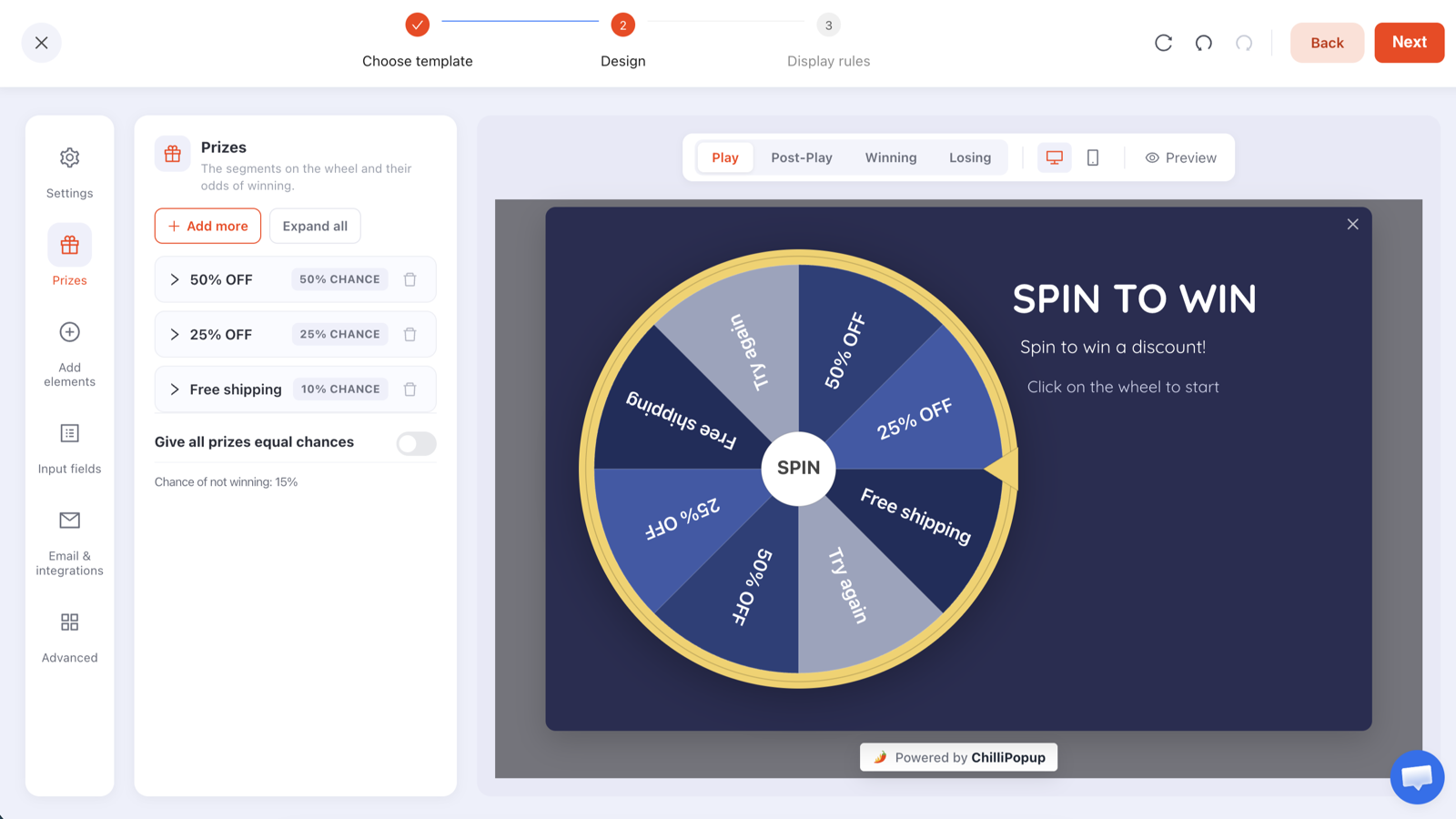
Seasonal campaigns usually have to invent a reason for whatever mechanic you wanted to run anyway. St Patrick's Day is the exception: luck is the theme, and luck is exactly what a prize game is made of. A wheel on 17 March needs no explanation at all.
Which is why the interesting part of this campaign is not the idea — it is the prize pool. Get the odds wrong and you either give away your margin all day or run a game everybody loses. Here is how to design it, plus seven other campaigns for stores where a wheel is not the answer.
Key Takeaways
- Luck is a native mechanic here — a prize game needs no thematic justification on this date.
- Design the odds, don't leave them equal. The cheapest prize should be the most likely outcome.
- Play first, ask second. The email belongs on the claim screen, and submitting it reveals the code.
- Drinks brands need an age gate in front of the promotion — and no prize language before it.
- Skip the shamrocks if they are not you. Borrow the mechanic, not the costume.
Why a prize game fits this date
A prize game works when the play itself is the reward for attention — the visitor does something, then finds out what they got. That converts better than the same discount offered flatly, because the sequence is curiosity first and form second.
There are four mechanics to choose from, and they suit different stores:
| Game | Feels like | Best for | Theme fit |
|---|---|---|---|
| Spin wheel | A named prize pool you can see | Stores with 4–8 offers worth showing | The classic: "spin for your luck" |
| Scratch card | One private reveal | A single offer with a bit of theatre | "Scratch and find the gold" |
| Slot machine | Fast, playful, repeatable energy | Younger audiences, apparel, food | Three-in-a-row luck |
| Claw machine | Picking a specific thing | Playful catalogues, gifts, toys | "Grab your pot of gold" |
All four share the same structure, which is what makes them quick to build: an optional teaser screen before the play, the play itself, a claim step that collects the email, then a win reveal — with confetti if you want it — or a losing screen. Prizes are configured once and drive both the visuals and the odds.
Designing the prize pool
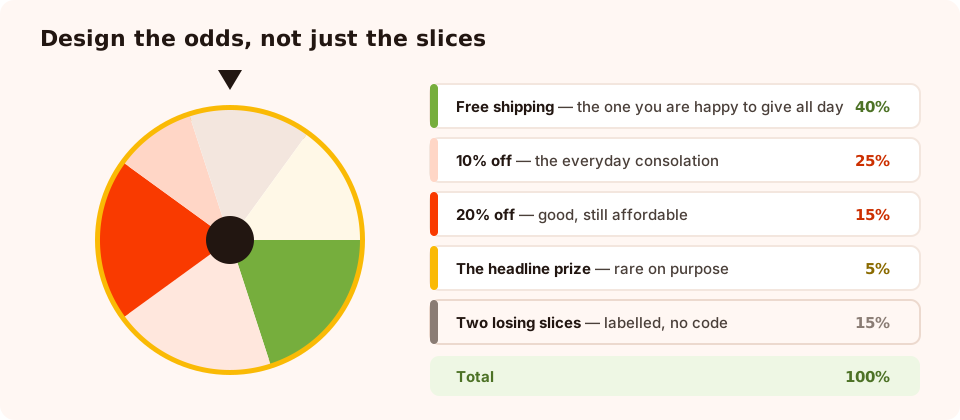
Six slices, odds that add up, and two losing slices that are allowed to say so.
Four rules cover almost every store:
- Make the cheap prize the likely one. Free shipping or 10% off should be the most common outcome, because it is the one you will be honouring all day. The headline prize is there to justify the play, not to be won.
- Set the odds explicitly. Every prize carries its own chance, and there is an equal odds switch if you want them uniform. Give each prize a number and make them add up to 100 — leaving a gap means the game fills the remainder with an outcome you did not design.
- Include one or two honest losing slices. A game where nobody loses is not a game, and visitors can feel it. A losing slice keeps its own label and colour and simply carries no code, so nothing has to be faked.
- Never put the discount code in the design. The winning outcome is decided server-side and the code is only revealed after the claim form is submitted — so the prize codes are not sitting in the page waiting to be read.
Keep the play free and unconditional. No purchase to spin, no entry fee, no casino vocabulary. One line of terms — one play per visitor, codes valid until the end of the week, one use per order — printed on the claim or win screen. It costs nothing and removes every awkward question.
Eight St Patrick's Day campaigns
1. The luck wheel. The main event.
"It's your lucky day — one spin, one prize." Six slices, odds set as above, on collection and homepage traffic with a 10-second delay. Teaser screen on if your audience needs the rules first, confetti on the win screen because this is the one campaign of the year where confetti is not too much.
2. Scratch for the gold.
Simpler and just as effective on mobile: one card, one reveal, one prize. Build it when you have a single offer and do not want to design a whole pool. The scratch card guide covers the reveal mechanics.
3. 17% off on the 17th.
The cleanest non-game offer available, because the number explains itself and expires by definition. Run it for one day with a date window that ends at midnight, and put the code on the popup's thank-you screen.
4. The green edit.
"Everything green, in one place." If your catalogue has colour filters, this is fifteen minutes of work and it converts because it is useful rather than themed. Page-target collection pages and link straight to the filtered view.
5. Pot-of-gold free shipping.
A threshold offer with a name: "Find the pot of gold — free delivery over £40 today." Better margin than a percentage on most catalogues, and it raises basket size rather than shaving the price.
6. The party bundle (food, drink, hospitality).
For anyone selling for a gathering: a bundle popup on the relevant collection, plus a delivery-deadline countdown in the two days before. The deadline is the campaign — see the countdown timer guide for keeping it honest.
7. Table and event bookings.
Venues do not need a discount; they need names and numbers. A short form — name, date, party size, phone — triggered on the events page, is worth more on this date than any offer.
8. The next-day-delivery countdown.
Costume, apparel and accessory stores live or die on the last 48 hours. A timer to the real cut-off, on product and collection pages, with the campaign scheduled to end when the cut-off passes.
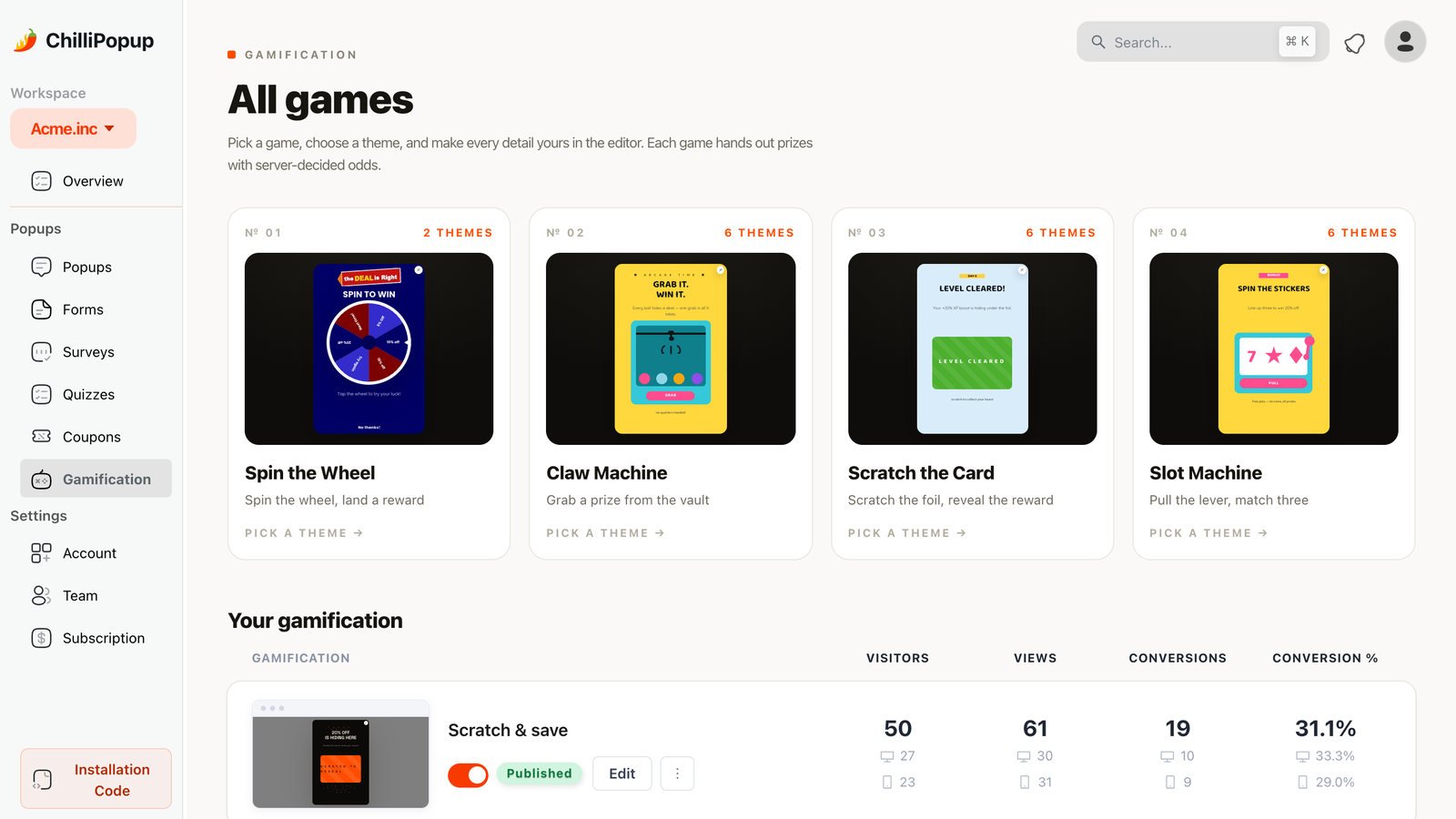
Four mechanics, one prize panel. Pick by how playful your brand is, not by which looks most complex.
If you sell alcohol
This date attracts drinks promotions, and drinks promotions attract rules. Three practical measures:
- Gate it. A short popup asking for age confirmation, with the content gate switched on so it must be completed and cannot be dismissed by clicking the background. This is the one legitimate use of a blocking popup.
- Nothing promotional before the gate. No prize wheel, no discount, no product imagery in the gate itself. The gate asks a question and nothing else.
- Target by market. Use page targeting and, where relevant, the device and schedule rules to keep the promotion off regions and hours you cannot advertise in. Where you are unsure, run the collection edit instead of the offer.
Advertising rules for alcohol differ substantially between countries, so treat the above as the mechanics and your own market's code as the constraint.
Copy that avoids the costume
WHEEL — teaser
  One spin, one prize. Everybody gets a go.
  → Spin the wheel

WHEEL — claim screen
  You won! Where should we send the code?
  → Reveal my prize

WHEEL — losing screen
  Not this time — but here's 10% off anyway.
  → Take the code

17% OFF
  17% off, on the 17th, today only.
  → Shop the sale

GREEN EDIT
  Everything green, in one place.
  → See the edit

FREE SHIPPING
  Find the pot of gold: free delivery over £40 today.
  → Start shopping

DELIVERY DEADLINE
  Order in the next 4h 20m to get it by Sunday.
  → Shop now
Two notes. A losing screen that still gives something small converts far better than a dead end, and it stops the game feeling like a trick. And avoid words borrowed from betting — "jackpot", "bet", "odds", "gamble" — even in jest; they change how the campaign reads to both visitors and platforms.
The week's schedule
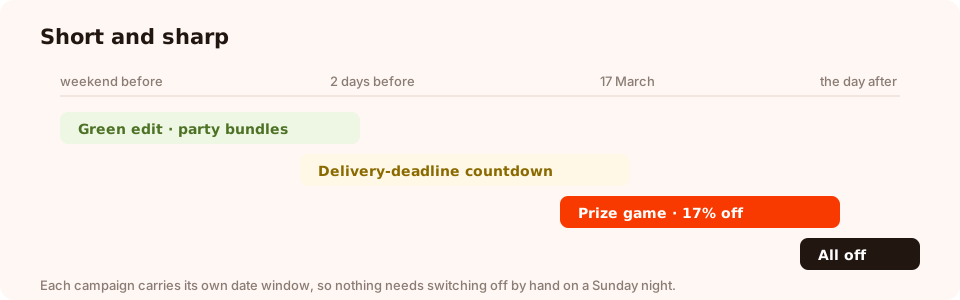
Short and sharp. The whole set is scheduled to end the day after.
- Weekend before. Green edit and party bundles. Trigger on scroll, everyone, once a day.
- Two days before. Delivery-deadline countdown on product and collection pages, ending when the cut-off does.
- The day itself. The prize game and the 17% offer. Frequency once a session — this is the one day where a second showing is defensible.
- The day after. Everything off, automatically, via each campaign's date window. Turn on one quiet follow-up if you collected emails: a thank-you with the code repeated.
Pause your standing offer. If a welcome discount normally runs, switch it off for the day. A visitor who is offered two different discounts in one session learns to wait for a third.
Six mistakes
- Green everything. A colour is not a campaign, and clip-art shamrocks age a brand fast.
- A wheel where every slice wins. Visitors notice, and the prize stops meaning anything.
- Asking for the email before the play. The whole advantage of a game is that the ask comes after the fun.
- Betting language. Cheap laugh, real risk.
- Alcohol promotions with no gate. Straightforwardly avoidable.
- No end date. A shamrock wheel spinning in April says nobody is looking after the site.
What to measure
A game reports the same numbers as any other campaign — views, clicks, submissions, conversion rate, and the values collected per field. Two things are worth looking at specifically:
- Plays versus claims. A high play rate with few claims means the prize is not worth the email, or the claim step is asking for too much. Cut the claim step to one field.
- Which prize was won most. If the expensive slice came up more often than you intended, your odds were not set the way you thought they were — check the numbers add up.
And keep the list. A prize game is the highest-volume email capture most stores will run all quarter; the follow-up email is where the campaign actually pays for itself.
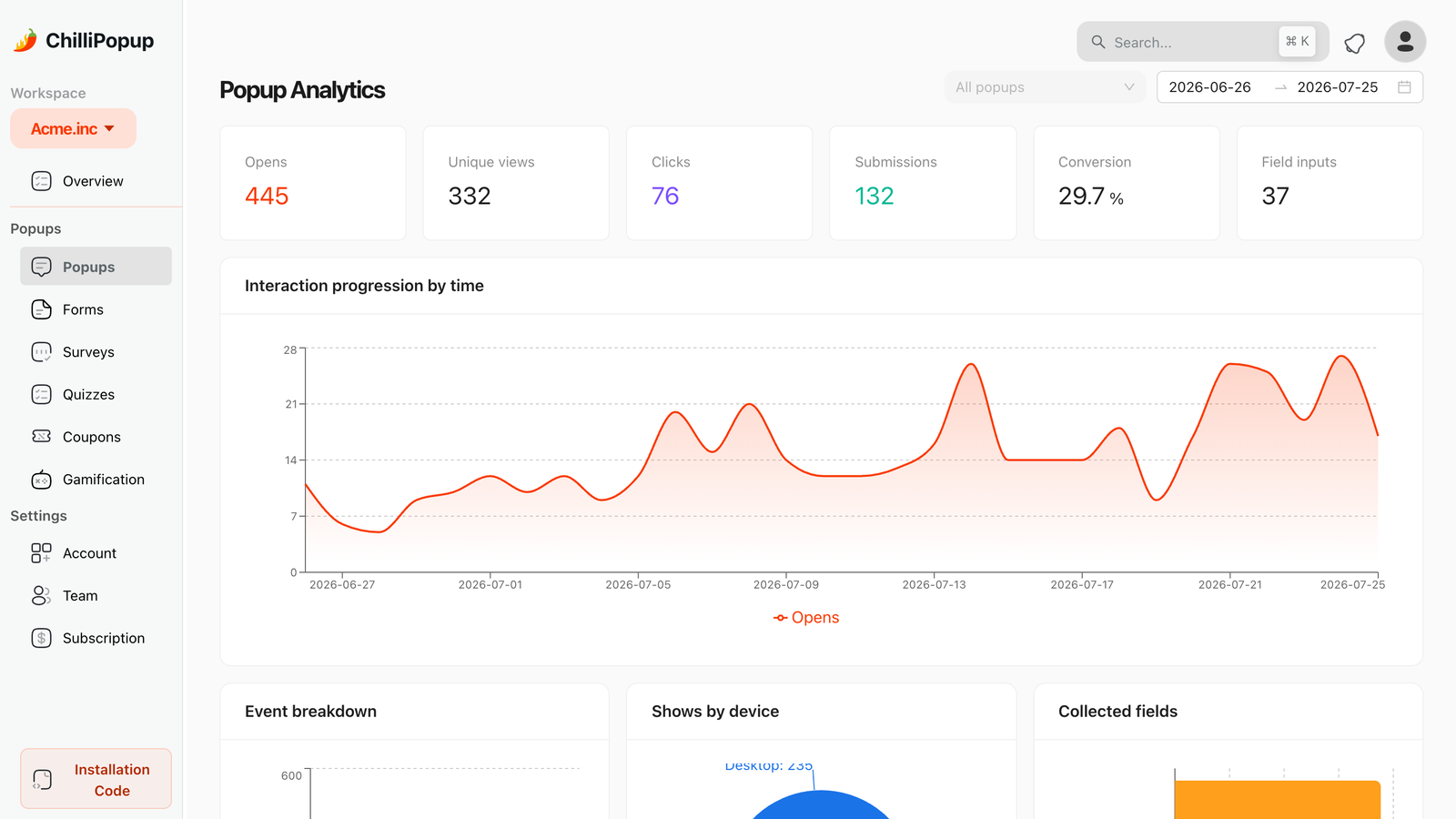
Plays, claims and the prize distribution — read all three before repeating the campaign next year.
Build the wheel in twenty minutes
Four prize games, one prize panel, server-decided odds. Free plan, no credit card required. Paid plans from $29/month.
Start free →Related reading
Frequently asked questions
What are good St Patrick's Day popup ideas for an online store?
The theme is luck, so a prize game is the natural fit: a spin wheel or a scratch card where the prizes are your own offers — free shipping, a small discount, a bonus item. Around it, a green or themed collection edit, a 17% off on the 17th offer, and for anything time-sensitive a delivery-deadline countdown in the days before.
How do you design a prize wheel that does not lose money?
Set the odds deliberately rather than leaving them equal. Make the cheapest prize the most likely outcome, keep the headline prize rare, and include one or two honest losing slices so the wheel is not pretending everyone wins. In ChilliPopup each prize carries its own odds, the winning outcome is decided server-side, and losing slices never carry a code.
Can I run an alcohol promotion in a popup?
Only with an age check in front of it, and with wording that stays within the advertising rules of every market you serve. Practically: a short gated popup that must be completed before anything promotional is shown, no prize or discount language before the gate, and page targeting that keeps the campaign off markets you cannot advertise in.
Is a prize game the same as gambling?
Not when nothing is staked and no purchase is required — the visitor plays for free and every outcome is a discount or nothing. Keep it that way: no entry fee, no purchase requirement to play, no casino-style language, and state the terms in one line. If your promotion involves a genuine prize draw, check the promotional-competition rules in your market.
When should the campaign start?
The weekend before 17 March for anything that needs delivery, and the day itself for the game and any in-store or hospitality offer. Set a date window when you build it so the campaign ends with the occasion rather than lingering into April.
What if my brand has nothing to do with St Patrick's Day?
Then skip the shamrocks and use the mechanic without the costume. A prize game does not need a theme to work; it needs a reason to play and prizes worth playing for. A campaign that borrows the format but not the iconography usually reads better than one covered in green clip art.