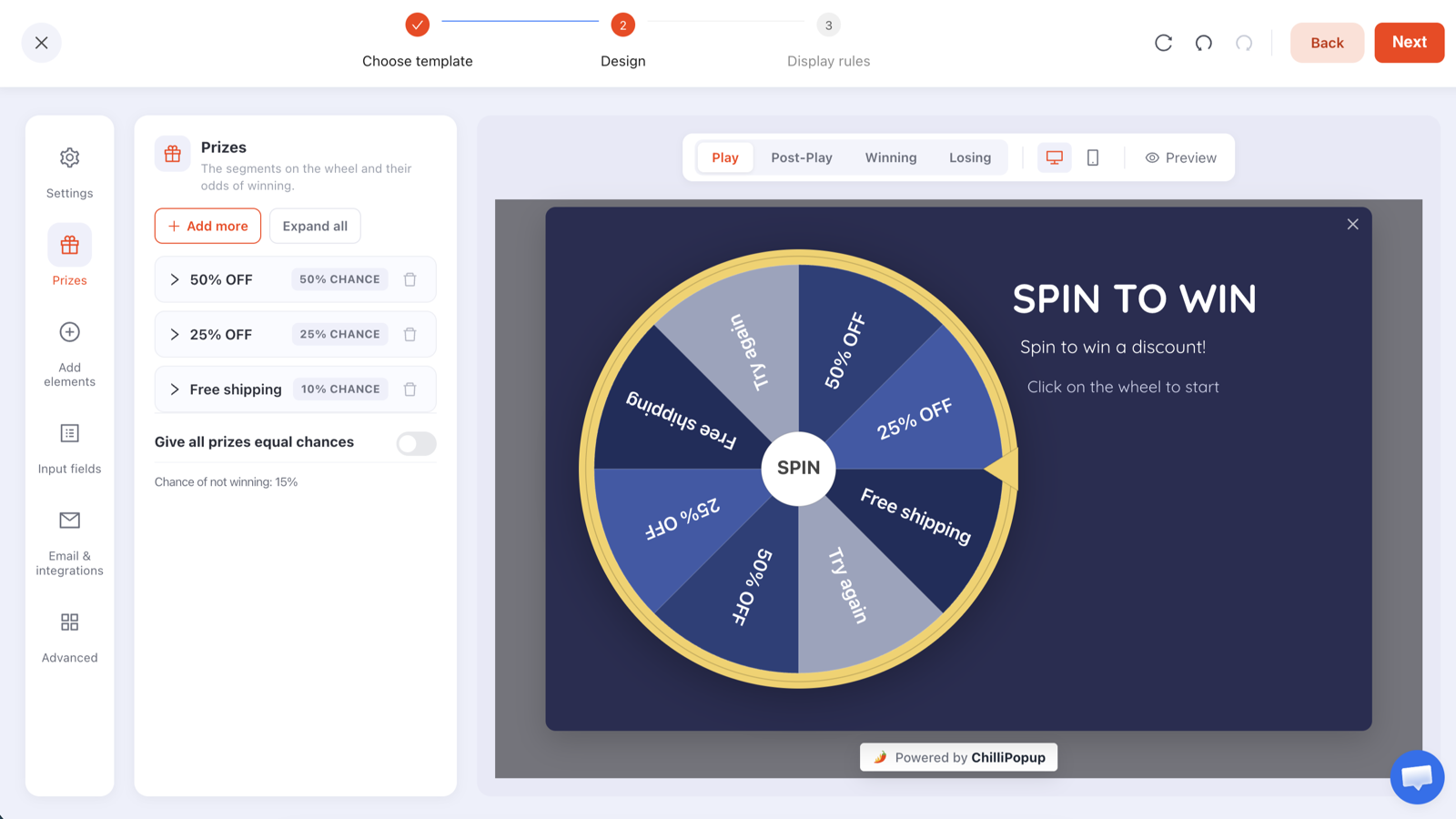
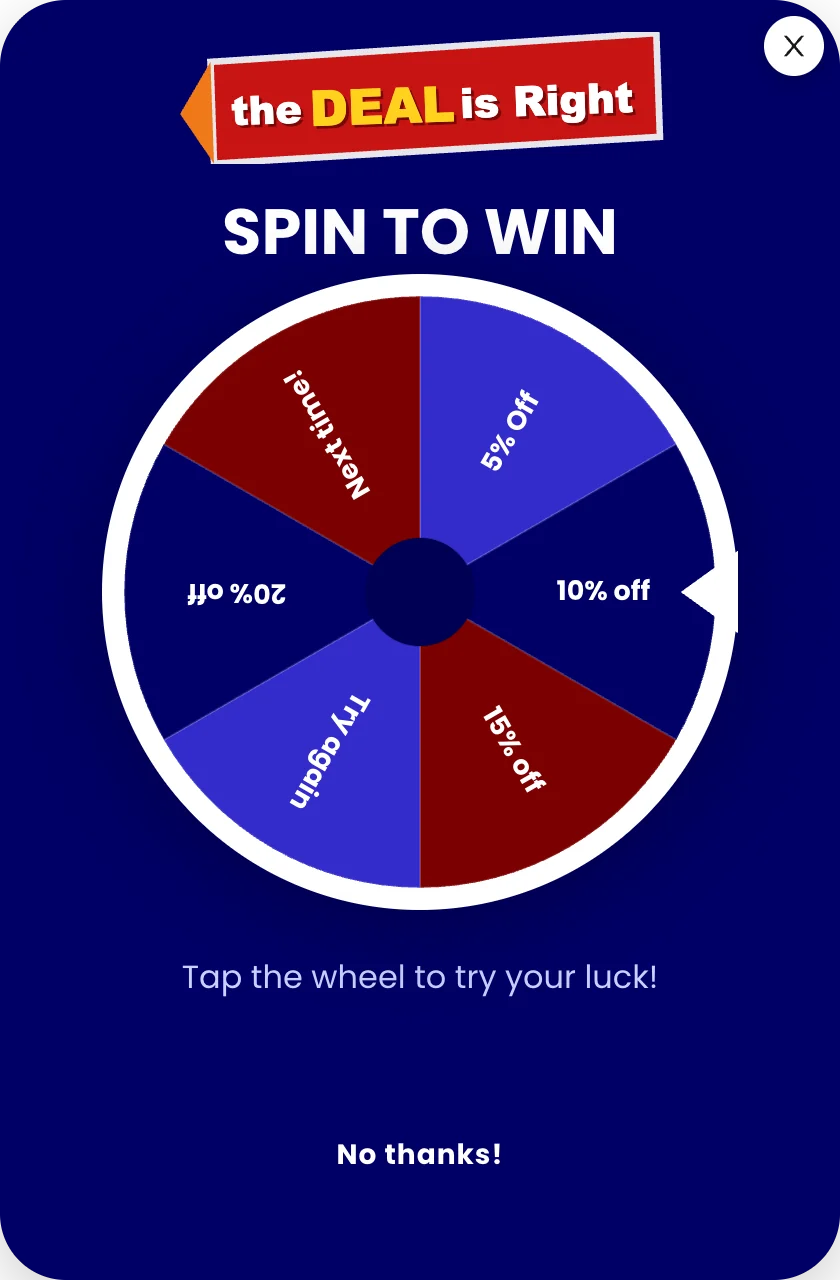
The best spin wheel prizes are a three-tier mix: one headline prize worth telling a friend about, three or four mid-tier prizes that are genuinely usable on a normal order, and one or two small consolation prizes. What kills a wheel is not the odds — it is a slice nobody wants to land on.
Everything below assumes you have already decided a prize game is right for your site. If you have not, the spin-to-win guide covers when a wheel beats a plain signup form. This post is about the part everyone gets wrong afterwards: what actually goes on the slices, and what the numbers next to them should be.
Key Takeaways
- Every slice must be worth landing on. One dud slice makes the whole wheel feel like a trick.
- The odds are a business decision. Each prize carries a percentage; whatever is left out of 100 is the chance of not winning.
- One losing slice at most — and only when the top prize is genuinely valuable.
- The email belongs on the claim screen, after the win. Never as a gate before the spin.
- Non-discount prizes often beat discounts: free shipping, early access, a sample, a draw entry. They cost less and read as more generous.
How a prize list actually works
Before choosing prizes it helps to know exactly what a prize is in the editor, because the constraints shape the creative work.

Four fields per prize, and one switch. That is the whole model — everything else is copywriting.
Each prize on the wheel carries:
- A label — the text printed on the slice, and the text substituted into your win message. Short wins: "20% OFF" beats "20% off your next order" on a slice, because the slice is small and rotating.
- A code — the reward the winner receives. This is never sent to the browser with the rest of the design; the player only receives it from the server when someone genuinely wins, which is what stops people reading the codes out of the page source.
- A chance, in percent — the probability weight for that prize.
- A colour, optional — otherwise slices alternate through the wheel's palette.
- A losing flag — a slice the visitor can land on that is treated as a loss. It keeps its label, colour and weight, but carries no code and shows the losing screen.
The odds rule that surprises everyone. The chances do not have to add up to 100. Whatever is left over is the chance of not winning — and a grey "no win" slice appears on the wheel only when that leftover is above zero. Set six prizes to 15% each and 10% of spins lose. Set them to add up to exactly 100 and nobody ever loses, with no extra slice drawn.
There is also an equal chances switch that ignores the per-prize percentages and gives every slice the same odds. It is the right default while you are testing the design, and the wrong one the moment your top prize is expensive.
Forty spin wheel prize ideas
Grouped by what kind of business you run. Take three or four from your row, add one headline prize and one consolation, and you have a wheel.
Ecommerce and retail
- 10% / 15% / 20% off the first order
- A fixed amount off over a threshold — £10 off orders over £60
- Free shipping on this order
- Free shipping for a month
- A free sample or sachet with the next order
- A free gift with purchase from a named list
- Buy one, get the second half price
- Double loyalty points on this order
- Early access to the next drop, 24 hours before everyone else
- Free gift wrapping or a handwritten note
- Free returns on the first order
- A bundle upgrade — the larger size at the smaller size's price
Fashion, beauty and lifestyle
- A free travel size with any order
- A personal styling or shade-match consultation
- An extended returns window
- A monthly draw entry for a full-size product
- Free monogramming or personalisation
- First look at the sale, one day early
Food, drink and hospitality
- A free side, dessert or coffee with the next order
- A pastry with any takeaway before 11am
- A free delivery slot
- A tasting flight or upgrade on the next booking
- A discount that only applies midweek — cheap for you, real for them
- A place on the next tasting event's guest list
Services, agencies and local business
- A free 20-minute consultation
- A free audit or quote with a named deliverable
- A waived setup or booking fee
- A priority appointment slot this week
- An extra month on the first contract
- A downloadable checklist or template pack
SaaS and digital products
- An extended trial — 30 days instead of 14
- The first month at a fixed low price
- A free onboarding or migration session
- A seat added to the plan for free for three months
- A premium template, preset or course module
- A one-to-one walkthrough with a specialist
Consolation prizes worth having
- 5% off — small, real, and it still converts a first order
- A free digital download: a guide, a recipe card, a wallpaper pack
- An entry into this month's draw
- Early access to the next sale
The one prize never to put on a wheel: anything you cannot honour instantly and automatically. "A chance to win a holiday, drawn in March" turns a two-second game into a promotion with terms, a legal footing and an administrative tail. If the reward is not a code your store can validate today, it does not belong on a slice.
Building the mix: a worked wheel
A homewares store with a £70 average order and roughly 55% gross margin. Here is a six-slice wheel and the reasoning behind each number.
| Slice label | Tier | Chance | Why |
|---|---|---|---|
| 25% OFF | Headline | 5% | Big enough to be the reason someone spins. Rare enough to survive the margin. |
| FREE SHIPPING | Mid | 25% | Costs less than a percentage discount and removes the most common objection. |
| 15% OFF | Mid | 20% | The workhorse. Usable on any order, comfortably inside margin. |
| FREE CANDLE | Mid | 15% | A gift with purchase feels larger than its cost and moves slow stock. |
| 10% OFF | Small | 25% | The consolation that still converts. Nobody is disappointed by it. |
| SO CLOSE | Losing | 10% | One losing slice makes the rest mean something. Styled to match, not greyed out. |
Those chances add up to 100, so no extra "no win" slice is drawn — the only way to lose is to land on SO CLOSE, which is a slice you designed and wrote yourself. That is the arrangement to aim for: if you want a losing outcome, make it a real slice with real copy rather than leaving a gap for an automatic one.

Whatever is missing from 100 becomes the chance of not winning — and draws its own slice.
The number that decides your top prize
Multiply your best prize's cost by its chance and compare it to the margin on an average order. At 5% odds, a 25% discount on a £70 order costs you about 88p per spin in expectation. A 10% discount at 25% odds costs £1.75. The expensive prize is often the cheap one, because rarity is doing the work.
Set expiry dates on every code. A wheel that hands out codes with no expiry creates a permanent discount your customers will learn to farm. Two weeks is generous.
Prizes that cost you almost nothing
If your margins cannot support discounts — handmade goods, food, low-markup resale — the wheel still works. You just change what is on it.
| Prize | Real cost to you | Perceived value |
|---|---|---|
| Early access to a launch | Nothing | High — scarcity is the product |
| A digital download or guide | Nothing after you make it once | Moderate, higher if it is genuinely good |
| Free personalisation | A few minutes | High — it is not available elsewhere |
| A draw entry | One prize per month, total | Moderate — and it gives you a reason to email |
| A free consultation | Your time, on a slot you choose | Very high for services |
| Free shipping over a threshold | Partly offset by the larger basket | High — it removes the main objection |
Notice how many of those are worth more to the customer than a small percentage off, while costing you less. "5% off" is the least imaginative slice on most wheels and usually the one people are least pleased to land on.
Should you include a losing slice?
Three defensible positions, depending on the wheel:
- No losing slice. Every outcome is a small win. The wheel becomes a delightful way to hand over a code rather than a gamble. Best when your prizes are modest and similar — and it removes any argument about fairness.
- One losing slice, well written. Best when the top prize is genuinely valuable. Losing is what makes winning feel like winning. Style it like every other slice, give it a warm line — "So close! Here's 5% anyway." — and keep it under about 15%.
- Two or more losing slices. Almost never right on a marketing wheel. The game starts to feel like a slot machine that takes your email and gives nothing back, and the dismissal rate tells you so within a week.
A kinder pattern: make the "losing" screen still give something small. The visitor did not win the headline prize, but they get the 5% code and your welcome email. You keep the drama of the spin and lose none of the goodwill.
The five screens, and what to write on each
A prize game is not one screen. Each of these has a job, and a wheel that underperforms is usually losing people on the second or third.
| Screen | Its job | Sample line |
|---|---|---|
| Teaser (optional) | Earn the interruption before the game loads | "Feeling lucky? One spin, one prize." |
| Play | Make it obvious what to do | "Spin to win — every slice is a prize." |
| Claim | Collect the email, after the win | "You won! Where should we send your code?" |
| Win | Reveal the code and tell them what to do next | "Here's your code. It expires in 14 days." |
| Lose | Keep the goodwill, give something | "So close. Here's 5% for turning up anyway." |
Two mechanical rules that matter more than the copy. First, the email field belongs on the claim screen — after a winning spin, not before it. Second, on the play screen the wheel itself is what starts the game; do not put a submit button next to it, because a visitor who presses the wrong one has an experience that feels broken.
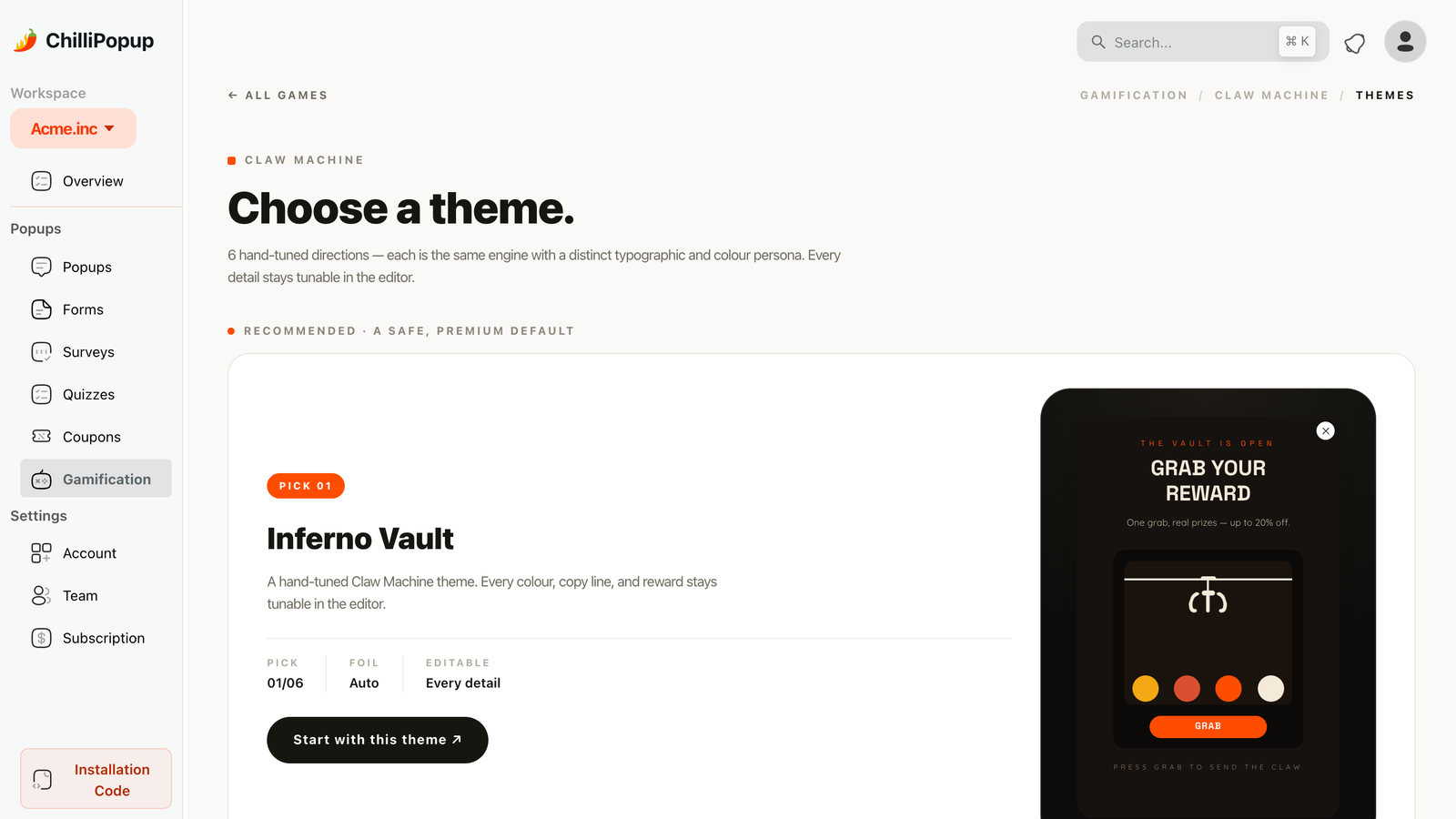
Start from a theme, then replace the placeholder prizes with your own — the theme decides the look, you decide the economics.
Try the four games live
Each card is a game's starter theme, exactly as it ships in the editor. Press Try it live and the real game opens over this page: played in your browser, decided on our servers, the same way it runs on your site.
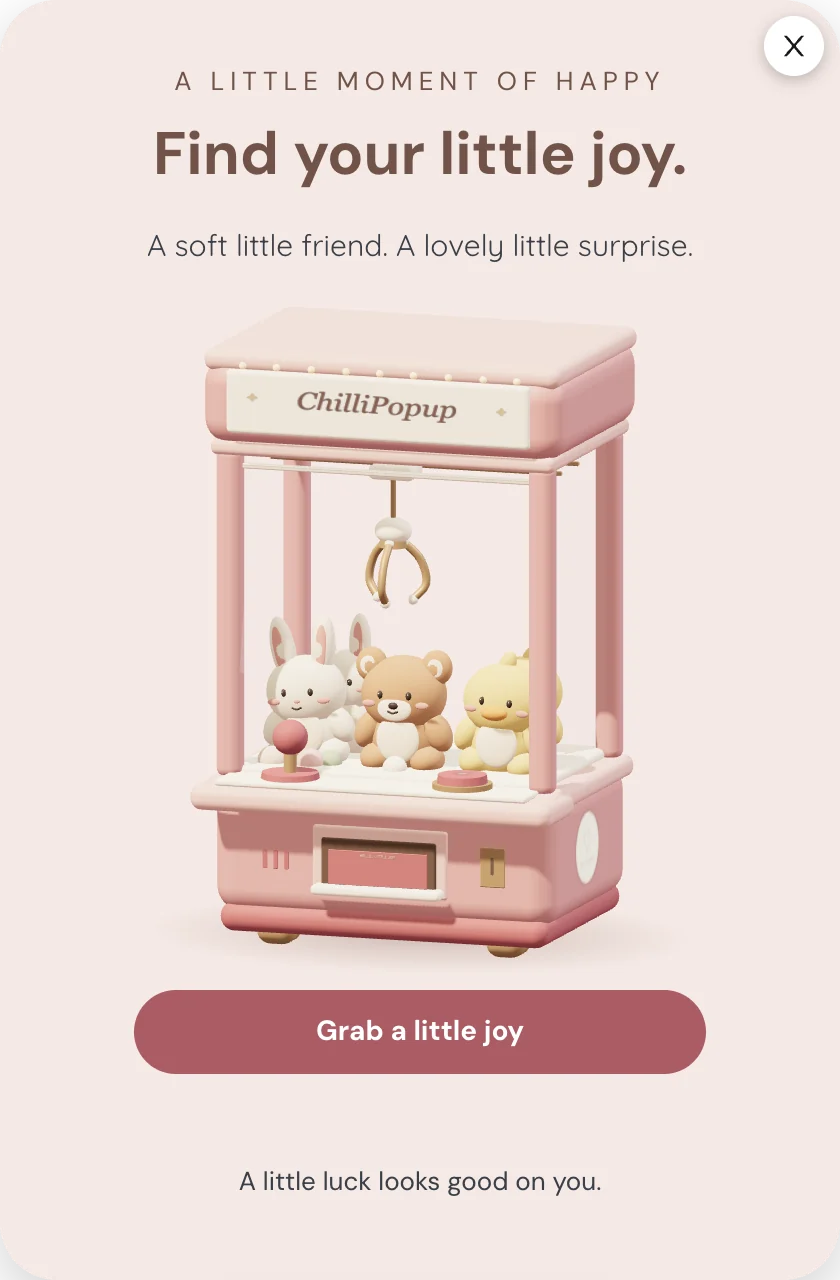
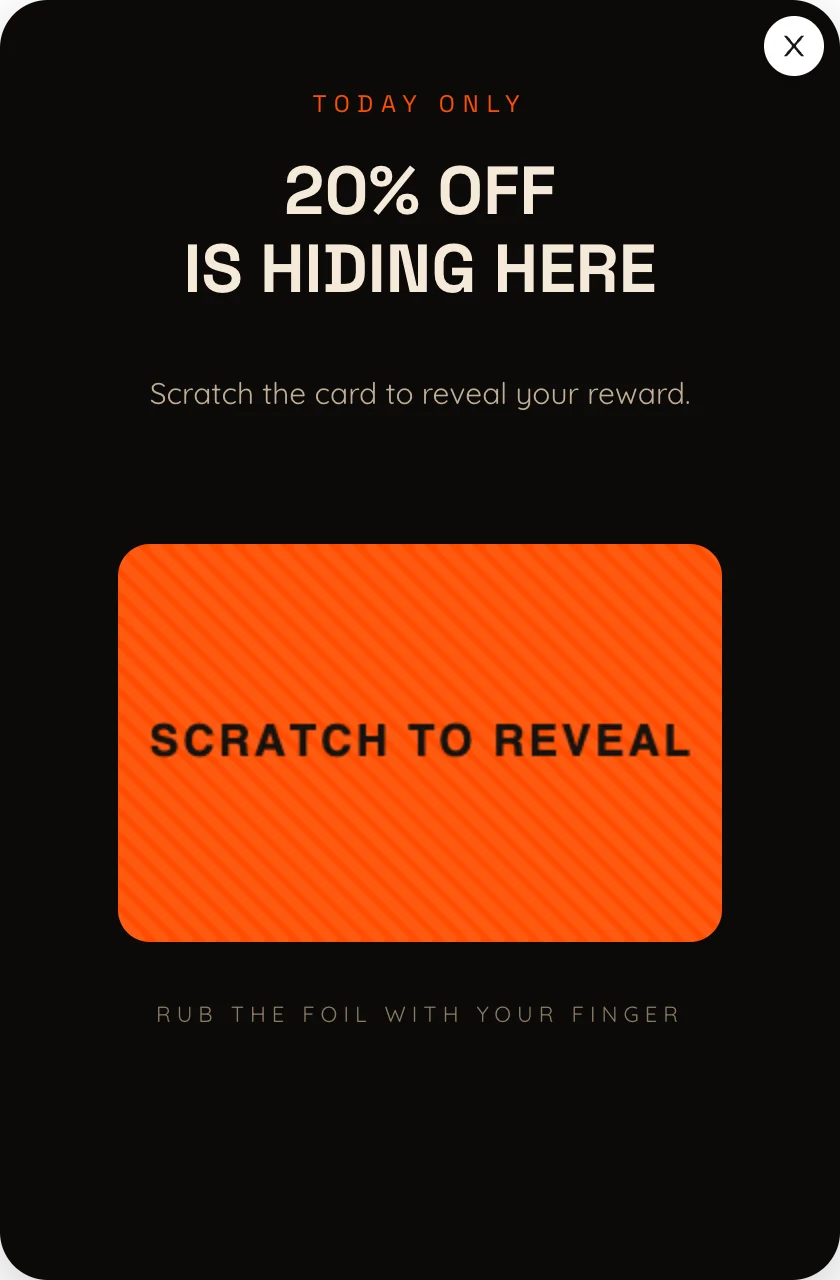
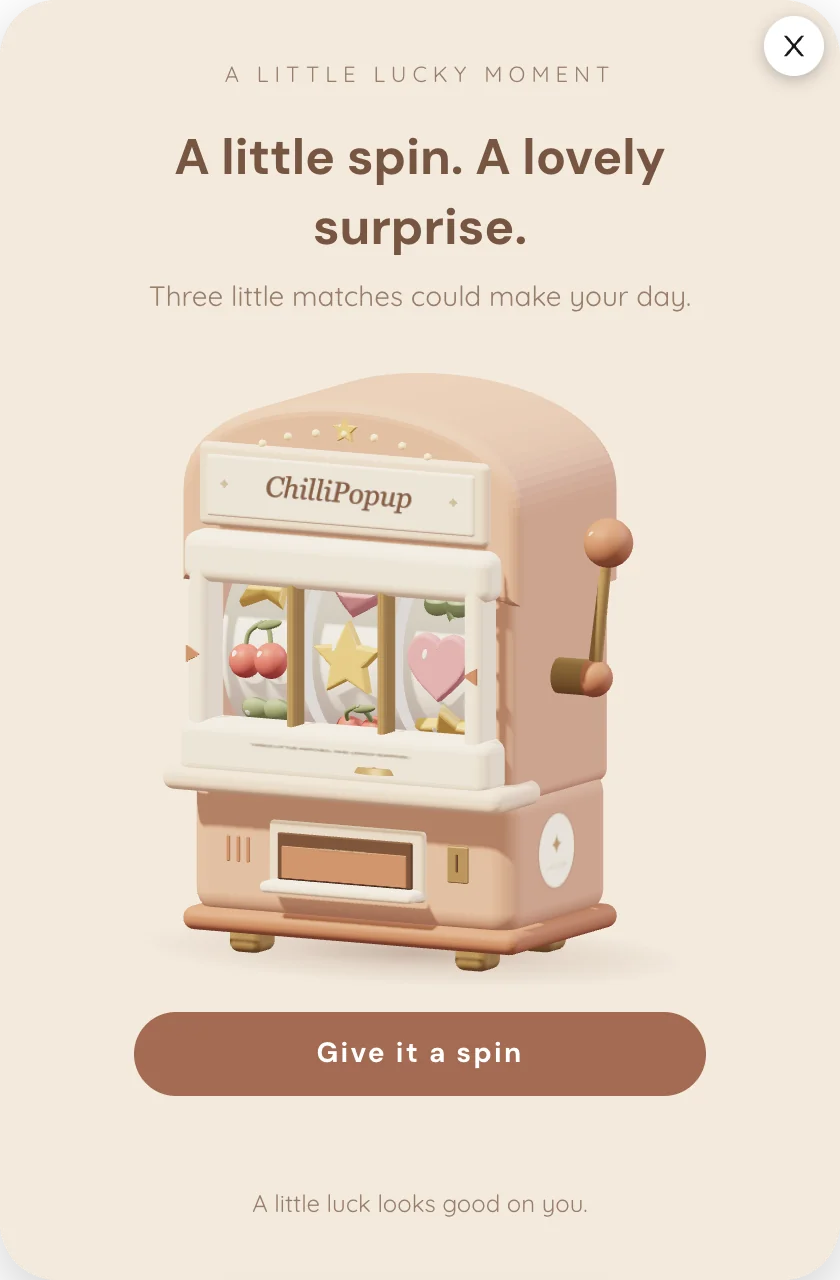
The prizes you can win here are demo codes. On your site you set the prizes, the odds and every screen.
Build a wheel your margins can survive
Spin wheels, scratch cards, slot machines and claw machines — with server-decided outcomes and per-prize odds. Free plan, no credit card required. Paid plans from $29/month.
Start free →Seven mistakes that flatten a spin wheel
- A slice nobody wants. "Try again", "Nothing", "Better luck" repeated three times. One losing slice, written kindly, is the limit.
- Asking for the email before the spin. It converts the game back into a form and throws away the reason you built it.
- Prizes that all look the same. 5%, 10%, 10%, 15%, 10%, 5% is not a game. It is a rounding error with a wheel around it.
- A headline prize you would resent honouring. If 40% off would hurt, do not put it on the wheel at 1% and hope. Someone will win it today.
- No expiry on the codes. You have created a permanent discount.
- Running it permanently. A wheel is a moment — a launch, a sale weekend, a seasonal push. Run it all year and it becomes furniture.
- Never checking which slice actually wins. The wheel reports its outcomes. If one prize is landing far more than intended, your percentages are not what you think.
Fairness, and why it matters commercially
Two things keep a promotional wheel honest. The first is technical: the winning slice should be decided on the server, not in the visitor's browser, and prize codes should not exist in the page until someone wins. Anything else can be read or rigged by a curious visitor with developer tools open — and on a discount wheel, that is a real revenue leak.
The second is editorial. The odds you set are the odds people get, so do not advertise a prize you have weighted to almost never appear. Beyond the ethics, promotional games are regulated in many countries; anything resembling a prize draw with a genuine cash-value prize deserves a line of terms and a quick check of local rules. A wheel that hands out discount codes on the spot avoids nearly all of that complexity, which is another argument for keeping the prizes instant.
What to measure
A wheel has more steps than a popup, so read it as a funnel rather than a single conversion rate.
- Views → spins. If people see the wheel and do not spin it, the problem is the teaser or the play screen, not the prizes.
- Spins → claims. A drop here means the claim screen is asking too much. One email field, nothing else.
- Prize distribution. Check which slices are actually landing. It is the fastest way to catch a percentage you fat-fingered.
- Code redemption in your store. The only number that proves the wheel made money rather than a list.
Compare the wheel against a plain signup popup on the same traffic before you conclude anything. Games usually win on attention and lose on setup time — see gamified popup ideas for the other three game types and where each fits.
Related reading
Frequently asked questions
What prizes should I put on a spin-to-win wheel?
A mix of three tiers: one headline prize worth talking about, three or four mid-tier prizes that are genuinely usable on a normal order, and one or two small consolation prizes. Every slice has to be something a visitor would be pleased to land on — a slice nobody wants is worse than one slice fewer.
What are good odds for a spin wheel?
Set them from the economics, not from a rule of thumb. Give each prize a percentage, and remember that whatever is left over out of 100 becomes the chance of not winning. If the percentages add up to 100 there is no losing outcome at all; if they add up to 70, three in ten spins lose.
Should a spin wheel have a losing slice?
Usually just one, and only if the top prize is genuinely valuable. Losing makes winning mean something, but two or three losing slices on a discount wheel just makes the game feel rigged. If every slice is a small win, run it with no losing outcome and treat the wheel as a fun way to hand over a code.
Can visitors cheat a spin wheel?
Not in a well-built one. The outcome should be decided on the server, not in the browser, and the prize codes should never be sent to the page until someone actually wins. That is how ChilliPopup works — the winning slice comes back from the server on each spin.
Where should the email field go on a spin wheel?
On the claim screen, after a winning spin. Asking for an address before the visitor has played is the surest way to lose the very people the game was meant to attract; asking after they have won is a formality they will happily complete.
What prizes work when I cannot afford discounts?
Free shipping thresholds, early access to a launch, a sample or add-on with the next order, a free consultation or audit, entry into a monthly draw, loyalty points, a digital download, or a personalisation you would otherwise charge for. Several of those cost almost nothing and read as more generous than 5% off.