A social proof popup puts evidence that other people already said yes right next to the moment you're asking someone else to. A review quote above the email field, a star rating under the headline, a subscriber count beside the button — small additions that answer the doubt the offer itself can't: is this any good, and am I the only one?
This guide covers the six kinds of proof worth using, where each goes inside a popup, the copy to write, and — importantly — how to do it without inventing numbers, which is both dishonest and, in most markets, unlawful.
Key Takeaways
- Proof supports the offer; it never replaces it. Five stars on a bad deal is still a bad deal.
- Specific beats impressive. “4,182 verified reviews” outperforms “loved by thousands”.
- Nearest-neighbour proof wins — a review of this product beats a generic brand testimonial.
- Never fabricate. Invented purchase notifications and made-up counts are misleading commercial practice, not growth hacking.
- One piece of proof per popup. Two competes with the offer; three looks like insecurity.
Why social proof works in a popup
A popup interrupts a stranger and asks for something — an email address, a click, a purchase. The visitor's instinctive question isn't “is 10% a good discount?” It's “who are these people?”
Social proof answers that in a fraction of a second, because we use other people's behaviour as a shortcut when we lack information. It's the same instinct behind picking the busy restaurant. In a popup, that shortcut is unusually valuable because the visitor has so little else to go on: no page to read, no navigation to explore, just a small box asking for something.
It's one of several behavioural levers you can pull inside a popup — reciprocity, loss aversion and anchoring are the others, and they're covered in popup psychology principles.
Proof is a multiplier, not an offer. If the offer is weak, adding testimonials makes a weak offer with testimonials. Fix the offer first — see improving popup conversion rate for the order to work in.
Six types of social proof you can put in a popup
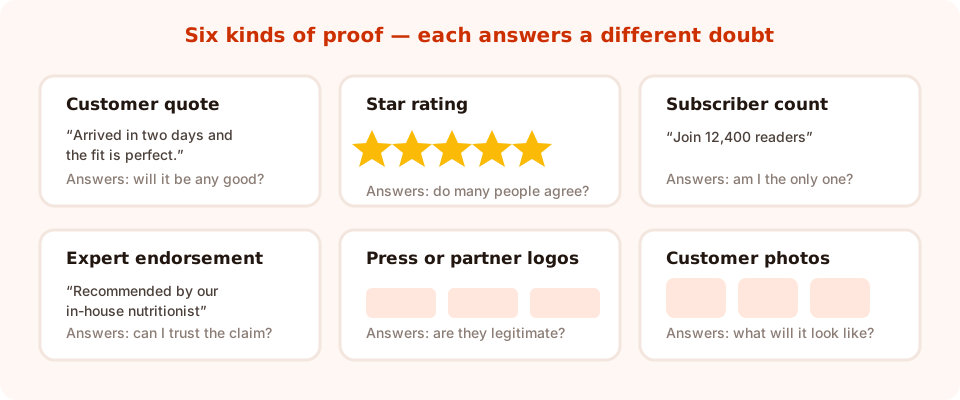
Pick the one that answers the doubt this particular popup creates.
1. The customer quote
One sentence, a first name, and a marker of legitimacy (“verified buyer”, a city, a job title). Short beats eloquent — nobody reads a paragraph inside a popup.
“Turned up in two days and the fit was exactly right.” — Marta, verified buyer
2. The star rating
A rating plus the number it's based on. The count is what makes it credible: 4.8 from 3,000 reviews is a different claim from 4.8 from six.
★★★★★ 4.8 out of 5 — 3,104 reviews
3. The subscriber or customer count
The classic newsletter proof. Use the real number, and use it precisely — specificity is what makes it read as a fact rather than a boast.
Join 12,400 readers who get the Friday edit
4. The expert or staff endorsement
Authority proof, useful when the purchase carries risk: a specialist, a certification, a qualified person on your team. Only claim credentials you can evidence.
Chosen by our in-house nutritionist
5. Press, partner or platform logos
Borrowed credibility. Powerful in B2B and for young consumer brands — and only usable where you genuinely have the coverage or partnership and the right to display the mark.
6. Customer photos
Real product, real light, real people. For anything worn or displayed, one customer photo does more than three testimonials, because it answers a question a quote can't: what will it actually look like? Get permission before you republish someone's photo.
Where the proof goes inside the popup
A popup is a layout of blocks — text, images, shapes, icons, inputs and buttons, each positioned on the canvas. Social proof is built from those same blocks, which means placement is a design decision rather than a feature you switch on.
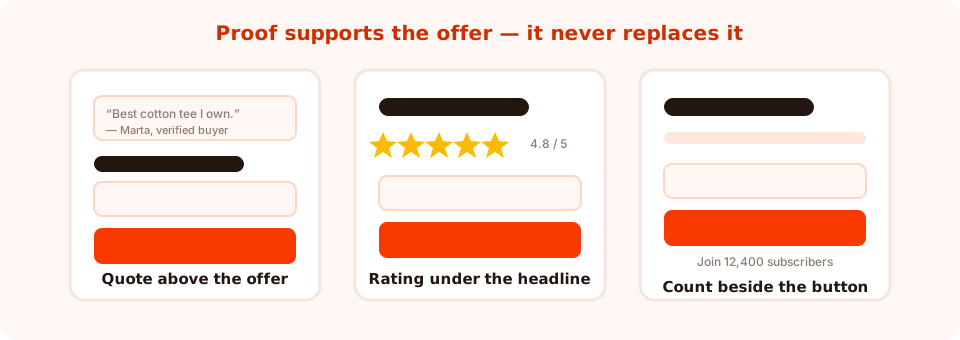
Three placements that don't fight the offer for attention.
| Placement | Proof type that fits | Why it works there |
|---|---|---|
| Above the headline | Star rating, press logos | Establishes credibility before the ask lands |
| Directly under the headline | Rating with review count | Supports the claim the headline just made |
| Beside or under the button | Subscriber count, “no spam” line | Removes the last objection at the decision point |
| As the popup's image side | Customer photo | Shows the product in real use without stealing copy space |
| On the thank-you screen | Quote, community count | Confirms they made a good decision, right after they made it |
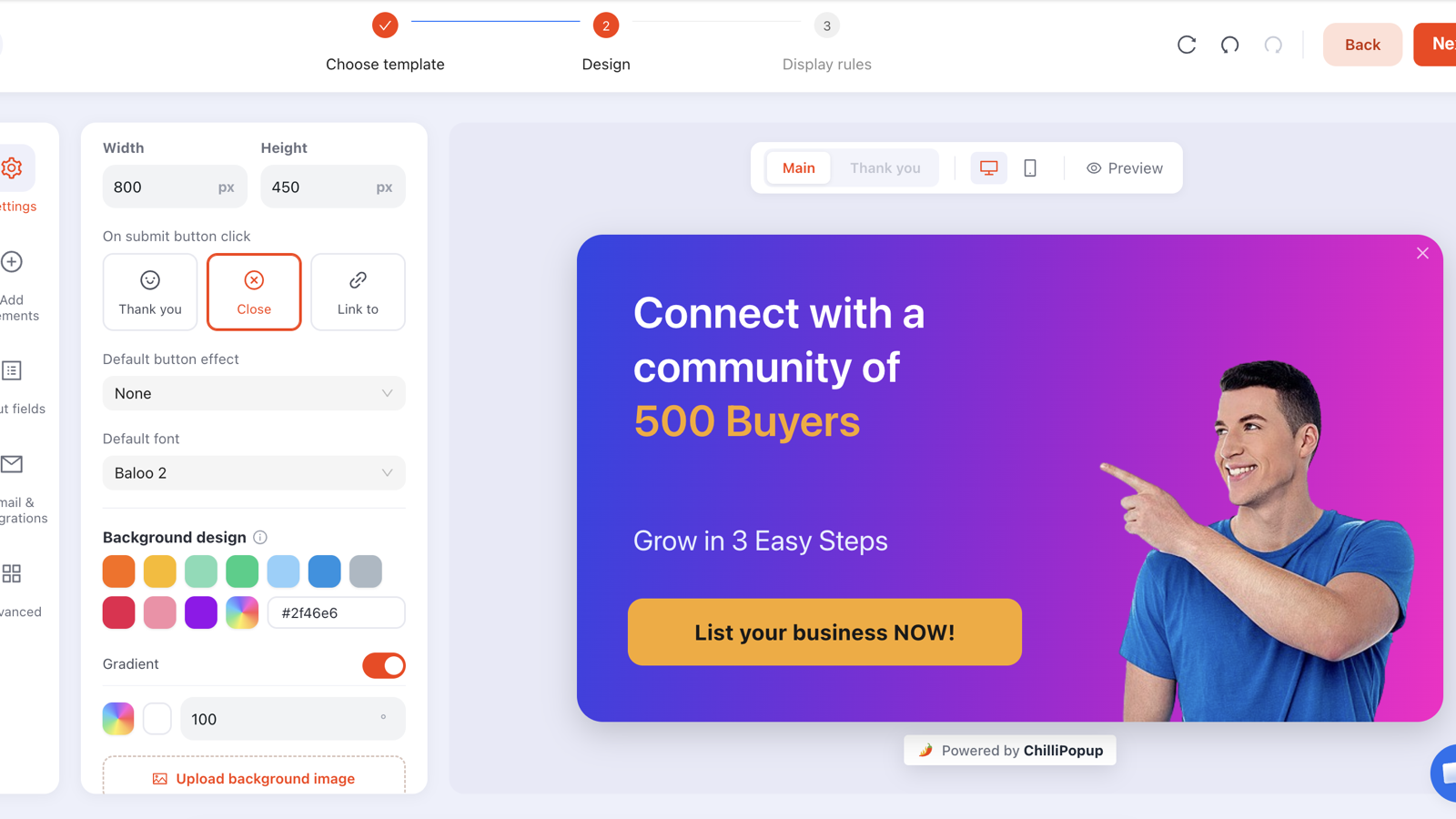
Quote, stars and count are ordinary text, icon and image blocks — positioned wherever the layout needs them.
The honesty rule — read this before you build anything
There is a category of “social proof” widget that shows a stream of notifications like “Someone in Manchester just bought this”. When those events are real, they're proof. When they're generated from a list of plausible names and cities, they are fabricated claims about your business.
That distinction isn't only ethical. In the EU and UK, presenting false information about a product's popularity or about consumer reviews is a misleading commercial practice, and consumer-protection rules specifically target fake or unverified reviews. In the US, the FTC has rules addressing fake reviews and testimonials. Invented purchase notifications sit squarely in that territory.
Be clear about what ChilliPopup does and doesn't do. It gives you the blocks to display proof you already have — a quote, a rating, a count, a photo, a logo. It does not generate live “someone just bought” feeds, and it does not invent numbers. If you want a rolling purchase feed, it has to be wired to your real order data. Everything in this guide is proof you can evidence.
Three practical rules that keep you on the right side of it:
- Every number is countable. If someone asked you to show the query behind “12,400 subscribers”, you could.
- Every quote is attributable. A real person said it, and you can point to where.
- Set a refresh reminder. A count that was true two years ago is now a false claim. Diarise a quarterly update — it takes five minutes.
Copy that makes proof land
The difference between proof that works and proof that gets skipped is almost always specificity.
| Vague | Specific | Why the second one lands |
|---|---|---|
| Loved by thousands | 4,182 verified reviews | A number you could be asked to prove |
| Our customers love us | “Third order this year.” — Sam, Leeds | A real person, a real detail |
| Join our community | Join 12,400 readers | Tells them how big the room is |
| Trusted worldwide | Shipping to 34 countries | A countable fact instead of an adjective |
| Highly rated | 4.8 / 5 from 3,104 reviews | The denominator is the credibility |
Two more craft notes. Pick the nearest neighbour: a review of the exact product on the page beats a general brand testimonial, because the visitor's doubt is about this item. And don't round up — 12,400 reads as a count; “over 12,000” reads as marketing.
Four worked social proof popup examples
Apparel store — review quote on the exit popup
Exit intent on product pages. Above the offer, one line: “Best cotton tee I own — I've bought four.” — Marta, verified buyer. Then the headline “10% off your first order”, one email field, button Send me the code. The quote does the trust work; the discount does the persuading.
Newsletter — subscriber count beside the button
Corner slide-in at 60% scroll on articles. Headline “One email, Friday, five minutes”, button Join the Friday list, and directly under it: Join 12,400 readers. Unsubscribe any time. Proof and objection-handling in a single line.
B2B software — logos on the demo popup
Time delay on the pricing page. Three genuine customer logos across the top, headline “See it working on your data”, business-email validation switched on so the list stays a business list, button Book my walkthrough.
Local service — rating on the booking popup
Scroll trigger on the services page. ★★★★★ 4.9 from 212 local reviews under the headline, one phone field, button Call me back. For a local business the review count is the offer — there's a related walkthrough in the restaurant popup guide.
Collect your own proof with a popup
Most sites don't have a proof problem — they have a collection problem. The same tool that displays proof can gather it:
- A post-purchase survey. A one-question survey on the order-confirmation page — “How was it?” with a rating scale and one optional comment box. The comments become your quote bank; there's a fuller version in the customer feedback survey guide.
- An NPS question. Promoters are the people to ask for a public review — see the NPS survey guide.
- A review request popup. Target returning customers on the account page with a link to wherever you collect reviews.
One rule: always ask permission before you republish a name or photo, and keep a record of the consent. A survey answer isn't automatically a public testimonial.
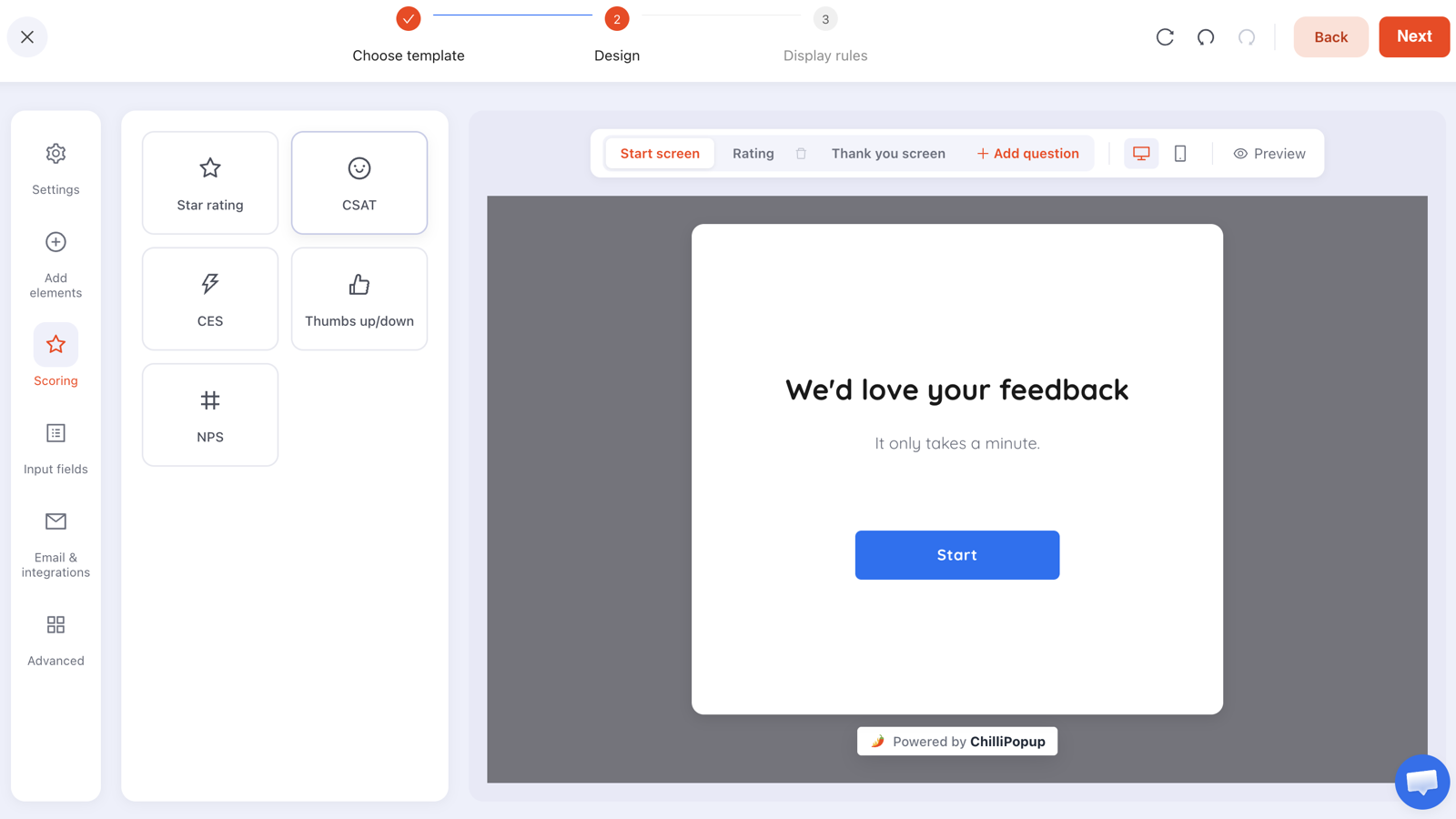
The quote bank starts here: one rating question and one optional comment, on the confirmation page.
What to measure
Adding proof is a change like any other, so treat it like one. Build the popup twice — identical except for the proof element — run both at once, and compare:
- Conversion rate — submissions divided by views, the headline number.
- Clicks — whether the proof got people as far as engaging at all.
- Field inputs versus submissions — proof shouldn't change this gap; if it does, the popup probably got taller and the button drifted below the fold on mobile.
The A/B testing guide covers running the two versions properly instead of comparing last week to this week.
Six ways social proof backfires
- Fabricated activity. Invented purchase notifications and made-up counts are misleading practice, and customers spot the pattern faster than you'd think.
- Small numbers displayed proudly. “Join 31 subscribers” is proof of the wrong thing. Below a few hundred, use a quote instead of a count.
- Stale counts. A figure from two years ago is no longer true. Diarise the refresh.
- Proof that outweighs the offer. Three testimonials, a rating and six logos leave no room for the reason someone should act.
- Generic testimonials. “Great service, highly recommend” reads as filler because it could be about anything.
- A taller popup on mobile. Proof adds height. Check the phone layout with the keyboard open — see mobile popup best practices.
Build a social proof popup in ChilliPopup
Twenty minutes, no code. If the script isn't on your site yet, the install guide takes one line.
1. Find the proof you can actually evidence
Pull your real review count and average rating, three short quotes with attribution, and your current subscriber number. If you have none of these, start with the collection survey in the section above and come back in a fortnight.
2. Pick the one piece that answers this popup's doubt
Product-page popup: a review of that product. Newsletter popup: the subscriber count. B2B demo popup: logos or a named customer. One piece, not three.
3. Add it as blocks, above or under the headline
A text block for the quote, star icons or an image for the rating, a small text block for the count. Keep the offer and the button visually dominant.
4. Check the mobile height
Proof adds vertical space. Preview the mobile layout and make sure the button is still visible without scrolling inside the popup.
5. Run it against the version without proof
Two variants, identical except for the proof element, live at the same time. Give each a few hundred views, then keep the winner and set a quarterly reminder to refresh the numbers.
Show the proof you already have
Build popups, forms, surveys, quizzes and games from one editor, and collect the reviews you display. Free plan, no credit card required. Paid plans from $29/month.
Start free →Related reading
Frequently asked questions
What is a social proof popup?
A social proof popup is a popup that shows evidence other people already chose you — a customer quote, a star rating with its review count, a subscriber number, an expert endorsement, press logos or customer photos — alongside the offer it is asking the visitor to accept.
Does social proof actually increase popup conversions?
It helps when the visitor's hesitation is about trust rather than about value, which is common on a popup because they have almost nothing else to judge you on. It cannot rescue a weak offer, so fix the offer first and treat proof as a multiplier on top.
Is it legal to show fake purchase notifications?
Presenting false information about a product's popularity or about consumer reviews is a misleading commercial practice under EU and UK consumer law, and the US FTC has rules covering fake reviews and testimonials. Only display activity, counts and quotes that are real and that you could evidence.
What social proof works best when you have very few customers?
A single specific quote from a real customer, or a concrete fact such as how long you have been trading or how many countries you ship to. Avoid counts until they are impressive on their own — 'join 31 subscribers' proves the opposite of what you intended.
Where should social proof go inside a popup?
Ratings and logos work above or immediately under the headline, where they establish credibility before the ask. Counts and reassurance lines work beside or under the button, at the decision point. Customer photos work as the popup's image side. Use one piece per popup.
How do I collect testimonials to use in popups?
Run a one-question survey on your order-confirmation page asking for a rating plus an optional comment, and use the comments as your quote bank. Ask permission before republishing anyone's name or photo, and keep a record of that consent.