The most common mistake in festive-season marketing is treating Diwali as a date. It is a five-day festival, each day with its own customs and its own buying motive, sitting inside a festive stretch that starts weeks earlier. One "Diwali Sale" popup running for a month flattens all of that into a percentage.
A better plan is a small set of campaigns, each scheduled to the day it belongs to and switched off by its own date window. That is more work to set up once and considerably less work to run.
Key Takeaways
- Five days, five motives. Dhanteras buying is not the same as Bhai Dooj gifting.
- Bundles beat percentages in gift-led seasons — they solve choosing, not price.
- Reassurance is a conversion lever: delivery dates and payment options, said out loud.
- Schedule in local time. Each campaign's date window takes a GMT offset — use your market's.
- The dates move every year. Confirm them before setting a single timer.
The five days, and what each one sells
The exact dates shift each year with the lunar calendar, usually falling in October or November — so confirm them before you build. The sequence, though, is stable, and it is what your campaign calendar should follow.
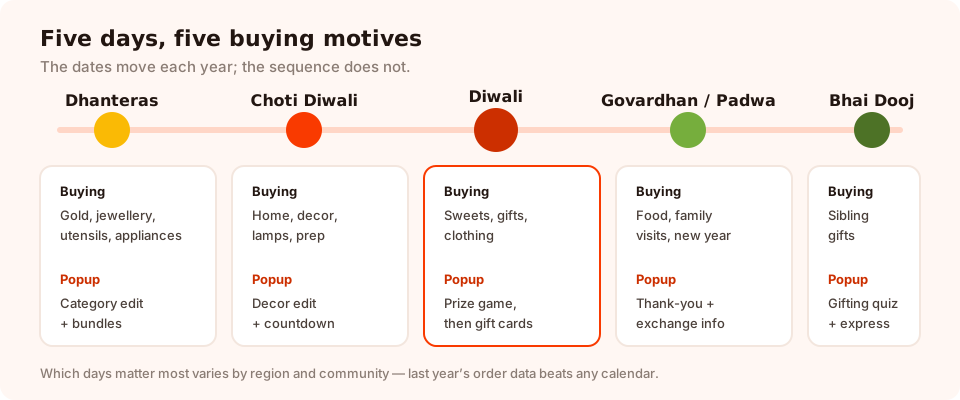
Five days, five motives. The sequence is stable even though the dates move each year.
| Day | What people are buying | The campaign |
|---|---|---|
| Day 1 — Dhanteras | Gold, silver, jewellery, new utensils and appliances — traditionally an auspicious day to buy | A category edit and a bundle popup on those collections |
| Day 2 — Choti Diwali | Home cleaning and decoration, lamps, last preparations | Home and decor edit, plus the delivery-deadline countdown |
| Day 3 — Diwali / Lakshmi Puja | Sweets, gifts, clothing, the main celebration | Prize game and the day-only offer; digital gift cards after cut-off |
| Day 4 — Govardhan Puja / Padwa | Family visits, food, in some regions a new-year start | Thank-you campaign and a returns or exchange reminder |
| Day 5 — Bhai Dooj | Sibling gifting — a genuine second gifting peak | A short gifting quiz aimed at siblings, with express delivery |
Regional variation is real. Which days are observed, and how, differs across regions and communities. If you sell nationally, treat the table as a superset and lean on the days your own customers actually buy on — your order history from last year is a better guide than any calendar.
Eight Diwali popup campaigns
1. The early-bird list (3–4 weeks out).
"Our festive edit opens on Friday. Want early access?" One email field, no discount, targeted at returning visitors on a scroll trigger. The cheapest campaign of the season and the one that makes every later campaign cheaper, because you now have somewhere to announce them.
2. The gifting quiz (2–3 weeks out).
Three tappable questions: who is it for (parents, partner, sibling, colleague), budget, category. Ends in one recommendation plus an email field. A quiz beats a discount here because the obstacle in gifting season is choosing, not price — and the answers tell you exactly which segments to build next year.
3. The Dhanteras edit (day 1).
Page-target your jewellery, homeware or appliance collections and link to the filtered view. "Auspicious-day picks, in one place." Scheduled to open and close on the correct local day, so it neither arrives early nor lingers.
4. Hampers and bundles (all season).
The highest-value campaign in a gift-led season. "Three ready-made hampers, wrapped and sent." Bundles remove the decision, raise basket size and protect margin far better than a percentage. If you run one discount all season, make it a bundle instead.
5. The festive prize game (day 3).
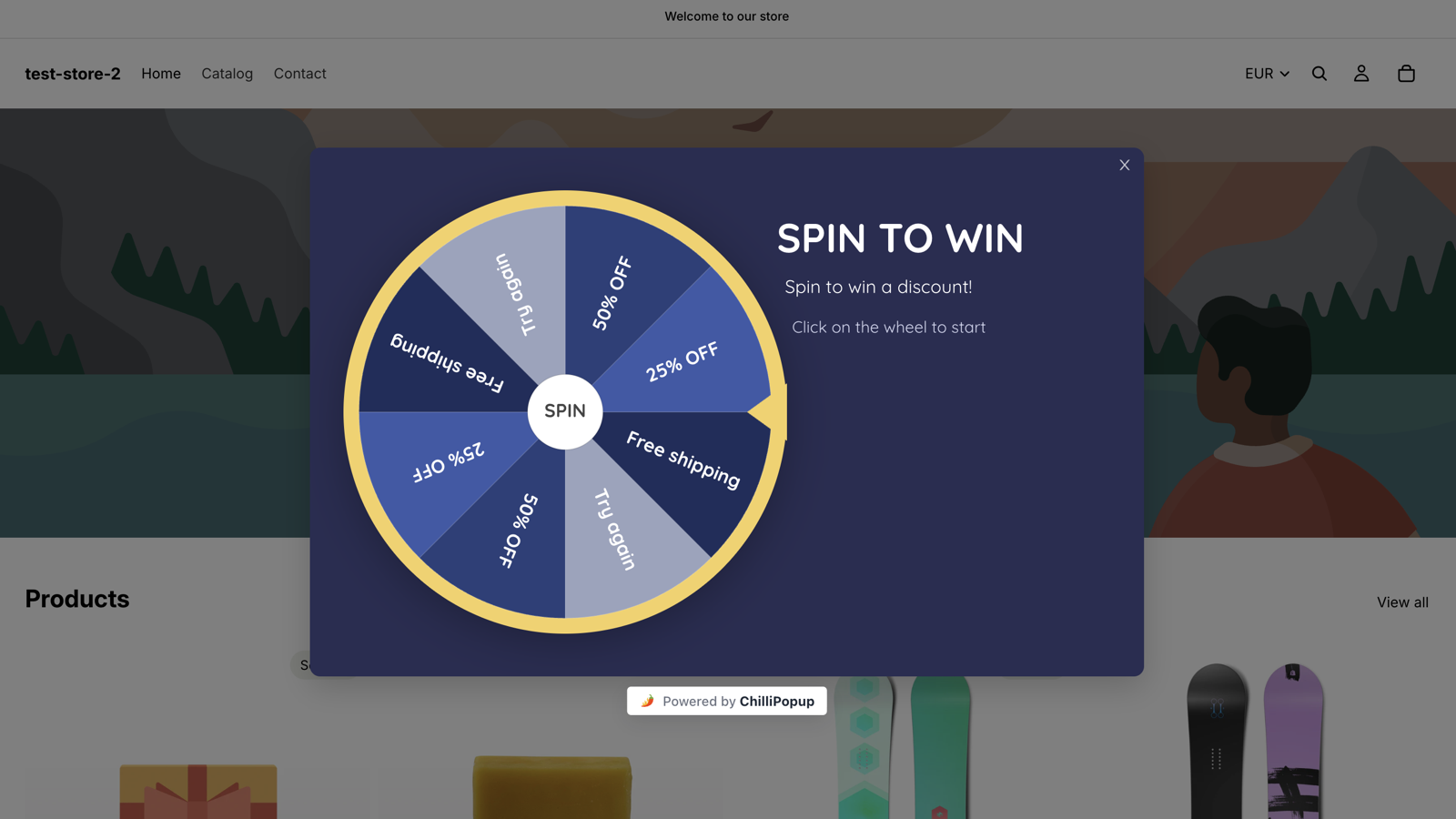
For traffic that has stopped reacting to static offers: a spin wheel or scratch card whose prizes are your own offers — free delivery, a bonus item, a modest discount. The visitor plays, the claim screen collects the email, and submitting it reveals the code. Odds are decided server-side, so nothing can be rigged from the browser.
6. Payment and delivery reassurance (final two weeks).
Underrated and almost free. "Pay your way — UPI, cards, wallets or cash on delivery. Free returns within 7 days." No field, no offer, triggered on inactivity on product pages. In a season where everything is a gift, "will it arrive and can I send it back" is the real objection.
7. The delivery-deadline countdown (final week).
"Order in the next 8h 40m for delivery before Diwali." A timer to the real cut-off, on collection and product pages, with the campaign's date window ending when the deadline passes. This is consistently the highest-converting popup of the season — and the fastest to lose trust if the deadline is invented.
8. Corporate and bulk gifting (whole season, separate audience).
A quiet campaign that many stores forget: a short form — company, quantity, budget, deadline — on your bulk or wholesale pages. One enquiry can be worth a week of retail orders, and the form takes ten minutes to build.
The order of operations. List first, quiz second, edits and bundles third, urgency last. Most stores start with urgency and then have nobody to send it to.
Scheduling: the part that makes this work
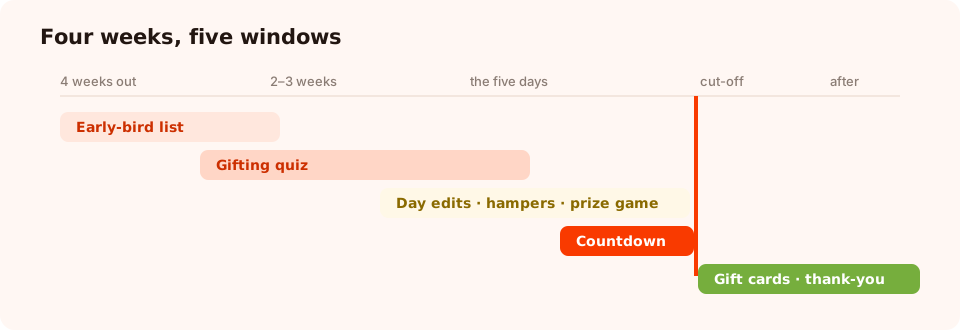
Nothing runs for the whole month, and every campaign carries the date it dies on.
- Date window per campaign. A start and end date with hours, expressed in a chosen GMT offset — set it to your main market so a day-specific edit follows the local day, not your server's.
- Page targeting. Day-specific edits belong on their own collections. Use contains, does not contain, is exactly, is not, starts with or ends with.
- Frequency. Once a day during the build-up, every session in the final 48 hours.
- Show again after conversion. Off on every email-capture campaign, so the people who joined the early list are not asked again on day three.
- Devices. Festive traffic in this market skews heavily to phones. Use scroll and delay triggers rather than exit intent, and check the close control with a thumb on a real device.
- Pause the standing offer. Your usual welcome discount should sleep while the festive campaigns run.
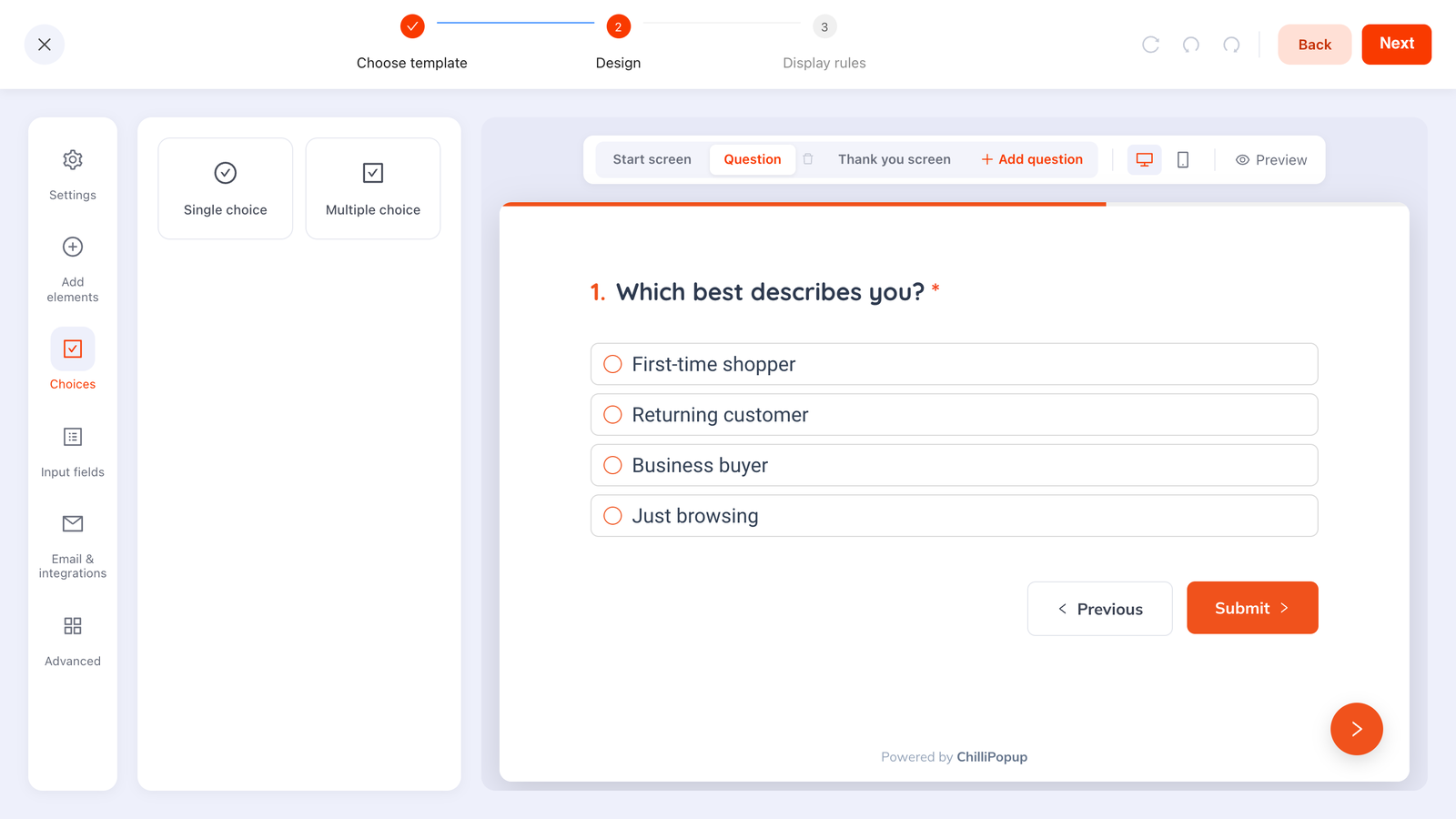
The gifting quiz: three questions, chips rather than text fields, one recommendation at the end.
Copy that respects the occasion
The rule is the same as for every seasonal campaign: say something specific. "Celebrate the festival of lights with 20% off" is a template. These are not.
EARLY BIRD
  Our festive edit opens Friday. Want early access?
  → Send it to me first

GIFTING QUIZ
  Not sure what to send? Three taps and we'll suggest something.
  → Find the gift

DHANTERAS
  Auspicious-day picks — jewellery and homeware, in one place.
  → See the edit

HAMPERS
  Three ready-made hampers, wrapped and sent for you.
  → Browse hampers

REASSURANCE
  UPI, cards, wallets or cash on delivery. Free returns within 7 days.
  → Keep shopping

DELIVERY COUNTDOWN
  Order in the next 8h 40m for delivery before Diwali.
  → Shop gifts

GIFT CARD RESCUE
  Past the delivery cut-off? Send a gift card instantly instead.
  → Send a gift card

BULK GIFTING
  Gifting for a team? Tell us the numbers and we'll come back today.
  → Get a quote
If you write in Hindi or another regional language, test it against the English version rather than assuming — and check the typeface actually renders the script before you launch. Families with wide script coverage such as Noto Sans, Poppins or Baloo 2 are safer starting points, and you can upload a specific font at workspace level if you need one.
Six mistakes in festive campaigns
- One "Diwali Sale" popup for the whole month. It ignores five different buying motives and becomes wallpaper by week two.
- A countdown to a deadline you cannot meet. The most expensive mistake in the season, because it costs you the order and the trust.
- No end date. A festive popup running in December is the clearest possible signal that nobody is minding the site.
- Skipping reassurance. Payment options and delivery dates convert; most stores never say them out loud.
- Festival imagery with nothing behind it. Decoration is not a campaign. Link to a real edit.
- Forgetting day four and five. Bhai Dooj is a second gifting peak, and almost nobody runs a campaign for it.
What to measure — and what to keep
Every campaign reports its own views, clicks, submissions and conversion rate, plus the values collected per field, so read the season campaign by campaign rather than as one number. Three comparisons are worth making:
- Quiz completions versus the flat offer's conversions. In gifting seasons the quiz usually wins, and if it does, that changes next year's plan.
- The countdown's rate against the week before it. This tells you what urgency was actually worth on your catalogue.
- Bundle popups against percentage popups. Compare basket size, not just conversion rate.
What you keep from the season is the quiz answers — who each shopper was buying for, at what budget, in which category. That is a segmented list for next year, collected while you were selling. The discount codes expire; the answers do not.
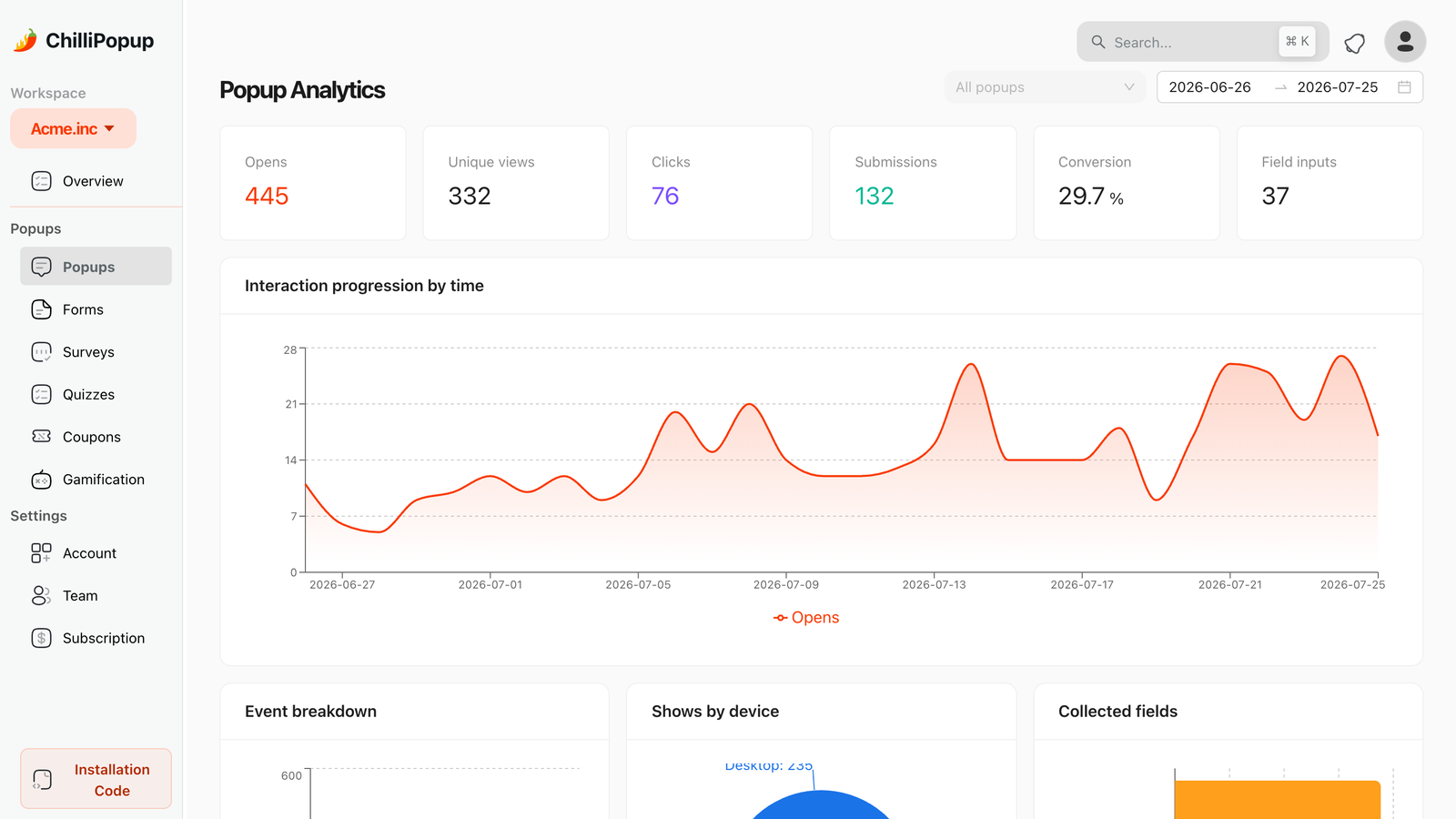
Per-campaign numbers, so the season can be read as a set of decisions rather than one blur.
Schedule the whole festival in one afternoon
Popups, quizzes, bars and prize games, each with its own date window and time zone. Free plan, no credit card required. Paid plans from $29/month.
Start free →Related reading
Frequently asked questions
When should Diwali popup campaigns start?
Three to four weeks before the main day for list building and the gifting quiz, one to two weeks out for the festive edits and bundles, and the final week for delivery-deadline urgency. The festival dates move each year, so confirm them before you set any schedule.
What are the best Diwali offers for an online store?
Bundles and hampers, category edits tied to the day (gold and appliances around Dhanteras, gifting and sweets before the main day, sibling gifts for Bhai Dooj), free or guaranteed delivery before the festival, and prize games for traffic that ignores flat discounts. Reassurance — will it arrive, can I pay how I want — converts as well as any percentage in this season.
How do I schedule a popup for a specific festival day?
Give each campaign its own date window: a start and end date with hours, expressed in the GMT offset of your main market. That way a Dhanteras edit opens and retires on the correct local day, and you are not relying on someone switching campaigns over manually at midnight.
Can I write popups in Hindi or another Indian language?
Yes, and it is worth testing against an English version. Check that the font you choose actually renders the script — families with wide coverage such as Noto Sans, Poppins or Baloo 2 are safer starting points — and if you need a specific typeface you can upload your own font at workspace level and use it across campaigns.
Should I run a discount or a bundle for Diwali?
Bundles usually win. Festive shopping is gift-led, so a hamper or a set removes the choosing problem and raises basket size, while a flat percentage mostly moves margin. Keep a small discount for the final 48 hours if you need urgency, and let the bundles carry the build-up.
What should a Diwali popup avoid?
Generic festival language with nothing behind it, imagery that treats the festival as decoration, countdowns to deadlines you cannot meet, and campaigns with no end date. Also avoid stacking a festive offer on top of your standing welcome discount — pause one while the other runs.