After someone signs up on your popup, send five emails over fourteen days: deliver the promised coupon or lead magnet immediately, then your brand story, then social proof, then objection handling, then a deadline nudge — in that order. That's the whole answer, and the rest of this guide writes it out for you: full sample copy for each email, how the sequence changes with the popup's offer, and the honest workflow for getting addresses from ChilliPopup into your email tool.
Because here's the uncomfortable truth about building an email list with popups: the popup is the easy half. A signup earns you nothing until the emails behind it turn a stranger with a discount code into a customer — and most stores either send one automated coupon email and go silent, or dump new subscribers straight into the weekly promo blast. The fourteen days in between is where the revenue actually is.
Key Takeaways
- Email 1 has one job: deliver exactly what the popup promised — the code, the download or the prize — as close to instantly as your setup allows.
- The blueprint is deliver → story → proof → objection → deadline: five emails across fourteen days, each with a single job and a single call to action.
- The sequence must match the popup: a coupon popup opens with the code, a spin-to-win with the prize won, a lead magnet with the download, a quiz with the results.
- ChilliPopup collects, your email tool sends. Submissions live in the dashboard; plan the handoff into your email tool or Email 1 arrives days late.
- Turn off "show again after conversion" so subscribers stop seeing the popup they already answered — the emails take over from there.
Why the first email after a popup signup matters most
No email you ever send this subscriber will be as welcome as the first one. They just typed their address into your popup specifically to receive it — they know your name, they want the thing they were promised, and many of them are still on your site with the tab open. That combination of recency, intent and expectation is why welcome emails are consistently the best-opened messages on any list, and it decays fast. The same coupon email that feels like service in minute one feels like spam in week one.
The first email also sets the terms of the relationship. It teaches the inbox — opens and clicks on email one are the strongest early signal your sender reputation gets — and it teaches the subscriber what your emails are for. If email one delivers something valuable, email two gets opened on trust. If email one is late, off-topic or missing, the sequence is over before it started: the subscriber got what they wanted from the popup's thank-you screen, or gave up waiting, and every later email lands as noise from a store that already broke one promise.
The rule that follows: nothing about your brand, your story or your best sellers belongs in email one. Deliver the promise, then earn the right to say more — one email at a time.
The 5-email blueprint at a glance
The sequence below is deliberately boring in structure and specific in content. Each email has one job, one call to action, and a reason to exist that the subscriber would recognise. Five emails in fourteen days is frequent enough to convert while the signup is still warm, and spaced enough that nobody feels ambushed.
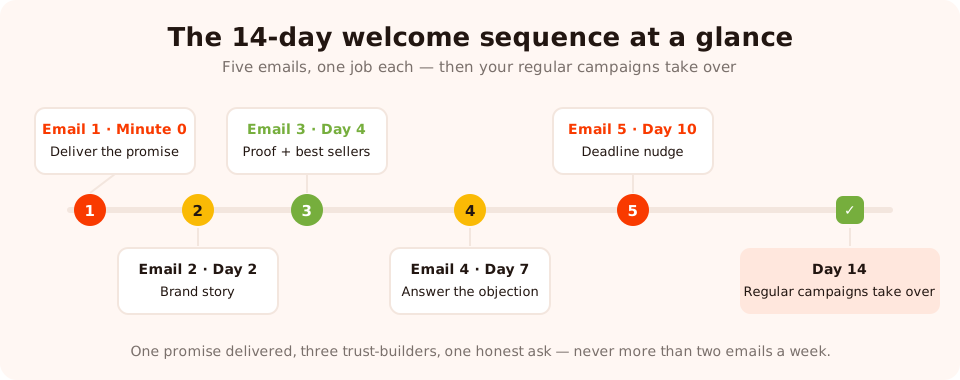
The 14-day map: one promise delivered, three trust-builders, one honest ask.
| Send | Job | Subject angle | The one CTA | |
|---|---|---|---|---|
| 1 — Deliver | Immediately | Hand over the code, download or prize the popup promised | "Your 10% off code is inside" | Use the code / open the download |
| 2 — Story | Day 2 | Explain why the store exists and what it does differently | "Why we started [Store name]" | See the range / the flagship product |
| 3 — Proof | Day 4 | Show best sellers backed by real customer words | "What everyone orders first" | Shop the best sellers |
| 4 — Objection | Day 7 | Answer the question that stops most first orders | The question itself, quoted | Read the guarantee, then shop |
| 5 — Deadline | Day 10 | One honest nudge before the welcome code expires | "Your 10% off ends tomorrow" | Use the code before it expires |
Timing is a rhythm, not a law — day 2 can be day 3, day 10 can be day 12. What you shouldn't bend: email one goes out immediately, no two emails land on the same day, and the deadline email is the only hard sell in the series. Now let's write them.
Email 1 — deliver the promise, immediately
Whatever your popup offered is the entire content of this email. Code above the fold, one button, and a two-line note on what you'll send next so the following four emails are expected instead of surprising. Resist every temptation to add more — the brand story, the Instagram link and the best-seller carousel all have their own email coming.
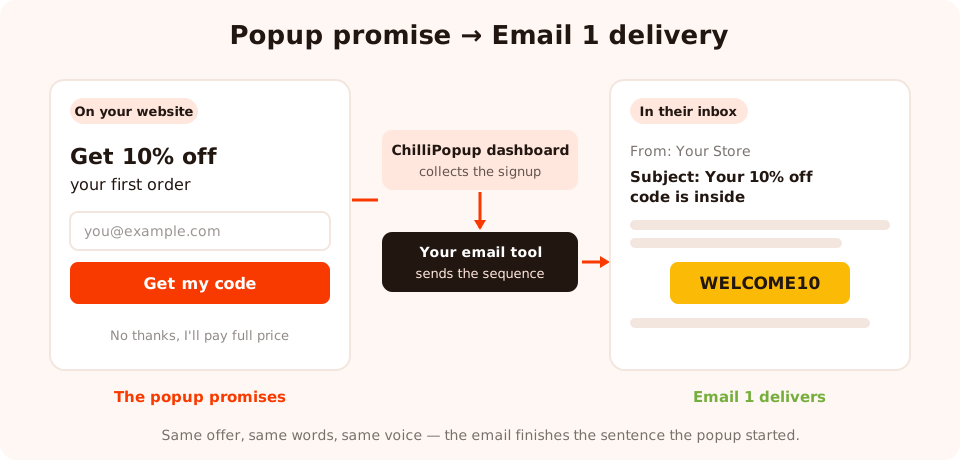
Email 1 finishes the sentence the popup started — same offer, same words, minutes apart.
Subject: Your 10% off code is inside
Preview text: Here's the code you signed up for — and how to use it.

Hi [first name / there],

Here's the code you were promised:

    WELCOME10 — 10% off your first order

Apply it at checkout. It works on everything in the store,
and it's good for the next 14 days.

[ Shop with my code → ]

One quick heads-up: over the next two weeks we'll send you a
handful of short emails — the story behind the store, what
customers order first, and honest answers to the questions we
hear most. That's it. No daily blasts.

— [Founder name], [Store name]
Don't make the email the only delivery. Put the code or download link on the popup's thank-you screen as well — ChilliPopup popups have a success screen and a coupon code block for exactly this. Then the promise is kept on-screen in the same second, and email 1 re-delivers it where the subscriber can find it again next week.
Email 2 — tell the story behind the store (day 2)
The subscriber has the discount; now give them a reason to want the products from you. The story email works because it's the one email in the sequence with nothing to sell — it converts by making the next two emails credible. Keep it to three short paragraphs: the problem you saw, the one concrete thing you do differently, and what that means for the reader. One concrete decision — a material, a process, a rule you never break — beats ten adjectives about passion.
Subject: Why [Store name] exists
Preview text: The problem we couldn't stop thinking about.

Hi [first name],

[One or two sentences on the problem: what was wrong with the
products you kept buying — the flimsy stitching, the mystery
ingredients, the sizes that fit nobody.]

So we made a rule: [the one concrete thing you do differently —
a material you always use, a process you never skip, a markup
you refuse to take]. Every product in the store passes it.

For you, that means [the plain-English benefit: it lasts longer,
it's actually traceable, it fits real bodies].

[ See how we make it → ]

P.S. Your welcome code WELCOME10 is still active — no rush.

— [Founder name]
Email 3 — show proof and best sellers (day 4)
By day 4 the subscriber knows what you stand for; now show them where to start. Curation is the gift here — a first-time visitor facing your full catalog defaults to buying nothing. Pick the three products new customers actually choose first, give each one line on who it's for, and let a real customer sentence do the selling. Pull those quotes from your actual reviews — never write them yourself, and never invent a number you can't back.
Subject: What everyone orders first
Preview text: The three products new customers pick — and why.

Hi [first name],

Deciding where to start? When people use their welcome code,
three products come up again and again:

1. [Product one] — [one line: who it's for / when to pick it]
   "[One real sentence from an actual customer review.]"

2. [Product two] — [one line]
   "[One real customer sentence.]"

3. [Product three] — [one line]
   "[One real customer sentence.]"

All three work with your WELCOME10 code.

[ Start with a favourite → ]

— [Store name]
Email 4 — answer the biggest objection (day 7)
Someone who has opened three emails and still hasn't bought isn't uninterested — they're stuck on something. Sizing, shipping cost, durability, "is it really worth the price": every store has one question that stops more first orders than all the others combined. You already know yours; it's the one your support inbox answers weekly. Email 4 answers it in public, plainly, before the deadline email asks for the order.
Subject: "But what if it doesn't [fit / work / suit me]?"
Preview text: The question we get most — answered honestly.

Hi [first name],

Fair question. It's the one we get most, so here's the
straight answer:

[Two or three sentences answering it honestly — how sizing
runs, what shipping really costs and takes, how the product
holds up and why. Specifics, not reassurance.]

And if it still isn't right: [your returns / guarantee policy
in one sentence — how long, who pays, how easy].

Three more quick ones:
• [Second question] — [one-line answer]
• [Third question] — [one-line answer]
• [Fourth question] — [one-line answer]

[ Shop with the guarantee → ]

— [Founder name]
Where to find the objection if you're not sure: ask it. A one-question ChilliPopup survey on your product pages — "What's holding you back today?" — collects the answers in the dashboard, and the most common one writes this email for you.
Email 5 — the deadline nudge (day 10)
One honest push. The welcome code you delivered in email 1 expires; email 5 says so, recaps the offer in three lines, and gets out of the way. It's short on purpose — everything persuasive has already been said, and the deadline is the only new information. The graceful exit line at the end matters more than it looks: it tells the subscriber that staying on the list without buying is allowed, which is exactly what stops the unsubscribe.
Subject: Your 10% off ends tomorrow
Preview text: After tomorrow night, WELCOME10 stops working.

Hi [first name],

Quick note — your welcome code expires tomorrow night:

    WELCOME10 — 10% off anything, until [date]

The short version, if you're still deciding:
• Most new customers start with [best seller].
• [The one-line answer to your biggest objection.]
• [Returns / guarantee in one line.]

[ Use my code → ]

And if now isn't the time — genuinely no problem. You'll
still get [what your regular emails are: the monthly edit,
new arrivals, subscriber-only offers].

— [Store name]
Only send this if the deadline is real. If your welcome code never expires, either give it a real expiry in your store's coupon settings or cut this email — a fake countdown that a subscriber can disprove by trying the code a month later costs more trust than the extra orders are worth.
Match the sequence to what your popup promised
The blueprint above assumes a classic coupon popup. If your popup made a different promise, email 1 changes completely and the rest of the sequence shifts to match — a subscriber who won a prize on a spin wheel and a subscriber who downloaded a buying guide are in very different conversations with you.
| What the popup promised | Email 1 must contain | How the rest shifts |
|---|---|---|
| Coupon / discount popup | The code, above the fold, with the expiry | The blueprint as written — the deadline email closes on the code's expiry |
| Spin-to-win or other game | The exact prize they won, named as a win ("You won 15% off") | Lead with the win everywhere; a "you won X, not Y" frame makes email 5's expiry feel like losing a prize, not missing a sale |
| Lead magnet (guide, checklist, template) | The download link itself — never "check the site" | Emails 2–4 teach: pull the three best insights from the magnet and connect each to a product; the deadline email offers a first-order code as a fresh reason |
| Quiz popup | Their result, restated — and the recommendation that follows from it | The whole sequence speaks to their answer: best sellers become "best for [their result]", the objection email answers that segment's question |
Two of these deserve a note. For games, the prize is decided server-side in ChilliPopup — the spin-to-win popup shows the winning screen and the submission in your dashboard records who signed up, so email 1's job is to repeat the win and make the prize redeemable. For quizzes, each submission stores the answers the subscriber gave; sort the submissions by answer and add each group to a different list in your email tool, so a "dry skin" result and an "oily skin" result don't receive the same best-seller email. And if you're still choosing what to offer in the first place, our ecommerce lead magnet ideas guide ranks the options by how well the resulting subscribers convert.
Whatever captures the address — popup, inline form, game or quiz — the promise it makes is the brief for email 1.
From ChilliPopup to your email tool — the honest workflow
Who does what
Let's be precise, because this is where sequences quietly fail: ChilliPopup does not send emails. It captures the signup — every popup, form, survey and quiz stores its submissions in the dashboard, campaign by campaign — and your email tool sends the sequence. The welcome flow lives entirely in your email platform; ChilliPopup's job ends when the address (and any other fields you asked for) lands in the submissions view.
The handoff, step by step
- Open the campaign's submissions in the ChilliPopup dashboard — each popup lists the addresses and field values it has collected.
- Copy or export the new addresses into a dedicated list in your email tool — one list per popup promise, so the coupon signups and the quiz signups don't share a sequence.
- Attach the welcome automation to that list in your email tool, so anyone added to it enters the five-email flow at email 1.
- Repeat on a fixed rhythm. The transfer is manual, so the rhythm is the product: a daily slot keeps email 1 genuinely fast. Batch it weekly and your "immediate" welcome email arrives six days stale for some subscribers.
Bridge the gap on-screen. Because email 1 can only leave after the handoff, the popup's thank-you screen must deliver the promise instantly — show the code or the download link right there. The subscriber gets the value in second one; email 1 makes it permanent.
Same offer, same voice
The popup and the sequence are one conversation, and subscribers notice seams. If the popup said "10% off", email 1 says "10% off" — not "a special discount". If the popup is playful, the emails are playful. Reuse the exact nouns: the code name, the offer phrasing, the button verb. The same rules that make popup copy convert make the emails feel continuous — our popup copywriting guide covers the voice, and the cheapest trick is to write the popup headline and email 1's subject line in the same sitting, as two halves of one sentence.
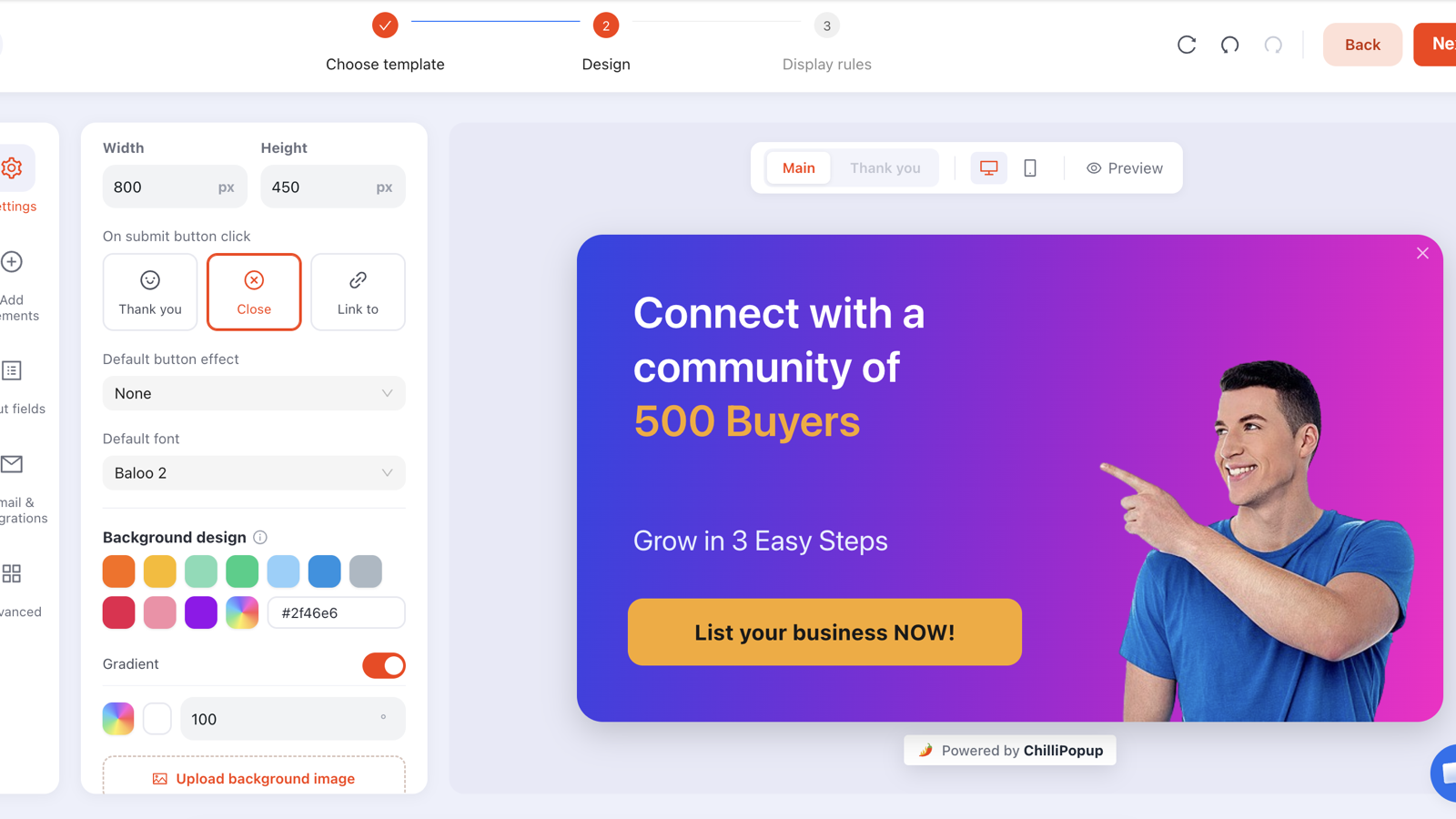
Whatever this popup promises is a contract email 1 has to honour — edit them as a pair.
Stop showing the popup after they convert
The final piece of the handoff: once someone has signed up, the popup should disappear for them. In the popup's display rules, switch on the display frequency rule and turn off "show again after conversion" — anyone who submitted that popup stops seeing it. Skip this and your newest subscribers get the worst experience on the site: a popup begging for the email address they gave you yesterday, right next to a welcome email pretending you know them.
Common mistakes that break a welcome sequence
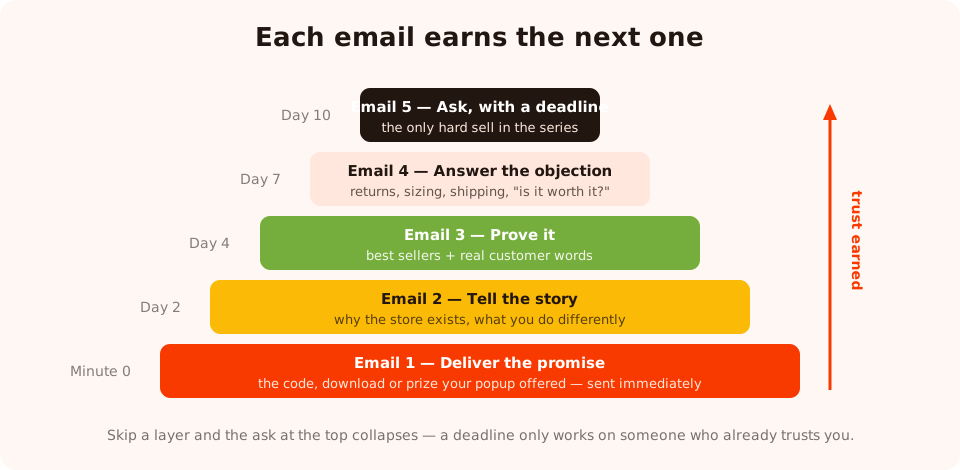
Most of the mistakes below are the same mistake: asking from the top of the pyramid before building the base.
- Delivering the promise late. A weekly export batch means some subscribers wait six days for "your code is inside". Fix the rhythm, and put the code on the popup's thank-you screen so nobody waits at all.
- Opening with the brand story. Email 1 that leads with your founding journey and buries the code in paragraph four breaks the promise on a technicality. Deliver first, narrate second.
- Selling in all five emails. If every email is a pitch, the sequence is just a promo blast with a schedule. Emails 2–4 build the trust that email 5 spends.
- Fake deadlines. "Ends tomorrow" on a code that works forever is discovered by exactly the subscribers who read carefully — the ones worth keeping.
- A voice transplant between popup and inbox. Playful popup, corporate emails — the subscriber concludes the popup was bait. Same offer, same nouns, same tone.
- Leaving the popup running for converters. Turn off "show again after conversion", or the people receiving your welcome emails keep meeting the signup popup.
- Ignoring what the popup learned. If a quiz collected answers or a game awarded a specific prize, a generic one-size sequence throws that away — segment the lists and let email 1 prove you were listening.
- No expectation-setting. Subscribers who were never told more emails are coming mark email 2 as spam. Two lines in email 1 buy permission for the next four.
The numbers that tell you it's working
You're reading two dashboards: your email tool for the sequence, ChilliPopup for the capture. In your email tool, watch per-email opens, clicks and unsubscribes, plus the share of subscribers who make a first order before the sequence ends. Read them as a shape, not as absolutes: email 1 should be the best-opened message you send anywhere, opens should slope down gently through emails 2–4, and clicks should spike at emails 1 and 5. A cliff instead of a slope points at the exact email to rewrite; unsubscribes clustering on one email means it oversold or arrived too close to its neighbour.
On the ChilliPopup side, the analytics dashboard shows each campaign's views, clicks, submissions and conversion rate — the health of the top of this funnel. A popup that converts poorly starves the best sequence ever written, so fix capture first; and because the popup's offer is also email 1's offer, an A/B test on the popup — two offers, two thank-you screens — is quietly also a test of which welcome sequence you should be running.
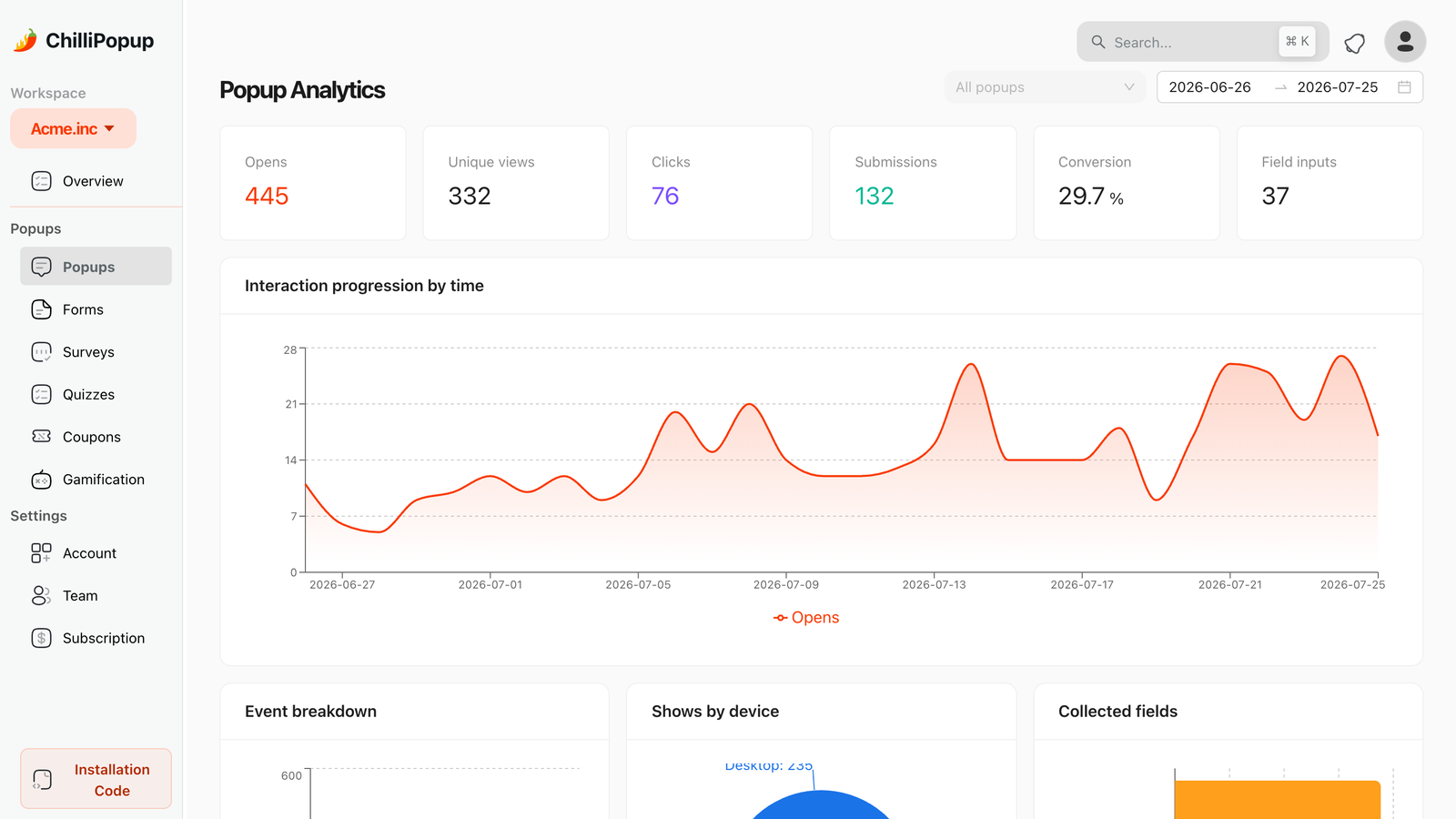
Capture metrics live here; sequence metrics live in your email tool. Together they're one funnel.
Start the sequence with a popup worth answering
Build popups, forms, surveys, quizzes and games from one editor — and one pixel. Free plan, no credit card required. Paid plans from $29/month.
Start free →Related reading
Frequently asked questions
How many emails should a welcome sequence have?
Five over about fourteen days is the sweet spot for most stores: deliver the promise, tell your story, show proof, answer the main objection, and close with a deadline. Fewer than three leaves the welcome offer unreinforced; more than seven starts costing unsubscribes before any trust exists. Start with five and cut or add based on where opens drop.
How quickly should the first email arrive after a popup signup?
As close to instantly as your setup allows. The minutes right after someone types their email are when attention is highest, and a delayed coupon reads as a broken promise. Show the code or download link on the popup's thank-you screen too, so the promise is kept on-screen even before the email lands.
Does ChilliPopup send the welcome emails?
No. ChilliPopup collects the signups — every popup, form, survey and quiz stores its submissions in the dashboard — and you send the emails from your own email tool. Move new addresses from the campaign's submissions into a dedicated list in your email tool, and attach the welcome automation to that list.
What should the first email to a new subscriber say?
Exactly what the popup promised, and almost nothing else. Deliver the coupon code, download or prize in the first lines, show how to use it, add one call to action, and briefly set expectations for what you'll send next. Save the brand story, the product tour and the social proof for the emails that follow.
How long should the welcome series run before regular campaigns start?
About two weeks. The five-email sequence ends around day 10 to 12; after that, new subscribers roll into your normal newsletter and promotions. If your email tool allows it, suppress regular campaigns while someone is inside the welcome sequence, so a brand-new subscriber isn't hit by a welcome email and a sale blast on the same day.
Should subscribers keep seeing the popup after they sign up?
No — it's one of the most common leaks. In ChilliPopup, switch on the display frequency rule and turn off 'show again after conversion' so anyone who submitted the popup stops seeing it. The welcome sequence takes over from there; the popup's job is done.