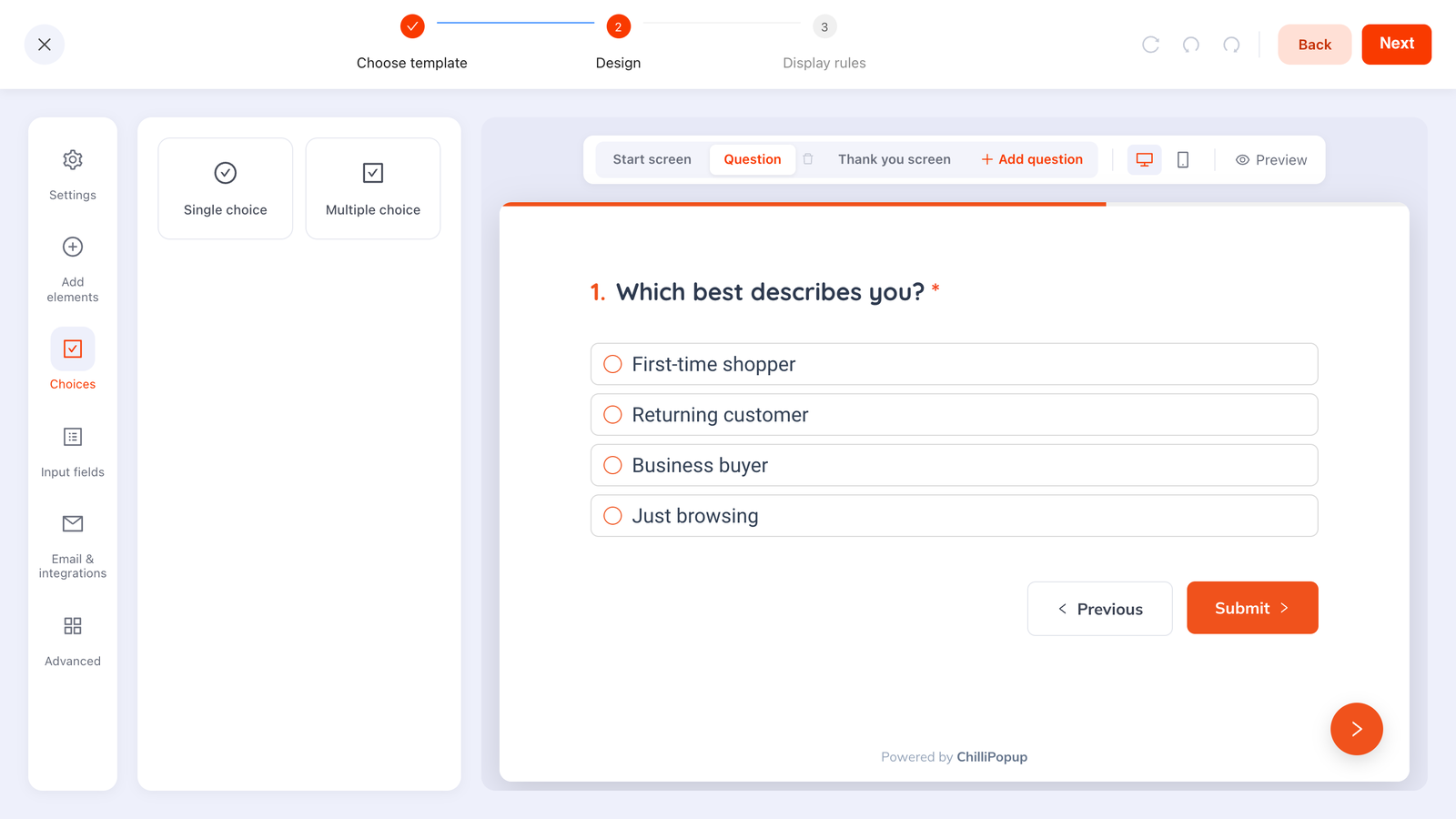
A quiz funnel is a lead funnel whose front door is a short multiple-choice quiz instead of a form. The visitor answers three to six questions, hands over an email to receive the outcome, and lands on a result that points at a specific product, plan or next step. You end up with an email address and the answers that explain it.
That last part is what makes quizzes worth the extra effort. A newsletter signup gives you a row in a list. A quiz gives you a row that already says oily skin, budget under $50, shopping for a gift — and every email you send afterwards can act on it.
Key Takeaways
- The quiz must promise an outcome, not ask for a favour. "Find your shade in 30 seconds" converts; "tell us about yourself" does not.
- Three to six questions. Fewer and the result is not believable; more and completion falls off a cliff.
- The email goes after the last question, before the result — the one moment where the visitor has invested and has not yet been paid.
- Options beat text inputs. Tappable choices finish in one gesture and return clean values you can actually segment on.
- Read the per-question drop-off, not just the completion rate. One bad question usually explains most of the loss.
Why a quiz outperforms a form
Both ask questions. Only one of them gives something back while it asks. That single difference changes the psychology of every step:
- Answering is the reward. People take quizzes for the result, so the questions read as progress rather than as an interrogation.
- Each answer is a micro-commitment. By question four, quitting means wasting the effort already spent — the same reason a two-step popup outperforms a one-step one.
- You collect zero-party data, the kind customers hand over deliberately. It does not decay like inferred data and it does not depend on third-party tracking.
- The result is a natural product recommendation. Nobody resents a recommendation they explicitly asked for.
Quiz funnel, in one sentence
A quiz funnel trades a short, entertaining diagnosis for an email address and a set of clean answers — then routes the visitor to the product, plan or content that matches what they just told you.
The five stages of a quiz funnel
Every quiz funnel that works has the same skeleton. Name the stages before you write a single question — most quizzes fail at stage 1 or stage 5, not in the middle.
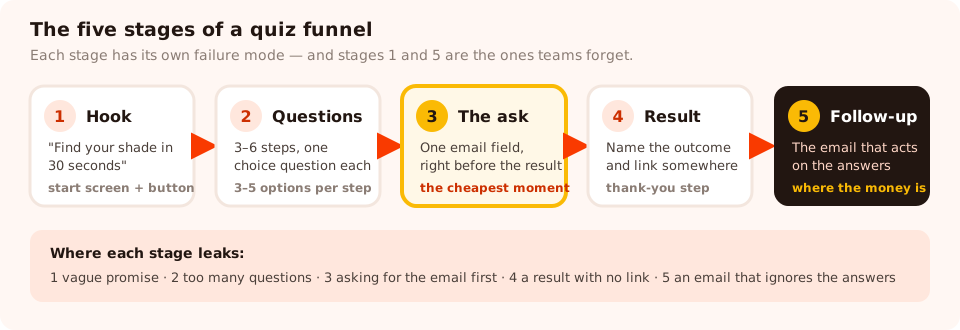
Five stages, five different failure modes. Most teams obsess over stage 2 and neglect stages 1 and 5.
| Stage | What it is | The question it must answer | Where it usually fails |
|---|---|---|---|
| 1. Hook | The start screen and its button | "What do I get, and how long will it take?" | A vague promise, or no time estimate |
| 2. Questions | Three to six choice steps | "Does this quiz understand my situation?" | Too many, or one question nobody can answer honestly |
| 3. The ask | The email step before the result | "Is the result worth an email address?" | Asking first, or asking for four fields instead of one |
| 4. Result | The thank-you step | "Was that worth 40 seconds?" | A generic thank-you with no recommendation and no link |
| 5. Follow-up | The email that repeats the result | "What do I do about it?" | Never being sent, or ignoring the answers entirely |
Four quiz types worth building
1. The recommendation quiz
"Find your perfect ___." The workhorse of ecommerce, and the easiest to justify: it replaces a 140-product collection page with three questions. Best on category and collection pages, where the visitor is already comparing. There is a dedicated walk-through in the product recommendation quiz guide.
2. The fit or qualification quiz
"Which plan is right for a team your size?" A B2B staple. It qualifies the lead while genuinely helping them, and the answers arrive as normalised values — 2–10, 11–50, 50+ — rather than whatever someone types into a free-text box.
3. The diagnostic quiz
"How healthy is your ___?" Works when your product fixes a problem people cannot self-diagnose. The result names the gap; your product closes it. Keep the scoring honest — a diagnostic that tells everyone they are failing reads as a sales pitch and gets shared as a joke.
4. The preference quiz
"What's your style?" The lightest of the four, and the best fit for top-of-funnel traffic that is not ready to buy. It earns a segment and an email, and the recommendation can be a content collection rather than a product.
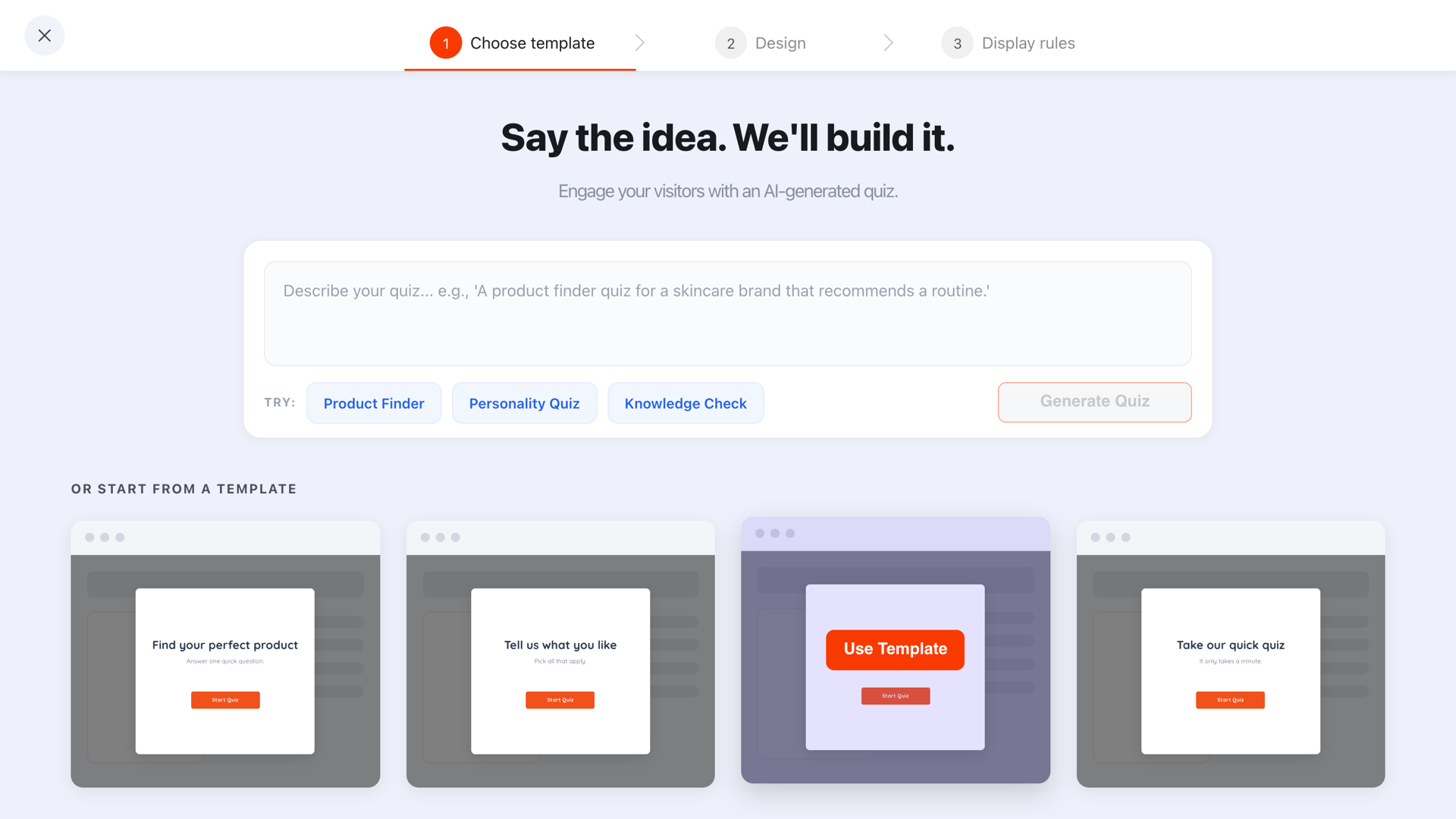
Starting from a template gets the step structure right for free — you only rewrite the questions and the result.
How to write the questions
Every question step in ChilliPopup carries one multiple-choice question with its own options, single- or multiple-select. That constraint is a gift: it forces one idea per screen, which is exactly what a quiz needs on a phone.
The rules that separate a quiz people finish from one they abandon:
- Three to five options per question. Six is a menu; two is a coin toss.
- Every option must be one somebody would pick. Filler options exist to make your preferred answer look good, and readers notice.
- Ask about them, not about you. "What are you shopping for?" beats "Which of our collections interests you?" — the second requires knowing your catalogue.
- Put the easiest question first. The first answer is the commitment; make it a one-second decision.
- Include an honest escape hatch. "Not sure yet" is a real answer and it is worth knowing — it also stops people guessing and poisoning your data.
- Use multiple-select sparingly. It is right for "which of these apply", wrong for anything that drives a single recommendation.
The "so what" test. For every question, name the recommendation, segment or email that changes because of the answer. If nothing changes, the question is friction with a curiosity payoff for you and none for the visitor. Delete it.
Where the email ask belongs
This is the one decision that moves the numbers most, and it has a clear answer: after the last question, before the result.
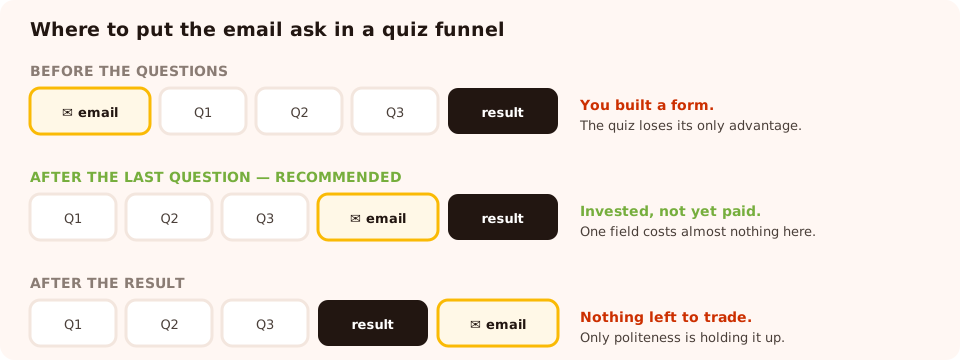
Ask too early and it is a gated form. Ask too late and there is nothing left to trade.
- Before the questions. You have converted the quiz into a signup form and thrown away its only advantage. Reserve this for quizzes promoted to an audience that already knows you.
- After the last question (recommended). The visitor has invested four taps and is one screen from the payoff. An email input costs almost nothing here — they were always going to want the result somewhere.
- After the result. Honest, and the weakest. Once the outcome is on screen, the only remaining reason to give an email is politeness.
Keep the ask to a single field. One email input, format validation on, and business-email validation instead if you are qualifying B2B leads and list quality matters more than volume. Do not add a phone number here — it behaves like an objection, not a step, and it belongs on a later ask entirely.
Delivering the result — without branching logic
Here is an honest constraint worth designing around: quiz steps run in a fixed order. There is no "if they answered oily, skip to question five" branching, and no engine that maps a combination of answers to one of eight personality types automatically.
That is less limiting than it sounds, because there are three patterns that work anyway:
- One strong result, personalised by email. The thank-you step names the outcome in general terms — "Your routine is built around hydration" — and the follow-up email, written from the actual answers, carries the specifics. Most quizzes only ever needed this.
- Buttons that route. A result step can hold several buttons that each link to a different page. "Shop dry skin →", "Shop oily skin →", "Not sure? Start here →" gives the visitor the branch instead of guessing it for them, and it is one click.
- Two short quizzes instead of one long one. If two audiences genuinely need different questions, run a separate quiz on each entry point and target it by URL. Two focused quizzes beat one quiz with a dead branch every time.
Whatever you do, the result step must contain a link. A quiz that ends on "Thanks, check your inbox" throws away the most engaged moment of the entire funnel. Name the recommendation and give them somewhere to go.
Where to put the quiz
A quiz can run as a triggered overlay on your site, be embedded inline in a page, or live on its own shareable link — and each placement suits a different stage.
| Placement | Best trigger | Why it works there |
|---|---|---|
| Collection or category page | Time delay of 8–15 seconds, or 40% scroll | The visitor is already comparing and has no shortlist |
| Home page | Time delay, new visitors only | First-time visitors have no idea where to start |
| Pricing page | Exit intent on desktop, scroll on mobile | Hesitation there is usually "which plan", not "whether" |
| Blog post | 50% scroll | An engaged reader will take a quiz about the thing they are reading |
| A shareable link | No trigger — it is the destination | Social posts, email campaigns and paid traffic that needs a landing page |
Two rules to set on every quiz: turn off "show again after conversion" so finishers never meet it again, and set an explicit display frequency so someone who dismissed it is not asked again on the next page view. The targeting rules guide covers the rest.
Build a quiz funnel this afternoon
Multi-step quizzes, surveys, forms, popups and prize games from one editor and one script tag. Free plan, no credit card required. Paid plans from $29/month.
Start free →What to measure
A quiz produces more diagnostic data than any other lead-capture format, because every step is a separate decision you can watch people make.
- The session funnel — views → interactions → abandoned → submissions. The gap between views and interactions is a hook problem; the gap between interactions and submissions is a question problem.
- Completion rate — finishers as a share of starts. Compare a quiz against itself over time, never against someone else's number.
- Per-question drop-off — which question people were last touching when they left. This is the single most useful number in the whole report, and it names your rewrite for you.
- Average time to finish — if it is climbing, a question has become ambiguous.
- Option counts per question — the distribution of answers. A question where 92% pick the same option is not segmenting anybody; either rewrite the options or delete the question.
- Partial answers — what people had entered before leaving without submitting. Free insight into the exact moment the quiz lost them.
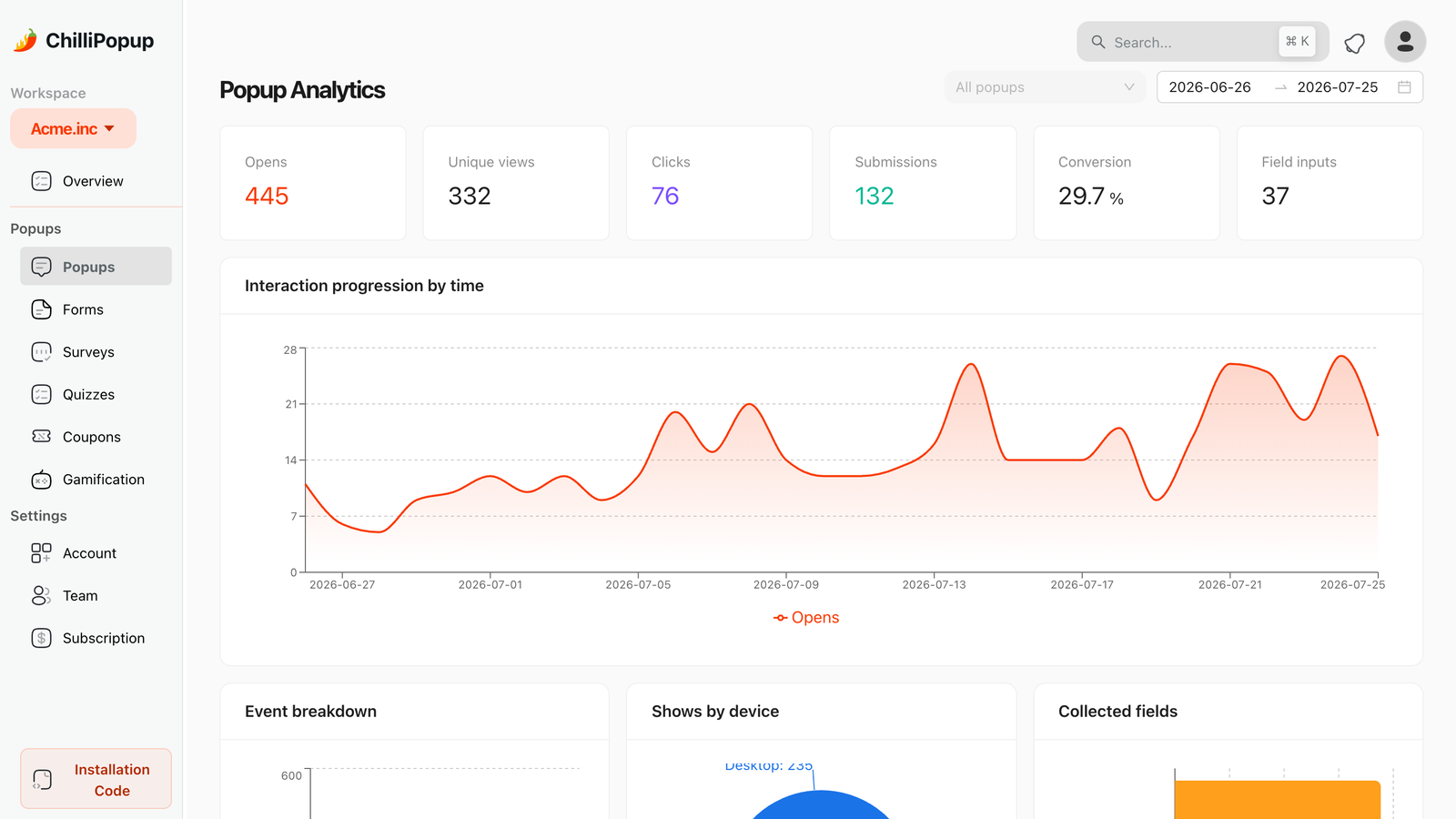
Views, interactions, abandons and submissions in one funnel — then drill into the question that leaks.
Six mistakes that kill a quiz funnel
- A quiz with no promise. "Take our quiz!" is not a reason. Name the outcome and the time it takes on the start screen.
- Ten questions. Every question past six costs completions and buys almost no extra precision.
- Asking for the email first. You have rebuilt a signup form with extra steps.
- A result nobody can act on. If the outcome does not link somewhere, the funnel ends at the most valuable moment.
- Never using the answers. If the follow-up email is identical for every result, you collected zero-party data and then ignored it.
- Running it everywhere. A quiz on the checkout page interrupts a purchase to ask what the customer wants to buy.
Related reading
Frequently asked questions
What is a quiz funnel?
A quiz funnel is a lead funnel whose first step is a short multiple-choice quiz instead of a form. The visitor answers three to six questions, gives an email address to receive the outcome, and lands on a result that recommends a specific product, plan or next step. You get an email address plus the answers behind it, which makes the follow-up far more specific than a plain signup.
How many questions should a quiz funnel have?
Three to six. Below three the result feels arbitrary and nobody believes it; above six, completion drops sharply because each extra question is another chance to close the tab. Every question should change either the recommendation or the segment you put the person in — if it changes neither, delete it.
Should I ask for the email before or after the quiz?
After the last question, before the result. Asking first turns the quiz into a gated form and loses people who had not yet decided to trust you. Asking after the result removes the reason to hand anything over. The step between the final answer and the outcome is where the ask costs the least.
Do quiz funnels work for B2B?
Yes, when the promise is a diagnosis rather than a personality. 'Which plan fits a team your size', 'how mature is your process' and 'what is blocking your onboarding' all qualify a lead while giving them something useful, and the answers arrive as clean values your sales team can route on.
Can a quiz show different questions based on earlier answers?
Not in ChilliPopup — quiz steps run in fixed order, with no conditional branching. In practice that is less limiting than it sounds: keep questions universal so every path makes sense, or run two shorter quizzes on different pages when the audiences genuinely need different questions. If you need to send people to different destinations, use buttons that link out on the result step.
How do I measure whether a quiz funnel works?
Three numbers, in this order: completion rate (how many finishers per start), the per-question drop-off that shows where the rest stopped, and the conversion rate of the traffic the result step sends onward. A quiz with a 70% completion rate and no downstream conversion is entertainment; fix the result step before you touch the questions.