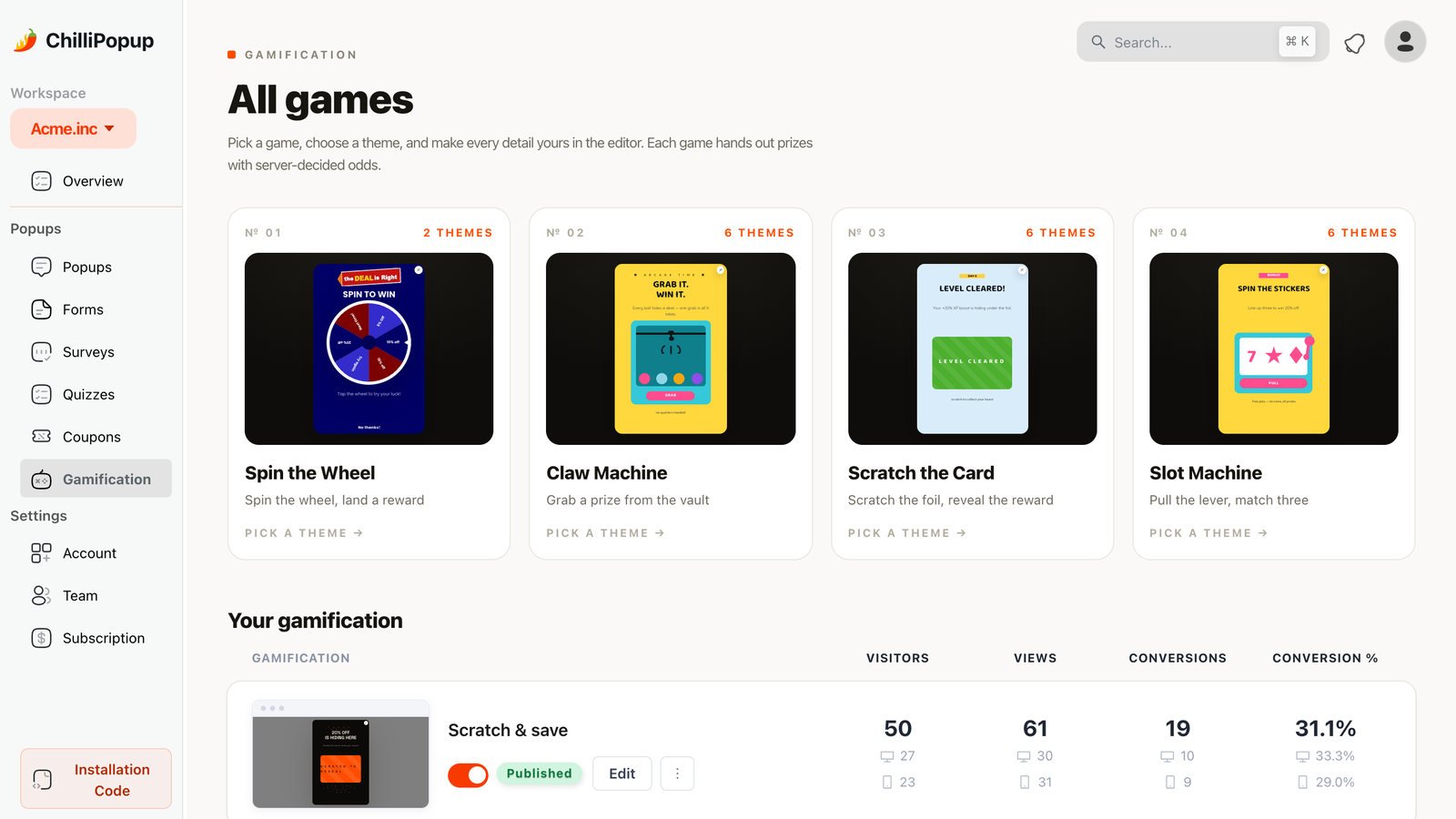
A giveaway popup trades an email address for a chance at a prize. It is the highest-volume list builder most stores can run, because the perceived value of "you might win the whole bundle" is far larger than "10% off", and it costs you one prize instead of a margin cut on every order.
It is also the campaign most likely to fill your list with people who will never buy anything. Everything below is about getting the first outcome without the second.
Key Takeaways
- The prize is the targeting. A prize only your customers want filters the list before anyone subscribes.
- Never give away a gift card or a tablet — you will get thousands of entries and no customers.
- One field. Email, plus a consent checkbox if the entry is by consent. Nothing else.
- Schedule the close. A date window switches the popup off on its own; a countdown in the final week does the rest.
- The runner-up email is the campaign. What everyone who lost receives decides whether the list survives.
Giveaway, discount, or game?
These three are the standard email-capture offers and they behave very differently. Most stores should run more than one, on different pages or at different times of year.
| Discount popup | Instant-win game | Giveaway | |
|---|---|---|---|
| What the visitor gets | A certain small reward | A random small reward, now | A chance at a big reward, later |
| Cost to you | Margin on every order | Margin, weighted by odds | One prize, total |
| List quality | Good — buyers with intent | Good | Depends entirely on the prize |
| Volume | Baseline | Higher than a plain discount | Highest |
| Shareability | Low | Low | High — people tell friends |
| Runs | Always on | Always on | Two to four weeks, a few times a year |
| Main risk | Trains discount-waiting | Prize table set badly | Prize hunters |
The pattern that works. Run an instant-win game or a discount as your always-on capture, and layer a giveaway over it two or three times a year — a product launch, a seasonal peak, an anniversary. The giveaway is an event; treating it as an always-on mechanic wears it out.
Choosing the prize (this is the whole campaign)
There is one rule and everything else is detail: the prize should be worthless to someone who is not your customer.
Give away a €500 gift card and you will collect an enormous list of people who enter every draw on the internet, professionally, with a dedicated email address. They will never open your emails. They will damage your deliverability. And you will look at the entry count and think the campaign worked.
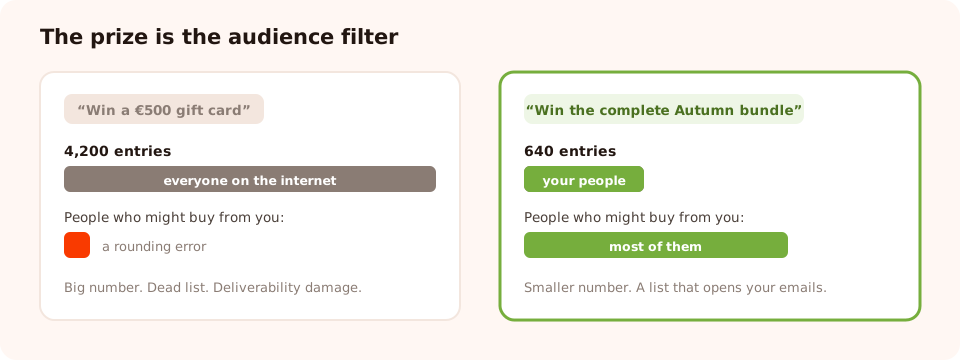
The same entry mechanic, two prizes, two completely different lists. The prize is the audience filter.
| Prize | What it attracts | Verdict |
|---|---|---|
| Cash or a general gift card | Everyone on the internet | Avoid |
| A popular consumer gadget | Prize hunters | Avoid |
| A bundle of your best sellers | People who already want your products | Ideal |
| A year's supply of a consumable | Heavy users — your best future customers | Ideal for repeat-purchase categories |
| A made-to-order or personalised item | People invested enough to specify it | Excellent, and highly shareable |
| An experience tied to your brand | Your community | Strong, if you can deliver it |
| Store credit at your shop | Near-customers | Good — and it costs you margin, not cash |
What the entry popup should say
A giveaway popup has one extra job compared with a discount popup: it has to make the prize believable. People have learned to assume online draws are fake, so specificity is doing the persuading.
- Name the exact prize. "Win the complete Autumn bundle — six pieces, worth €340" beats "Win a prize bundle".
- Show it. One product photo does more than three lines of copy.
- State the closing date in the popup itself, not only in the terms.
- Say how many winners there are. "Three winners" reads as more honest than one, and converts better.
- Link the terms. A visible rules link makes the whole thing look real, which is the opposite of what most people expect.
- Ask for one field. The draw needs an email address. It does not need a name, a phone number or a birthday, and every one of those costs entries.
Sample copy that has all six:
Win the complete Autumn bundle
Six pieces, worth €340. Three winners, drawn on 30 November.
[ email ] [ Enter the draw → ]
Open to residents of the EU and UK. Full terms.
Consent is not the same as entry. If you intend to market to entrants afterwards, ask for that separately — a consent checkbox alongside the email — rather than burying it in the terms. It is the legally safer position in most of Europe, and the people who tick it are the only ones worth having. See the GDPR-compliant popups guide.
Building it
Mechanically a giveaway entry popup is the simplest campaign there is — a headline, an image, one email input and a button. What makes it a giveaway is the rules around it.
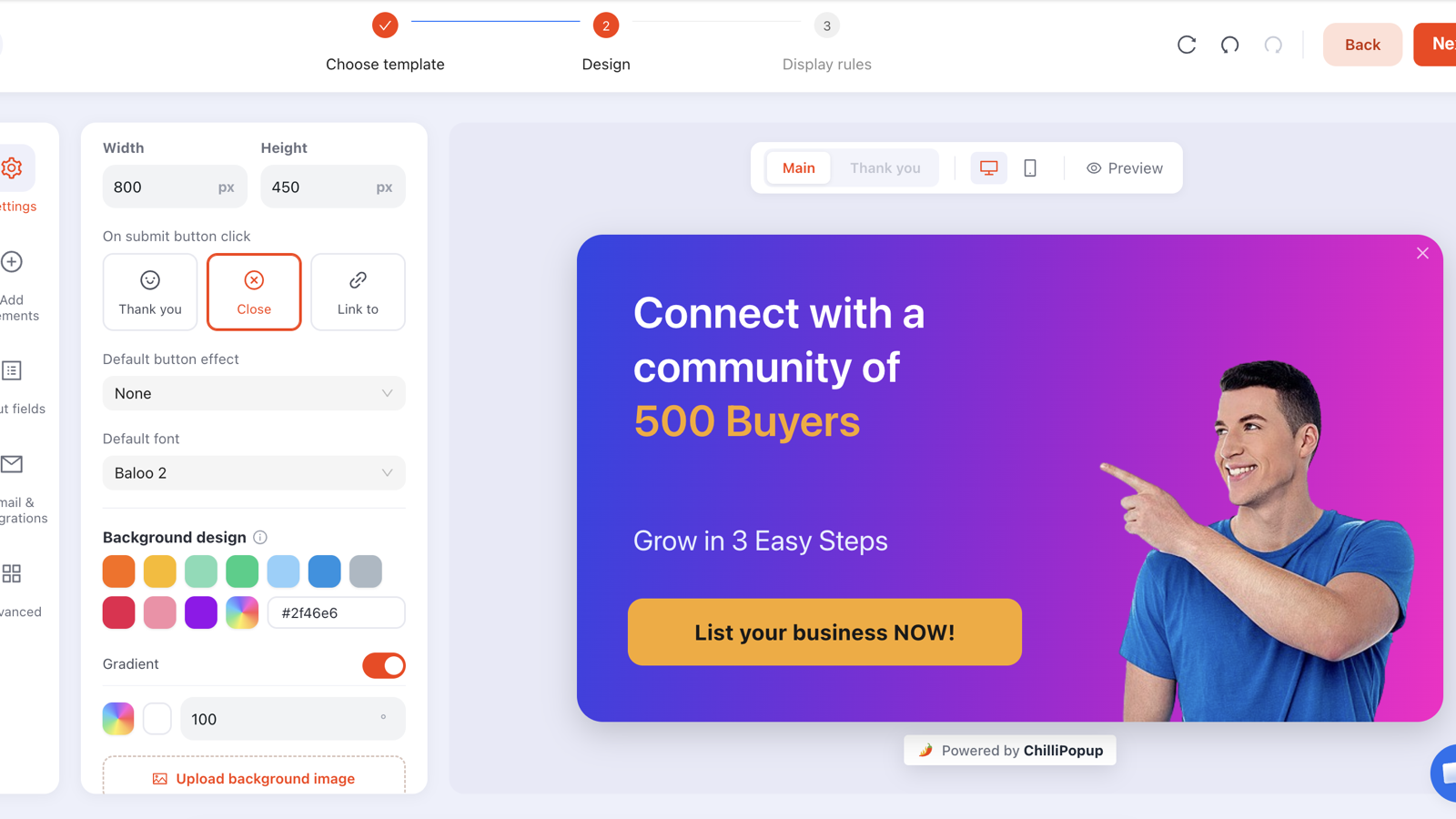
Blocks for the prize image, the headline, the countdown and the single input. Nothing else earns its place.
- A date window. Advanced targeting takes a start and end date with a GMT offset, so the popup appears when entries open and stops when they close — no diary reminder, no popup still collecting entries for a draw that already happened.
- A countdown timer, switched on for the final week only. A timer running for four weeks is wallpaper; a timer running for four days is a deadline.
- Frequency and the conversion gate. Set a cooldown, and turn off "show again after conversion" so people who already entered are not asked again — which, in a giveaway, also stops the same person entering repeatedly by accident.
- Page targeting. Homepage and collections yes; checkout never.
Give the giveaway a shareable home
A popup only reaches people already on your site, and the entire advantage of a giveaway is that
people share it. So build a second entry point: an
inline form embedded on a
dedicated /giveaway page. That is the URL you put in your Instagram bio, your newsletter
and your packaging insert — and unlike a popup, arriving there means the visitor came
for the draw.
Run your next giveaway without a developer
Build popups, forms, surveys, quizzes and games from one editor — and one script tag. Free plan, no credit card required. Paid plans from $29/month.
Start free →Where a giveaway popup should appear
| Page | Trigger | Why |
|---|---|---|
| Homepage | 5–8 second delay | Most first-time traffic lands here during a campaign push |
| Collection pages | 50% scroll | Someone browsing your catalogue wants your products — exactly who the prize is for |
| Product pages | Exit intent | A last offer to someone who is not going to buy today |
| Blog and content | Scroll or a delay | Great for reach, weaker for intent |
| Cart | — | Skip it. Do not distract someone who is about to buy |
| Checkout | — | Never |
| Order confirmation | 5 second delay | Excellent — a customer who just bought is the best possible entrant |
That last row is worth taking seriously. Entrants who are already customers are the ones whose email addresses are actually worth something, and the order-confirmation page reaches them at their most positive moment.
What happens after the draw decides whether it worked
The campaign is not the popup. The campaign is the email everyone who lost receives, because that is the moment a giveaway list either becomes a customer list or unsubscribes en masse.
- Announce the winner properly — first name and city, or a photo if they agree. Anonymous winners confirm everybody's suspicion that the draw was fake.
- Give the runners-up something real. Not "10% off, like everyone gets" — a genuine consolation: early access to the new range, a free-shipping code, a small credit. This is the email that earns the subscription.
- Say what happens next. "You'll hear from us about once a week" sets an expectation, and an expectation you meet is what stops the unsubscribe.
- Watch the first two sends. A giveaway list has a higher unsubscribe rate than a discount list. That is normal and it is healthy — let the people who only wanted the prize leave rather than dragging them along and hurting your deliverability.
Segment the entrants for at least a month. They behave differently from your normal subscribers, and mixing them straight into your main list makes every metric you have harder to read. Tag them, watch them, and merge them once they have opened something. The segmentation guide covers how.
Seven mistakes that ruin a giveaway
- A generic prize. The single biggest one. You get entries instead of customers.
- No terms. Prize promotions are regulated, the rules vary by country, and a draw without published rules is both a legal risk and a trust problem.
- Asking for four fields. The draw needs an email. Everything else is you being greedy at the exact moment you have leverage.
- No end date on the popup. Nothing says "abandoned website" like a popup promoting a draw that closed in March.
- Running it on checkout. Never interrupt a payment.
- Silence after the draw. No winner announcement means every entrant assumes it was fake, and tells people so.
- Judging it on entry count. The number that matters is how many entrants buy something in the following ninety days.
Run your giveaway, step by step
1. Pick a prize only your customers want
Your own products, a year's supply, a personalised item, an experience. Never cash or a gadget.
2. Write the terms and publish them
Who can enter, closing date, how the winner is picked and contacted, what the prize is. Link it from the popup.
3. Build the entry popup with one field
Prize photo, exact prize, number of winners, closing date, email input, consent checkbox if you will market to them.
4. Schedule the open and close
Set the date window in advanced targeting, and switch a countdown on for the final week only.
5. Add a shareable /giveaway page
Embed the same entry form inline so the campaign has a URL you can put in a bio, a newsletter or a box.
6. Draw, announce, and reward the runners-up
Name the winner, give everyone else something real, and set the expectation for what arrives next.
Related reading
Frequently asked questions
What is a giveaway popup?
A giveaway popup is a popup that offers entry into a prize draw in exchange for an email address. The visitor gets a chance at something genuinely desirable, you get a subscriber, and unlike a discount popup it does not train people to expect money off every order — which is why stores with thin margins often prefer it.
Do giveaway popups actually grow a good email list?
They grow a big list quickly and a good one only if you design against prize hunters. Tie the prize to your own products rather than a gift card or a tablet, make the follow-up email clearly about your brand, and expect a higher unsubscribe rate in the first two weeks than a discount popup produces. A prize nobody wants except your customers is the whole trick.
What prize should I give away?
Something only your customers want. A bundle of your own products, a year's supply, a made-to-order item, or an experience tied to your brand. Generic electronics and gift cards pull enormous entry numbers and almost no future customers, because the people they attract are entering hundreds of draws a week.
Is a giveaway the same as a spin-the-wheel popup?
No, and the difference matters. A spin wheel or scratch card resolves instantly — the visitor plays and finds out immediately whether they won, so the reward is fast but small. A giveaway defers the result to a draw date, which lets the prize be far bigger. Many stores run the game for everyday capture and a giveaway two or three times a year.
Do I need to publish terms and conditions?
Yes. Prize promotions are regulated, and the rules differ by country — some jurisdictions restrict how a draw can require a purchase or what qualifies as a lottery. Publish who can enter, the closing date, how the winner is chosen and contacted, and what the prize actually is, then link that page from the popup. Get local advice if you are unsure; this is not legal guidance.
How long should a giveaway run?
Long enough to be shared and short enough to feel urgent — two to four weeks is the usual sweet spot. Use a scheduled date window so the popup switches itself off when entries close, and add a countdown in the final week rather than for the whole run.