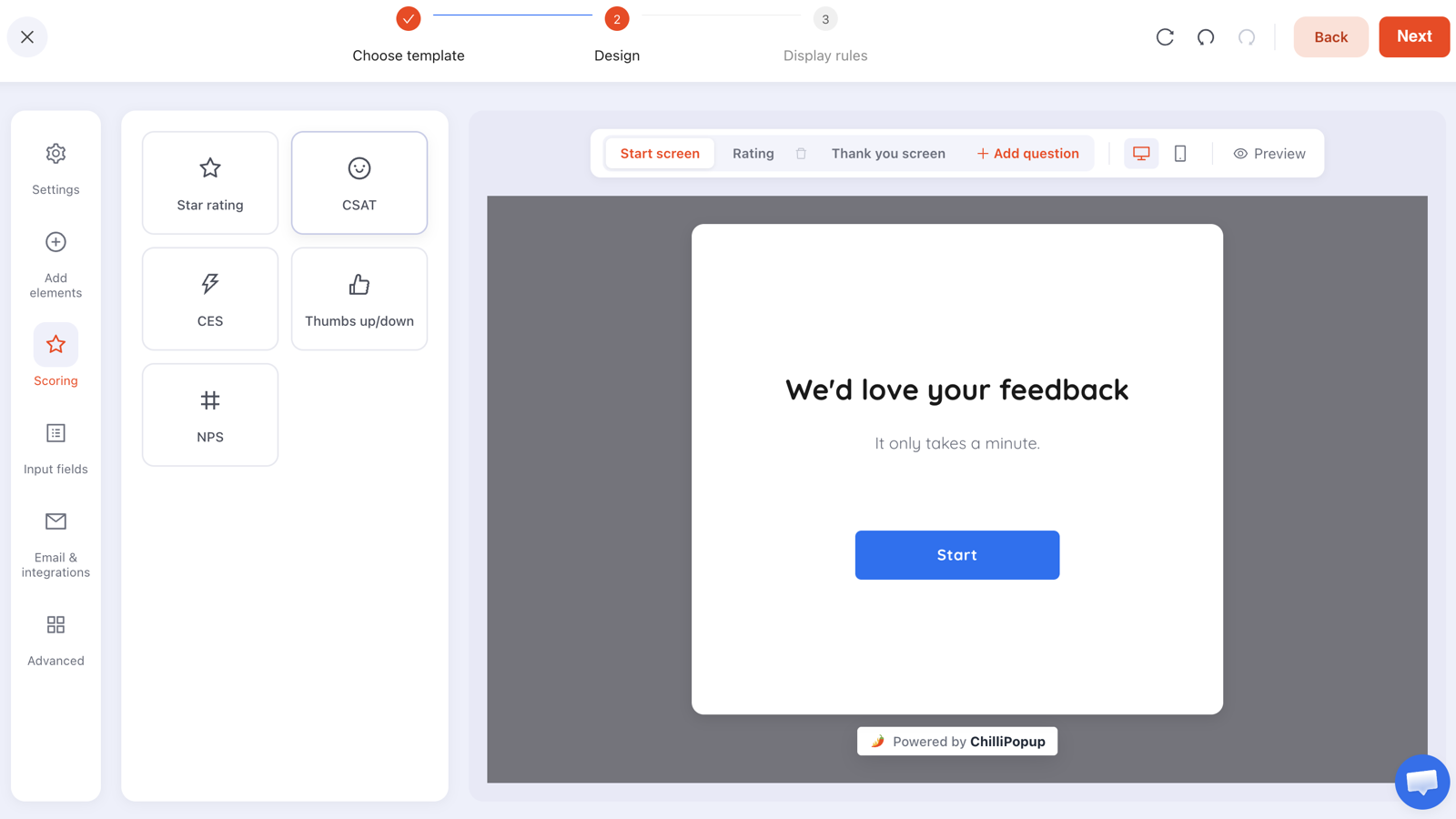
Pick the scale by the moment, not by habit. A thumbs up or down for a quick reaction to a page. CSAT for satisfaction with something that just happened. CES for anything the customer had to work through. Stars for a product or a delivery. NPS for the overall relationship, a few times a year — not after every interaction.
Those five are the scoring widgets available in a ChilliPopup survey, and the rest of this guide is about telling them apart properly: what each one measures, the question wording that belongs with it, and how to read the result without flattering yourself.
Key Takeaways
- The scale is a decision about the moment, not a house style. Different moments need different questions.
- Shorter scales get more responses. Two options beat five; five beat eleven.
- Always follow the number with one open question on the next step, worded to match the score.
- Never mix scales in one survey. Two different ranges in one flow makes both harder to answer and impossible to compare.
- Changing scale resets your trend line. If you switch, note the date and treat it as a new series.
The five scales at a glance

Five ranges, five different questions. The width of the scale is a cost you pay in response rate.
| Scale | Range | What it measures | Best moment | Effort to answer |
|---|---|---|---|---|
| Thumbs | Down or up | A snap reaction | Was this page / article / answer useful? | Lowest |
| Stars | 1 to 5 | Quality of a thing | A product, a delivery, an order | Low |
| CSAT | 1 to 5 | Satisfaction with an interaction | Immediately after support, checkout, onboarding | Low |
| CES | 1 to 7 (7 = very easy) | How hard it was | After any task: return, signup, checkout, ticket | Medium |
| NPS | 0 to 10 | Likelihood to recommend | The relationship, a few times a year | Highest |
Thumbs: the cheapest question you can ask
Two options, one tap, no interpretation required. Thumbs is the right scale whenever the cost of the question has to be near zero — a help article, a blog post, a search results page, a chatbot answer.
Wording that works: "Was this useful?" Nothing more.
How to read it: as a ratio, per page, over time. The absolute percentage is close to meaningless because only people with an opinion answer; the movement of that percentage when you rewrite a page is the actual signal. A page with a lot of thumbs-down and a lot of traffic is a rewrite queue, in order.
Pair it with one open field. A thumbs-down that also asks "What were you looking for?" on the next step turns a score into a content plan. That single follow-up is worth more than the score itself.
Stars: familiar, and about a thing
Five stars is the most universally understood scale on the internet, which is its whole advantage. People rate things with stars — a product, a delivery, a meal — and they do it without reading instructions.
Wording: "How would you rate the mug you received?" Name the object. Star ratings applied to abstractions ("rate our service") drift towards a general mood rather than a measurement.
How to read it: watch the distribution, not the mean. Star data is famously J-shaped — a pile at 5, a small pile at 1, very little in between — so an average of 4.2 can hide a serious problem affecting one order in ten. Look at the share of 1s and 2s as its own number.
CSAT: satisfaction with what just happened
A 1-to-5 satisfaction scale, asked immediately after a specific interaction while the memory is intact. This is the scale for support conversations, checkout, onboarding, a booking.
Wording: "How satisfied were you with the help you just received?" — with 1 as very unsatisfied and 5 as very satisfied. Say which interaction. "How satisfied are you with us?" is a different question and a much worse one.
How to read it: most teams report the share of 4s and 5s, which is a reasonable headline. But the actionable number is the 1s and 2s, segmented by whatever context you can attach — which page, which order type, which day. CSAT is a smoke alarm; it tells you there is a fire, not where.
Our CSAT survey guide covers the timing and follow-up in detail.
CES: how hard was that?
The customer effort score runs 1 to 7, where 1 is very difficult and 7 is very easy. It is the least famous of the five and often the most useful, because for anything transactional the question "was that easy?" predicts repeat behaviour better than "were you satisfied?".
Wording: "How easy was it to complete your return?" Note the direction: high is good. Get that backwards in your reporting and you will spend a quarter congratulating yourself on a broken checkout.
Where it fits: after checkout, after a return or exchange, after a signup or account setup, after a support ticket closes, after any form long enough to be annoying. If your form abandonment is high, a CES question on the completion page tells you whether the survivors found it painful too.
The CES survey guide has the full treatment, including how to phrase the follow-up for a low score.
NPS: the relationship, not the interaction
Zero to ten, one question: how likely are you to recommend us. NPS is the broadest of the five and the most misused, because it is easy to bolt onto every interaction and then wonder why the number never moves.
Wording: "How likely are you to recommend Northfield to a friend or colleague?" Then, on the next step, the question that actually earns its keep: "What is the main reason for your score?"
How to read it: as a trend, on a stable audience, measured a few times a year. The classic promoter-minus-detractor arithmetic is fine, but the value is in the verbatim answers and in the direction of travel. See the NPS survey guide for sampling and cadence.
Do not ask NPS after every interaction. An 11-point relationship question after a two-minute support chat is the wrong instrument, and running it constantly trains your customers to dismiss it. Once or twice a year, to a sample, is plenty.
Which scale for which moment

The moment picks the scale. If two scales look equally reasonable, take the shorter one.
| Moment | Scale | The question |
|---|---|---|
| Help article or blog post | Thumbs | "Was this useful?" |
| Order confirmation page | CES | "How easy was it to place your order?" |
| A few days after delivery | Stars | "How would you rate what arrived?" |
| End of a support conversation | CSAT | "How satisfied were you with that?" |
| After a return or exchange | CES | "How easy was your return?" |
| After onboarding or setup | CES | "How easy was it to get set up?" |
| Twice a year, to customers | NPS | "How likely are you to recommend us?" |
| Exit intent on a pricing page | None — ask an open question | "What stopped you today?" |
That last row matters. Not every survey wants a number. When you do not yet know what the problem is, a rating scale gives you a score you cannot act on; one open question gives you sentences you can. Save the scales for things you intend to track over time.
How to build it: one question per step
A survey is a sequence of steps, and a rating scale belongs on a step of its own with nothing else competing for the tap. The follow-up goes on the next step, so the wording can respond to what they just said.

Start from a template that already carries the right scale, then change the wording to name your specific moment.
Four build rules that make the difference between a survey people finish and one they close:
- One scale per survey. Mixing a 1-to-5 and a 0-to-10 in the same flow slows everyone down and produces two numbers you cannot combine.
- Make the rating required, the follow-up optional. A required open field is where completion rates go to die.
- Label both ends. "Very difficult" and "very easy", not just numbers. This matters most on CES, where the direction is not obvious.
- Keep it to two or three steps. Rating, reason, thank you. Anything longer belongs in an emailed survey, not a popup.
Partial answers still count. If someone rates you and closes the survey before submitting, that rating is recorded as a partial response. So the score you were most worried about losing — the angry 1 from someone who did not want to explain — is exactly the one you keep.
Ask the right question, in one step
Website surveys with star, CSAT, CES, thumbs and NPS scoring, per-question drop-off and partial responses. Free plan, no credit card required. Paid plans from $29/month.
Start free →Reading the results without fooling yourself
Every rating scale on a website shares the same bias: only people with an opinion answer, and strong opinions answer more. Four habits keep you honest.
- Watch the movement, not the level. "Our CSAT is 4.3" means almost nothing on its own. "Our CSAT fell from 4.3 to 3.9 after we changed the returns flow" means everything.
- Read the bottom of the distribution. The 1s and 2s are where the money is. Averages hide them by design.
- Check the response rate too. A score based on twelve answers is an anecdote. The results view shows views, interactions, abandons and submissions as a funnel, plus completion rate and average time to finish — read those before you trust the number.
- Use the drop-off ranking. On a multi-step survey, the dashboard ranks which question people quit on. If everyone leaves at your open follow-up, it is too demanding or badly worded, and the fix is a rewrite rather than a nag.
If your response rate is the problem rather than the score, the survey response rate guide covers timing, targeting and incentives.
Six mistakes with rating scales
- Using NPS for everything. It is a relationship instrument. Interactions want CSAT or CES.
- Reversing CES in your reporting. On a 1-to-7 effort scale, 7 is easy and therefore good. Half the confusion about CES comes from this one detail.
- Two scales in one survey. Slower to answer, impossible to combine.
- No follow-up question. The score tells you the temperature; only the sentence tells you which window is open.
- Asking too early. A satisfaction question before the parcel arrives measures anticipation, not experience.
- Changing the scale and keeping the chart. The line looks continuous and is not. Note the switch, split the series.
Related reading
Frequently asked questions
Which rating scale should I use in a website survey?
Match the scale to the moment. Use a thumbs up or down for a quick reaction to a page or an article, CSAT for satisfaction with a specific interaction you just completed, CES for anything the customer had to do effort to get through, stars for a product or delivery, and NPS for an overall relationship check a few times a year.
What is the difference between CSAT and NPS?
CSAT asks how satisfied someone was with a specific thing that just happened, on a 1-to-5 scale, and it is best asked immediately afterwards. NPS asks how likely someone is to recommend you overall, on a 0-to-10 scale, and it measures the relationship rather than the interaction. CSAT tells you whether a moment worked; NPS tells you whether the whole experience is holding up.
What is CES and when should I use it?
CES is the customer effort score: it asks how easy or difficult something was to do, on a 1-to-7 scale where 7 is very easy. Use it after any task the customer had to complete — checkout, a return, a signup, a support conversation. Effort predicts whether people come back better than satisfaction does for that kind of moment.
Does a shorter rating scale get more responses?
Generally yes. A thumbs up or down is one tap with two options and gets the highest response rate of any scale; an 11-point NPS question asks for the most consideration and gets the least. That is a reason to reserve the longer scales for moments where the extra precision genuinely changes a decision.
Should I add an open text question after the rating?
Yes — one, on the next step, and worded to match the score. The number tells you what happened; the sentence tells you why. Keep it optional so a low scorer who does not want to elaborate still counts.
Can I change the rating scale on a survey that is already running?
You can, but do not do it casually. Swapping a scale resets your ability to compare with previous months, because the numbers are no longer measuring the same thing on the same range. If you must change, note the switch date and treat the two periods as separate series.