CSAT — Customer Satisfaction Score — is the shortest useful question in customer research: how satisfied were you with this? One rating, one moment, one number you can track. It takes a visitor four seconds and it will tell you which part of your business is quietly annoying people.
It also gets misused more than any other metric, usually by being asked about everything at once and then averaged into meaninglessness. This guide covers what CSAT actually measures, how to calculate it honestly, the exact wording that works, the moments worth measuring, and how to read the answers.
Key Takeaways
- CSAT measures one moment, not your brand. Ask it about the thing that just happened.
- The formula is satisfied answers ÷ total answers × 100 — and you must state which boxes count as satisfied.
- The follow-up question is the valuable half. A score without comments cannot be acted on.
- Read the distribution, not the average. Two 1s and two 5s average to the same place as four 3s and mean something completely different.
- Benchmarks are a distraction. Compare your score against your own score, measured the same way.
What is a CSAT survey?
CSAT, in two sentences
A CSAT survey asks how satisfied someone was with a specific interaction, on a short scale — most often 1 to 5. The CSAT score is the percentage of answers that fall in the satisfied range, and it belongs to one touchpoint rather than to the business as a whole.
That last point is the one people skip. "How satisfied are you with our company?" is not a CSAT question; it is a mood reading. "How satisfied were you with your delivery?" is a CSAT question, because there is a process behind it that you can go and fix on Monday.
In ChilliPopup, CSAT is one of five scoring types you can drop into a survey — alongside a 1-to-5 star rating, CES on a 1-to-7 scale, thumbs up/down, and NPS on 0 to 10. There is a ready-made CSAT template to start from, and the dashboard computes the CSAT percentage for you.
How to calculate the CSAT score
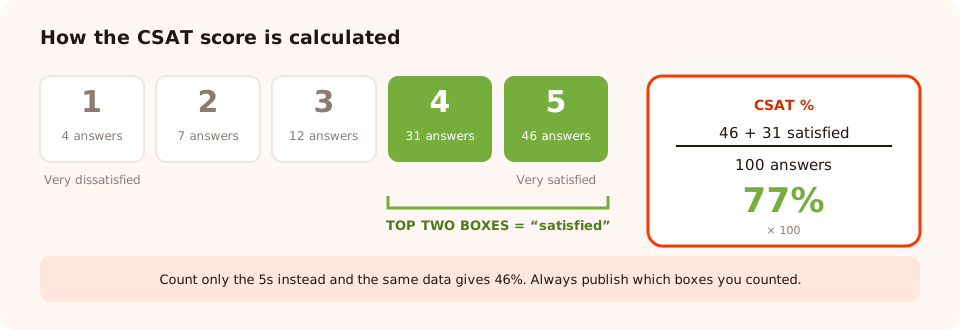
Top-two-box is the common convention. Whichever you choose, write it down — a CSAT number without its definition is not comparable to anything.
The arithmetic is trivial:
CSAT % = (satisfied answers / total answers) x 100

Example, 1-5 scale, top-two-box:
  5s = 46
  4s = 31          satisfied = 46 + 31 = 77
  3s = 12
  2s = 7           total     = 100
  1s = 4
                   CSAT      = 77%
The only decision that matters is which boxes count as satisfied. Counting 4s and 5s (top-two-box) is the usual convention. Counting only 5s gives you a much harsher, more sensitive number. Both are defensible; switching between them silently is not, because your score will jump twenty points and everyone will spend a week arguing about a change that never happened.
Write the definition into the dashboard name. "Checkout CSAT (top-2-box, 1–5)" is a boring campaign title and a very good one. Six months later nobody will remember what was counted.
CSAT vs NPS vs CES vs stars vs thumbs
All five measure something real. They fail when you pick the wrong one for the question you are actually asking.
| Metric | Scale | Asks about | Best moment | Weakness |
|---|---|---|---|---|
| CSAT | 1–5 | Satisfaction with one interaction | Right after an order, a delivery, a support reply | Very short memory; says nothing about loyalty |
| NPS | 0–10 | Willingness to recommend the brand | Quarterly, to established customers | Slow to move; useless for diagnosing a process |
| CES | 1–7 | How much effort something took | After a return, a signup, a support ticket | Only makes sense where effort is the risk |
| Star rating | 1–5 stars | General quality of a thing | Products, content, an individual article | Familiar but vague — stars mean different things to different people |
| Thumbs up/down | Binary | Was this useful, yes or no | Help articles, search results, recommendations | No nuance, so no trend worth plotting |
A simple division of labour. CSAT for the touchpoints you own and can fix. CES where the risk is friction rather than quality. NPS a few times a year, to customers who have been around long enough to have an opinion. Thumbs where the answer only needs to be yes or no.
Writing the CSAT question
A CSAT question has one job: name the moment precisely enough that the answer points somewhere. Compare:
| Weak | Better | Why |
|---|---|---|
| "How satisfied are you with us?" | "How satisfied were you with your checkout today?" | Names one process, so a low score has an owner |
| "Rate your experience" | "How satisfied were you with the answer you just got?" | Ties the score to a specific event the customer remembers |
| "Are you happy with your order?" | "How satisfied were you with the delivery of order #1042?" | Separates delivery from the product itself — two different teams |
| "Did we meet your expectations?" | "How satisfied were you with how easy this was to set up?" | Avoids a yes/no framing that hides the middle |
Label the ends of the scale
"1 = Very dissatisfied, 5 = Very satisfied" removes an entire class of noise. Without labels, a meaningful share of people answer 1 thinking it means "first place".
Always add the follow-up
One optional open question, and word it to match the score you just received: "What would have made that a 5?" is a far better prompt than "Any comments?" because it asks for a specific, actionable change rather than an essay.
Keep it to two questions total. Every extra one costs responses, and a longer questionnaire belongs in a separate feedback survey aimed at the people who already told you something is wrong.
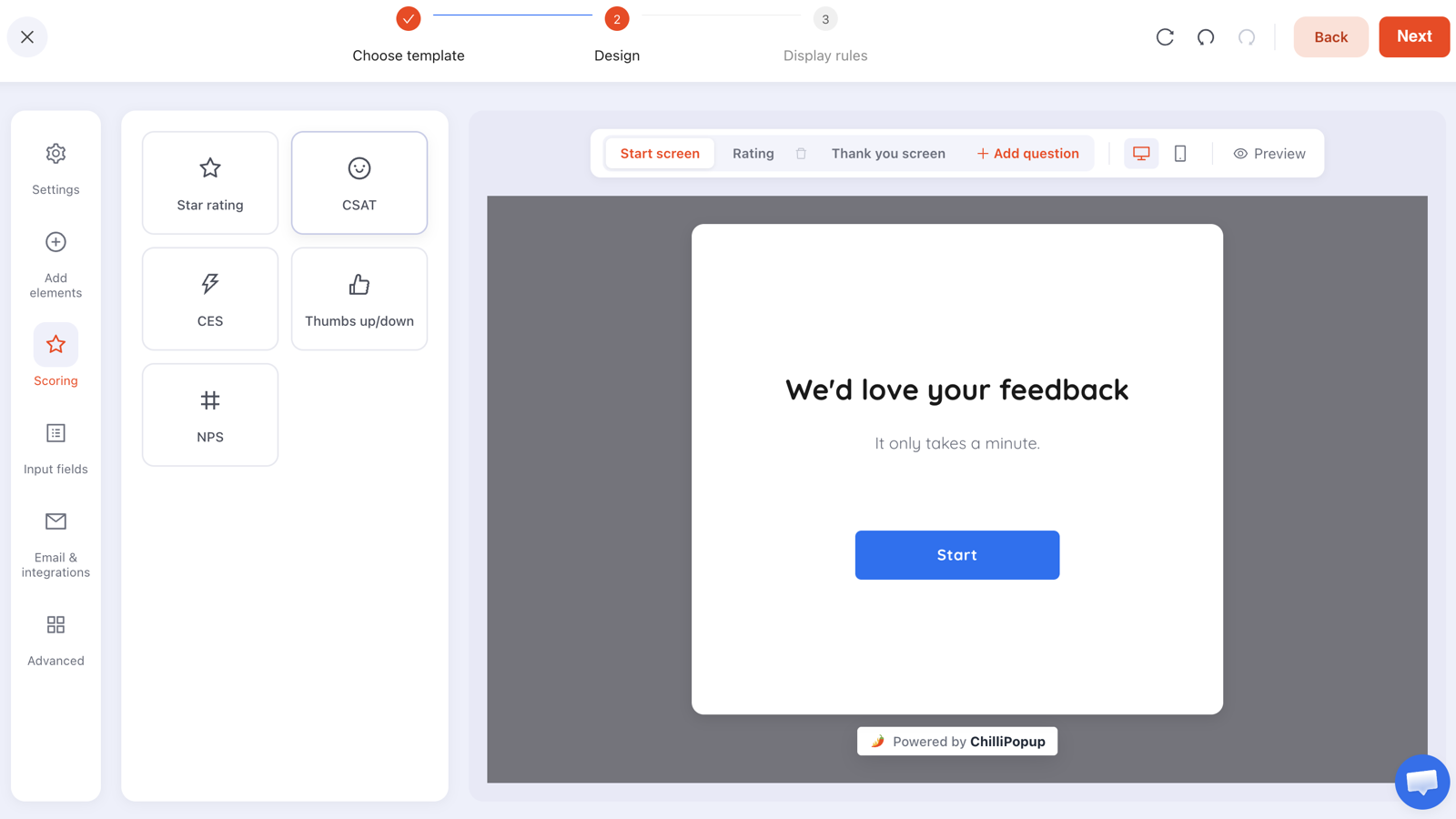
A CSAT survey is a start screen, one rating, one optional comment and a thank-you screen. Anything more is a different survey.
When and where to ask
CSAT decays fast. Ask it while the interaction is still in short-term memory and the answer is about what happened; ask it a week later and the answer is about how the customer feels today.
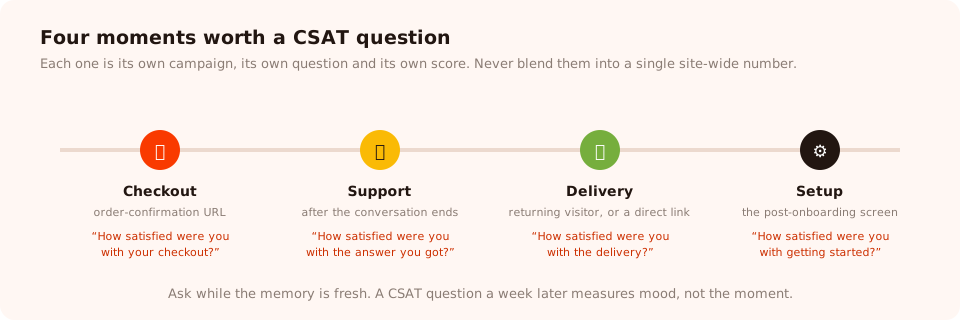
Four moments, four separate campaigns, four separate scores. One blended "site CSAT" tells you nothing.
| Touchpoint | How to target it | Question |
|---|---|---|
| After checkout | Page targeting on the order-confirmation URL, plus a short delay | "How satisfied were you with the checkout?" |
| After support | Opened from your help flow, or targeted on the page the customer returns to | "How satisfied were you with the answer you got?" |
| After delivery | A returning-visitor rule a few days out, or a direct link in the delivery email | "How satisfied were you with the delivery?" |
| After setup or onboarding | Page targeting on the post-setup screen | "How satisfied were you with getting started?" |
The rules that keep a CSAT survey civilised are the same ones every campaign has: a trigger (a delay of a few seconds works better than firing the instant the page paints), page targeting for the moment, frequency capped, and "show again after conversion" turned off so nobody is asked twice about the same thing. Every campaign also has a shareable direct link, which is what you use when the right moment happens in an email rather than on your site.
Do not put a CSAT survey in front of a purchase. Feedback goes after the transaction, never during. A satisfaction question on a product page is an interruption that costs you the order and measures nothing, because nothing has happened yet.
A worked example, word for word
Campaign: Checkout CSAT (top-2-box, 1–5). Fires on the order-confirmation page, 4-second delay, once per customer.
Start screen
"Thanks for your order! One quick question — it takes about five seconds."
Question 1 — CSAT, required
"How satisfied were you with your checkout today?"
Scale 1 to 5, labelled Very dissatisfied to Very satisfied.
Question 2 — open text, optional
"What would have made that a 5?"
Thank-you screen
"Thank you — that genuinely helps. Your order is on its way."
Two screens of questions, under ten seconds, and it produces both a number to track and a queue of specific complaints to work through. If response rates are lower than you would like, our guide to increasing survey response rates covers the levers worth pulling.
Put a CSAT score on your checkout this week
Start from the CSAT template, target one moment, and read the distribution in the dashboard. Surveys, popups, forms, quizzes and games from one editor. Free plan, no credit card required. Paid plans from $29/month.
Start free →Reading the results properly
The dashboard gives you per-question distributions and averages, and the CSAT percentage itself. Read them in this order:
- The distribution. Always first. Four 3s and a pair of 1s with a pair of 5s produce the same average and describe completely different businesses. A bimodal spread means you are serving two different groups of customer, and averaging them hides both.
- The 1s and 2s, with their comments. This is the actionable half. Read every one; there will not be many.
- The trend against yourself. Same question, same scale, same touchpoint, month over month. That is the only comparison that means anything.
- The response funnel. Views, interactions, abandons and submissions, plus completion rate and average time to finish. A collapsing completion rate usually means the survey grew a question it did not need.
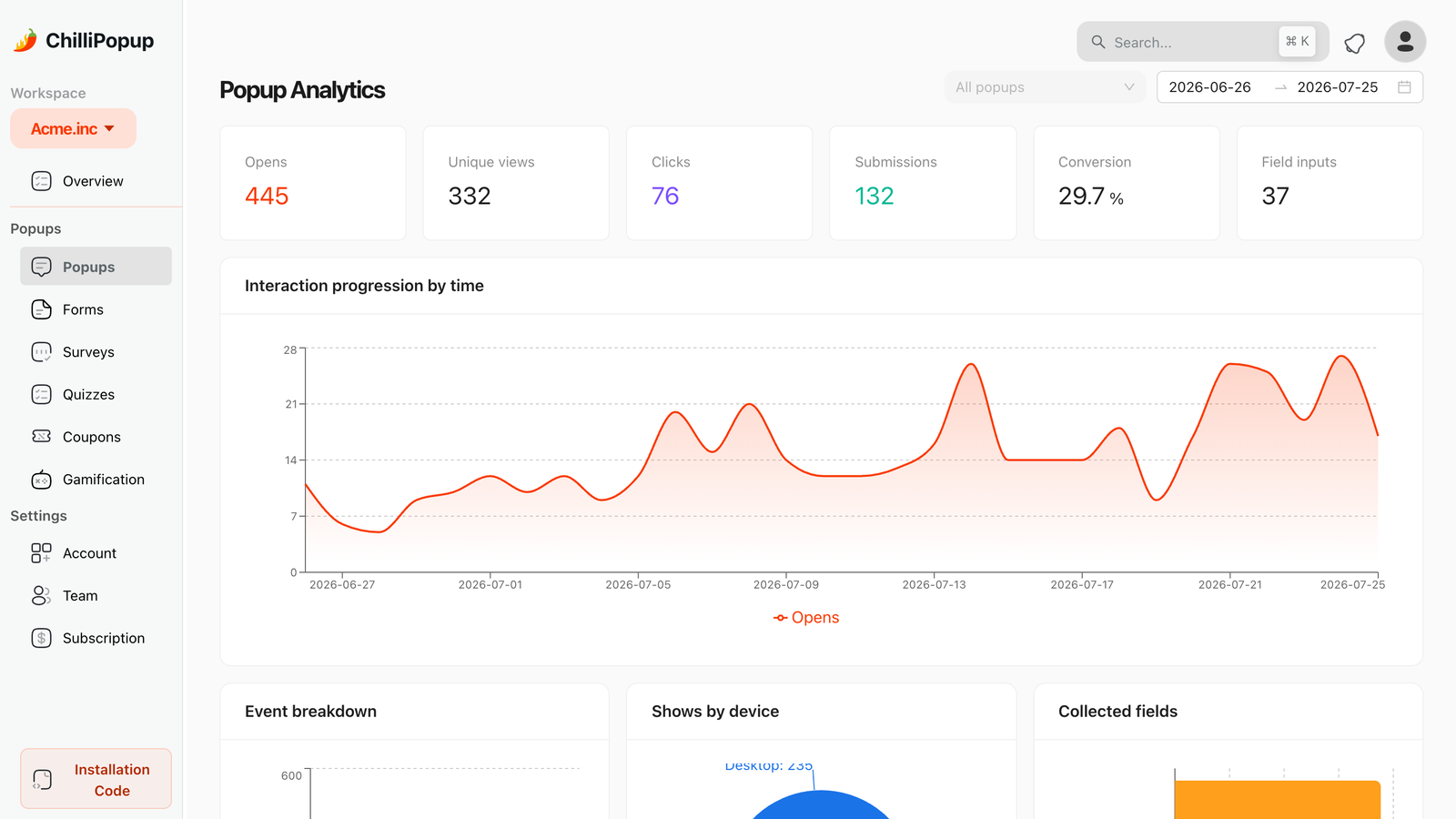
Distribution first, average second. And read the drop-off analysis if people are quitting mid-survey.
One more source most people miss: answers people entered before leaving without submitting are kept as partial responses on stepped content. Someone who rated you a 2 and then thought better of writing the comment still told you something.
Closing the loop
A CSAT programme that only produces a chart is a cost. The value comes from what happens after a low score:
- Route the 1s and 2s to a human within a day or two. A quick, specific reply converts a detractor more reliably than any campaign you could run.
- Group the comments monthly. Three people complaining about the same delivery window is a project; thirty separate one-offs is noise.
- Tell people what changed. "You said the checkout asked for too much — we cut two fields" is the single best thing you can put in a newsletter.
- Ask the 5s for something. A review, a testimonial, a referral. Our guide to collecting reviews covers how to ask without being pushy.
Seven mistakes that ruin a CSAT programme
- Asking about "us" instead of a moment. The answer has no owner and nothing gets fixed.
- Changing which boxes count as satisfied. Your score jumps and the change is entirely fictional.
- Reporting the average and hiding the spread. The spread is the finding.
- No open follow-up. You now know something is wrong and nothing about what.
- Asking too late. A week after delivery you are measuring mood, not the delivery.
- Asking too often. Cap the frequency and turn off "show again after conversion", or your best customers get surveyed into silence.
- Chasing a benchmark. Someone else's 87% was measured on a different scale at a different moment. It is not a target.
Related reading
Frequently asked questions
What is a CSAT survey?
A CSAT survey is a one-question survey that asks how satisfied someone was with a specific interaction, answered on a short scale — most commonly 1 to 5. CSAT stands for Customer Satisfaction Score. It measures a single moment, such as an order, a delivery or a support reply, rather than an overall opinion of the brand.
How is the CSAT score calculated?
Count the satisfied answers — usually the top two boxes on a 1-to-5 scale, meaning 4s and 5s — divide by the total number of answers, and multiply by 100. That gives you a percentage: 80 satisfied answers out of 100 is a CSAT of 80%. The important part is not the formula but stating which boxes you counted, because a CSAT calculated on 5s only is a completely different number from one calculated on 4s and 5s.
What is a good CSAT score?
Anywhere between roughly 75% and 85% is a common range for consumer businesses, but published benchmarks are close to useless because everyone measures a different moment with a different scale. The only benchmark worth acting on is your own score last month, measured the same way, at the same touchpoint.
What is the difference between CSAT and NPS?
CSAT measures satisfaction with a specific interaction that just happened; NPS measures overall willingness to recommend the brand. CSAT moves quickly and points at a fixable process; NPS moves slowly and points at the relationship. Most teams should run CSAT continuously at their key touchpoints and NPS a few times a year.
When should a CSAT survey be sent?
Immediately after the interaction it asks about, while the memory is intact. On a website that usually means the order-confirmation page, the page after a support chat closes, or a short delay after a returning customer lands post-delivery. A CSAT question asked a week later measures memory, not satisfaction.
How many questions should a CSAT survey have?
Two. The rating, and one optional open question asking why. Every extra question costs you responses, and the score with no comments attached tells you something is wrong without telling you what. If you need more depth, run a longer feedback survey separately for the people who scored you low.