A local business website has one job, and it isn't building an email list. It's producing calls, bookings and quote requests. That single difference changes everything about how you should use popups: what you ask for, what you offer, and — the part almost nobody sets up — what the popup says when you're closed.
The good news is that local traffic is unusually easy to convert. Someone searching for a plumber, a dentist or a driving instructor in your town is not browsing. They have a problem, a deadline and a shortlist of about three. The popup's job is to make you the one they contact first.
Key Takeaways
- Ask for a phone number, not an email. For services, a callable number is worth more, and people give it more readily.
- Change the offer when you close. A day-and-hour schedule can run "call us now" in hours and "leave your number" out of hours.
- Sell certainty, not discounts. Response time, guarantees and free estimates convert better than 10% off a service.
- Name your service area in the popup, and ask for a postcode — filtering out bad enquiries is real work done.
- Count leads, not conversion rate. Eleven calls this month versus four last month is the only metric that pays anyone.
Why local sites need different popups
Ecommerce popups are built around a list: capture the email now, sell over the following weeks. A local service business has no such runway. Someone with a leaking boiler is not joining a newsletter. They are contacting three businesses and going with whoever responds.
Three consequences:
- The ask is a contact detail, not a subscription. Name, number, one line about the job.
- Speed is the offer. "We'll call you back within the hour" beats any percentage.
- Availability matters. The same popup should not say "call us now" at 11pm on a Sunday.

The same visitor, two hours apart, needs two different popups. A schedule rule is what makes that automatic.
The seven campaigns worth building
1. The callback request
The workhorse. Three fields — name, phone, and one short "what do you need?" — on your service pages, triggered after 20 seconds or on exit.
"Rather we called you?"
"Leave your number and we'll ring you back within the hour, Mon–Fri 8am–6pm."
[ Name ] [ Phone ] [ What do you need? ] [ Call me back ]
The promise in line two is doing most of the work. Be specific and be honest — "within the hour" that turns into three days costs you more than never promising anything.
2. The out-of-hours catch
Evenings and weekends are when a lot of people finally get around to sorting out the thing they've been putting off. If your popup says "call us" and nobody answers, that visitor is now calling your competitor. Run a second campaign on a schedule covering the hours you're closed: "We're closed until 8am — leave your number and you'll be first in the queue."
3. The booking-link button
If you use an online booking system, don't make people find it in your navigation. A button with a link action opens it directly in a new tab, so the popup becomes a shortcut to the calendar. One line of copy, one button, no form to fill in at all.
4. The quote helper
For anything priced per job. A short quiz — how many rooms, what type of property, how urgent — ending in a contact field. It reads as helpful rather than salesy, it qualifies the lead before you speak to them, and it gets answered by people who would never fill in a blank "get a quote" form.
5. The opening-hours and holiday bar
A slim bar for anything time-bound: bank holiday closures, "we're at capacity until March", "emergency call-outs only this week". Give it a date window and it retires itself, which is the difference between an accurate website and one that still says "Christmas hours" in February.
6. The first-visit offer
Where it genuinely fits: a free consultation, a no-obligation estimate, a first-session discount for a gym or salon. Target new visitors only, so existing customers aren't offered a beginner's deal they can't use.
7. The review request
Post-job, by direct link rather than on the website. Every campaign gives you a link that opens it on arrival — drop that into your follow-up text or email and the customer lands on a one-tap rating instead of being asked to hunt for a review page.
The schedule rule most local sites never set
Advanced targeting includes a day-and-hour schedule: pick the weekdays and the hours a campaign may show, and it stays silent outside them. Two campaigns and one schedule cover the whole week.
| When | Campaign | Ask | Copy |
|---|---|---|---|
| Mon–Fri, 8am–6pm | In hours | Call now | "We're in the office — call and we'll book you in today." |
| Evenings and weekends | Out of hours | Leave a number | "Closed until 8am — leave your number and you're first in the queue." |
| Holiday week | Notice bar | Set expectations | "Back on the 5th. Emergencies: use the form and we'll triage." |
Set the offset deliberately. Schedule and date windows are anchored to the GMT offset you configure, not to the visitor's own timezone. For a local business that's exactly what you want — your opening hours are your hours — but do set the offset to your own, or you'll be "open" at odd times.
What to ask for — and what to leave out
Three fields is the sweet spot for a local enquiry. Every field beyond that trades a lead for a detail you could have asked about on the phone.
- Name — so the callback isn't cold.
- Phone — the whole point.
- One job field — either a short message box or, better, three tappable options covering the services you offer. Options let you route the enquiry before anyone reads it.
- Postcode or town — only if your service area is a real constraint. It is for trades; it usually isn't for a clinic.
Leave out email unless you genuinely follow up by email. Leave out "how did you hear about us" entirely — it's the classic field that costs conversions and produces nothing anyone acts on. If you need marketing attribution, get it from your analytics, not from a visitor with a broken boiler.
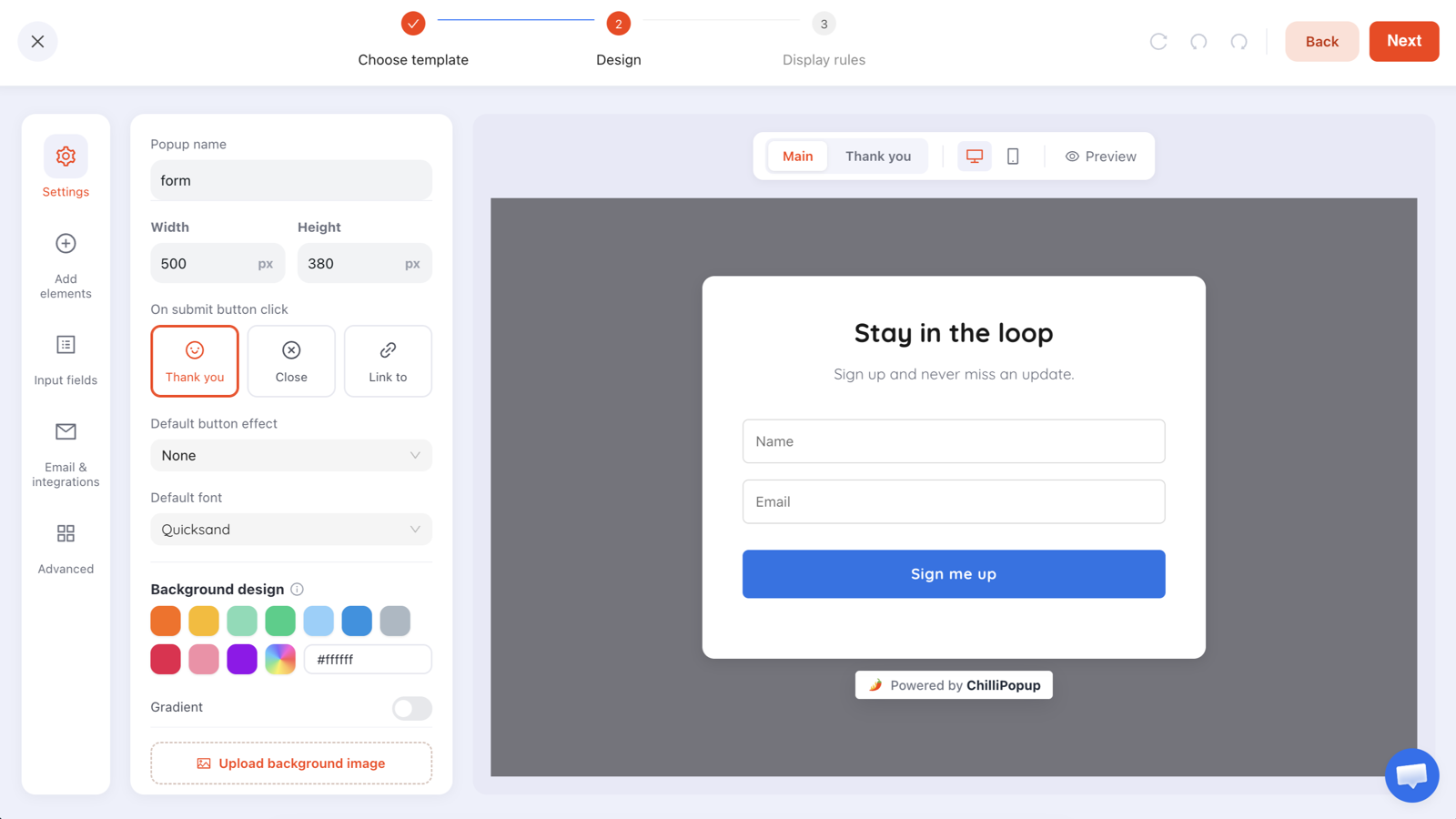
Name, number, what they need. Everything else is a question for the phone call.
Copy for six kinds of local business
| Business | Popup headline | The promise underneath |
|---|---|---|
| Plumber / electrician | "Need someone today?" | "Leave your number — we'll call back within the hour and tell you honestly if we can get there." |
| Dental or medical practice | "Looking for an appointment?" | "See this week's free slots — no phone call needed." |
| Salon or barber | "Book your first visit" | "Pick a time that suits you. New clients get a consultation with every cut." |
| Gym or studio | "Try a class free" | "Tell us what you're training for and we'll suggest the right one." |
| Law or accountancy | "Not sure if you need us?" | "Fifteen-minute call, no charge, no pitch. Leave a number." |
| Trades & renovation | "Want a rough price first?" | "Three questions and we'll send a ballpark before anyone visits." |
Notice what none of them say: "Sign up for our newsletter." A local visitor with intent should never be offered a subscription as the primary action.
Rules that fit a local site
- Trigger: a 15–25 second delay on service pages, exit intent on desktop, and inactivity on pricing pages where a stall usually means an unanswered question.
- Pages: your service pages and the contact page. Not the careers page, not the blog.
- Audience: new visitors for the first-visit offer; everyone for the callback.
- Frequency: once per session. Local visitors often open three or four pages comparing services — meeting the same popup on each one is how a good enquiry becomes a bounce.
- Show again after conversion: off, always. Somebody who has already left their number should never be asked again in the same visit.
About tapping a phone number. A button can open any link, and on most phones a
tel: link starts a call — but behaviour varies by browser, so test it on a real handset
before you rely on it. The safe pattern is to show the number as large, selectable text as well as offering
the callback form.
Measuring what actually matters
Conversion rate is the wrong headline metric for a local business. A site with 400 visits a month and eleven callback requests is doing extremely well, and its conversion rate will look unremarkable next to any ecommerce benchmark you read.
Track three things instead:
- Leads per month — submissions across all campaigns, compared with last month.
- Lead quality — how many were in your area and wanted something you do. If that number is poor, the fix is in the popup copy: name the service area and the services.
- Which campaign produced them — per-campaign views and submissions tell you whether the out-of-hours version is pulling its weight, which is usually the surprise.
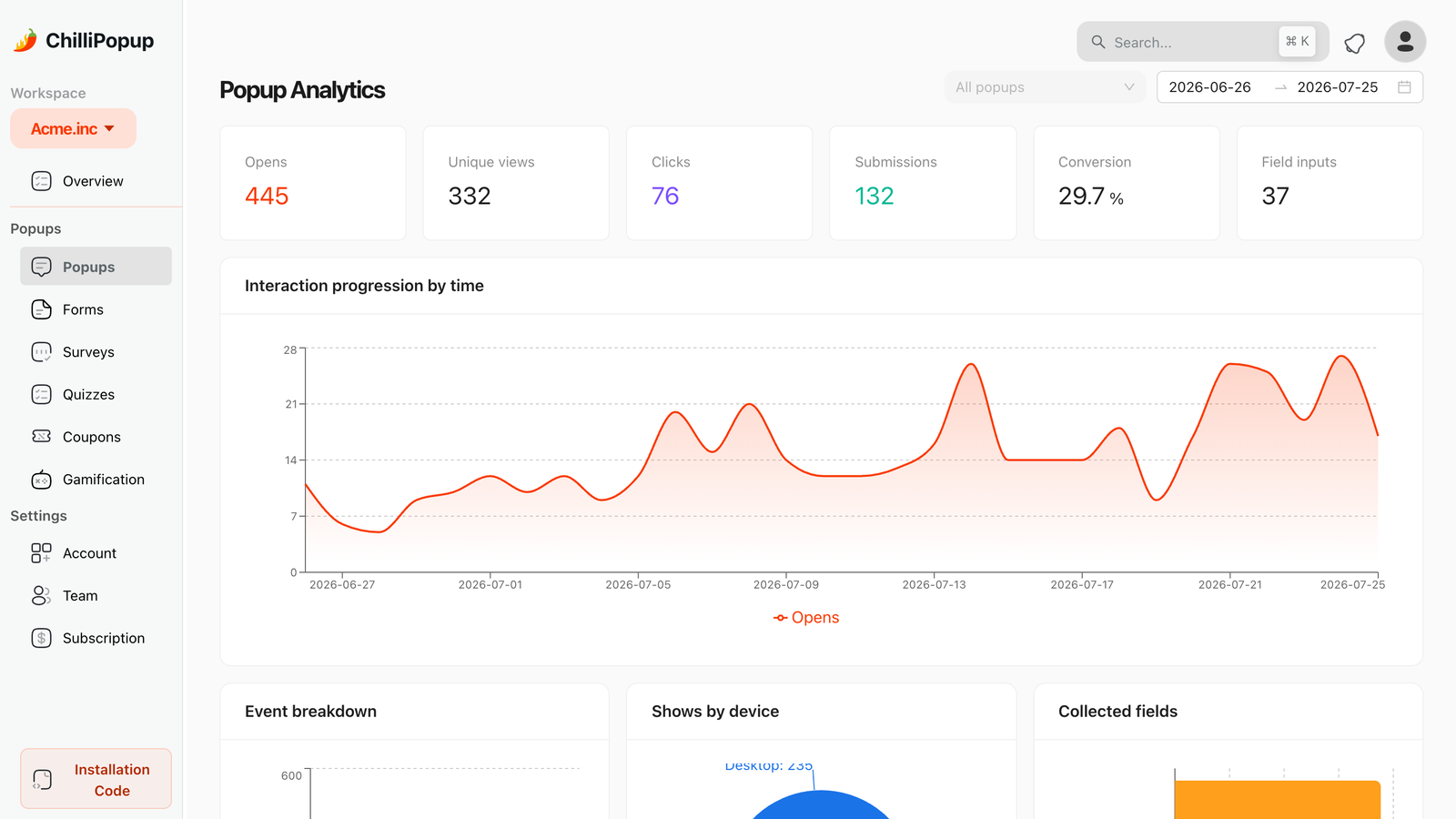
Per-campaign submissions, month over month. That's the local business scoreboard.
Six mistakes local sites make
- Offering a newsletter. Nobody with an urgent job wants your monthly update.
- "Call us now" at midnight. Set the schedule, or the popup makes you look absent.
- Not naming the service area. You get enquiries you can't serve and lose ones you could.
- A promise you can't keep. "Reply within 15 minutes" is only good marketing if it's true.
- Six fields. Every extra field on a phone is another reason to call the next business instead.
- Firing on load. Let people check you cover their street before you ask for their number.
Make your website produce phone calls
Callback forms, booking buttons and opening-hours rules, built in half an hour. Free plan, no credit card required. Paid plans from $29/month.
Start free →Related reading
Frequently asked questions
Do popups work for local service businesses?
Yes, and usually better than they do for ecommerce, because the ask is smaller and the traffic is more motivated. Someone searching for an emergency plumber at 9pm is not browsing — a popup that says “leave your number and we will call you first thing” catches a lead that would otherwise have gone to whoever answered first.
What should a local business popup ask for?
A phone number and a one-line description of the job, in most cases. Email is the right ask for ecommerce; for a trade, a clinic or a salon, a number you can call back is worth far more, and people give it more readily when the reason is obvious.
Can a popup show different messages during opening hours?
Yes. Advanced targeting includes a day-and-hour schedule, so you can run a “call us now” campaign only during business hours and a “leave your number” campaign the rest of the time. The times are anchored to the offset you configure rather than the visitor's own timezone.
Should a local business popup offer a discount?
Rarely as the first move. For services, certainty converts better than price: response times, guarantees, being properly qualified, and a free estimate. Save the discount for genuinely seasonal gaps in your calendar, where filling a slot at a lower rate beats leaving it empty.
How do I stop wasted enquiries from outside my area?
Say the service area in the popup itself — a single line naming the towns you cover — and ask for a postcode or town as one of the fields. A popup that filters badly-matched enquiries out is doing as much work as one that brings enquiries in.
What is the best trigger for a local business site?
A time delay of 15–25 seconds on service pages, exit intent on desktop, and inactivity on pricing or booking pages where a stalled visitor usually has an unanswered question. Never fire on load: a visitor still reading whether you cover their street is not ready to be asked for a phone number.