Juneteenth marks 19 June 1865, when Union troops reached Galveston, Texas and announced that enslaved people there were free — more than two years after the Emancipation Proclamation. It has been celebrated in Black American communities for well over a century, and became a US federal holiday in 2021.
It is a day of celebration, remembrance and community. It is not a sale weekend, and the campaigns that treat it like one are the ones that end up screenshotted. This guide covers the four approaches that hold up on a website, the copy rules, and an honest list of what to keep off your site entirely — including the option of doing nothing.
Key Takeaways
- Commemoration, not promotion. A discount attached to the day reads as using it to move stock.
- Four approaches work: educate, amplify, support, or give — and none of them need a coupon code.
- No urgency mechanics. Countdowns, scarcity copy and games do not belong anywhere near it.
- Specific beats broad. A named maker, a named organisation, a named amount.
- Saying nothing is allowed — and is far better than a thin gesture.
Decide whether to run anything at all
This is the first question, not an afterthought. Most brands would be better off doing one small, real thing than publishing a statement, and some would be better off doing nothing publicly at all.
Three questions worth answering honestly before you build a campaign:
- Do we have a genuine connection? Suppliers, makers, staff, a community, a long-running commitment. If the honest answer is "no, but it's on the calendar", that's your answer.
- Would we do this if nobody could tell it was us? The single most useful test there is.
- Are we willing to publish what we actually did afterwards? If not, the campaign is the point, which is the problem.
Silence is not neglect. A brand that quietly gives its team the day off, keeps buying from the same Black-owned suppliers it bought from in March, and posts nothing has done more than one that publishes a graphic.
Four approaches that hold up
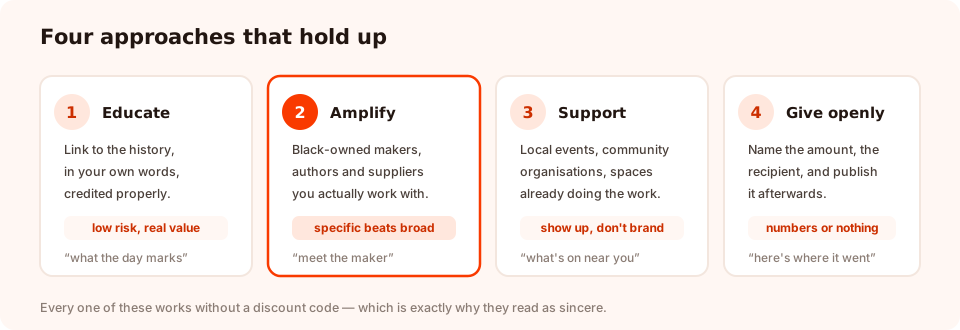
Every one of these works without a discount code — which is exactly why they read as sincere.
1. Educate — and credit properly
A quiet announcement bar or a small popup that says what the day marks, in your own words, with a link to an organisation, museum or historian who knows far more than you do. No offer attached. This is the lowest-risk, most useful thing most websites can do, and it takes twenty minutes.
Copy that works: "Today is Juneteenth, marking the end of slavery in the United States in 1865. We're closed / we're reading / here's where we're learning more." Then the link. That's the whole popup.
2. Amplify makers you actually work with
A popup or bar pointing to Black-owned makers, authors, brands or suppliers you have a real relationship with. The word doing the work there is actually. A curated list of businesses you've never bought from is a content exercise; a page about the supplier whose product you've stocked for three years is a recommendation.
If you're a retailer, this can be a collection page. If you're not, it can be a single link.
3. Support what's already happening
Local Juneteenth events, community organisations and spaces have been doing this work for a long time. Pointing your visitors at them — without your logo on it — is a genuinely useful thing a website can do. For a local business, a simple "what's on near you" link outperforms anything you could write about yourself.
4. Give, and publish the number
If you're donating, name the amount and the recipient, and commit to publishing the total afterwards. A vague pledge is worth less than a small specific one. "We're giving $2 from every order this week to [named organisation], and we'll post the total on Monday" is a claim you can be held to — which is what makes it credible.
The trap in option four is making a purchase the mechanism for the donation. It turns the commemoration into a sales incentive. If you can, give the money regardless of what people buy, and say so.
What to keep off the site entirely
This list is short and it is not a matter of taste. Every item exists to manufacture urgency or excitement, which is precisely the wrong register for a day about emancipation.
| Don't | Why | Do instead |
|---|---|---|
| A discount code named after the day | Attaches a commemoration to a transaction | Give without requiring a purchase |
| Countdown timers | Urgency mechanics on a day of remembrance | No deadline at all — nothing here expires |
| Spin wheels and scratch cards | Entertainment framing over a serious subject | A message-only popup with one link |
| "Celebrate with 20% off" | The two halves of that sentence don't belong together | Say what the day is, then stop |
| Summer-sale imagery with a flag on it | Repurposed promotional design reads as exactly that | Plain type, restrained colour, no offer |
| Collecting emails off the message | Turns the gesture into lead generation | No form. Nothing to submit. |
The last row matters most and is the one marketers resist. A commemorative message with an email field underneath it is a lead magnet in a suit. If the campaign is sincere, it collects nothing.
The copy and design rules
- Plain language. Say what the day is and what you're doing. No slogans.
- Short. Three or four lines. A long statement invites the reader to look for what you're really after.
- First person, specific. "We're closed today" and "we're giving £X to Y" are checkable. "We stand with" is not.
- Link out. The most useful thing on the popup is usually the link to someone else.
- Restrained design. Your normal sale styling — bright buttons, big percentages, exclamation marks — is the wrong instrument. A quiet announcement bar is often the right shape for the whole thing.
- Easy to dismiss. A visible close control, one interaction, and it doesn't come back.
On mechanics: use a date window covering 19 June only, with the time-zone offset you actually operate in, so the message appears and disappears on its own. Set the frequency so a returning visitor sees it once, not on every page. And target it at your homepage rather than site-wide — a commemorative message interrupting someone's checkout is its own kind of tone-deaf.
The four windows
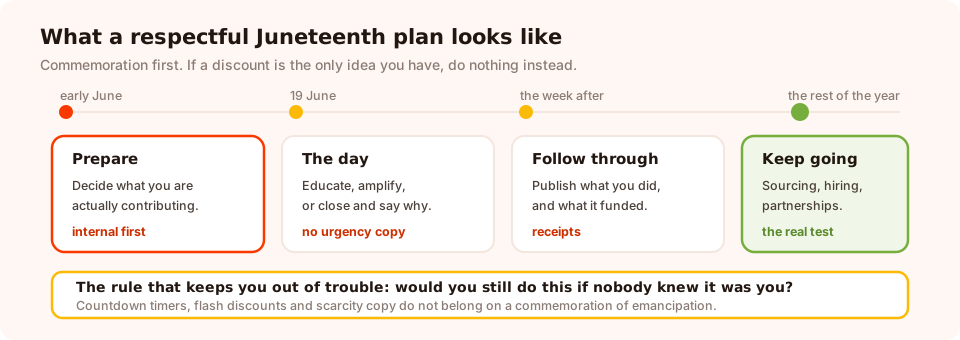
The last column is the one that decides whether any of the others were real.
The follow-through is the part that gets skipped. If you promised a donation, publish the total. If you pointed people at a supplier, keep buying from them in September. If you committed to something internal — sourcing, hiring, partnerships — the campaign was the announcement, not the work.
Build a message-only campaign in minutes
Popups, bars, forms, surveys and quizzes from one editor — and one pixel. Free plan, no credit card required. Paid plans from $29/month.
Start free →Six mistakes
- A sale with a themed banner. The most common version, and the one that reliably goes badly.
- A statement with no action behind it. Audiences check.
- Making the donation conditional on a purchase. It converts a gesture into a promotion.
- Publishing on the day and forgetting by July. The follow-through is the substance.
- Running it site-wide, including checkout. Target the homepage.
- Deciding on 18 June. Anything worth doing here needed a decision weeks earlier — which is an argument for planning it in, not for rushing it.
Plan it properly next time
Put 19 June in your seasonal calendar with a note that says what you decided and why. If you sat it out, write that down too, along with what would have to be true for you to take part — a supplier relationship, a partnership, a commitment you've actually made.
That note is worth more than any campaign, because it turns next June from a last-minute question into a decision you already thought about carefully.
Related reading
Frequently asked questions
What is Juneteenth?
Juneteenth marks 19 June 1865, the day Union troops arrived in Galveston, Texas and announced that enslaved people there were free — more than two years after the Emancipation Proclamation. It has been celebrated in Black American communities for well over a century and became a US federal holiday in 2021.
Should brands run Juneteenth promotions?
Discount-led promotions are the approach most likely to go wrong. The day commemorates emancipation, and attaching a sale to it reads as using a commemoration to move stock. If you want to mark the day, the approaches that hold up are educational, supportive or financial — and none of them need a coupon code.
Is it better to say nothing at all?
Saying nothing is a legitimate choice and is far better than saying something hollow. The question to ask is whether you have anything real to contribute — a relationship, a commitment, a resource, a community connection. If you don't, silence costs you nothing and a thin gesture costs you credibility.
What should a Juneteenth website message actually say?
Say what the day is, in plain language, and say what you are doing — specifically. A named organisation, a named amount, a named commitment. Avoid urgency language, avoid anything that resembles a call to buy, and link out to people who know more than you do.
Can a small business mark Juneteenth without a budget?
Yes. Amplifying Black-owned makers and suppliers you actually work with, pointing customers to local events, and giving your team the day off are all real and none of them require a marketing spend. Specific and small beats broad and expensive.
What should never appear in a Juneteenth campaign?
Countdown timers, scarcity copy, spin-the-wheel games, discount codes tied to the day, and any imagery you'd use for a summer sale. If a campaign element exists to create urgency, it does not belong on a commemoration.
How do I decide whether my brand should participate?
Ask whether you would do the same thing if no one could tell it was you. If the answer is yes, the campaign is probably sincere. If the whole point is that people see it, it is a promotion wearing a commemoration's clothes — and audiences are good at spotting the difference.